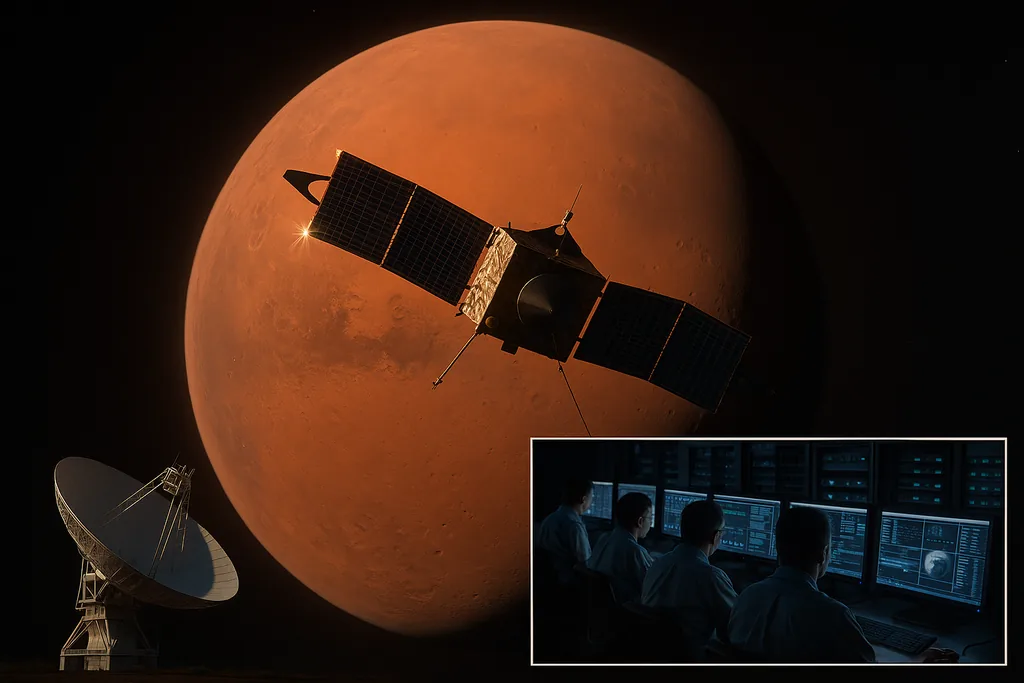
MAVEN falls silent after routine blackout
When NASA's Mars Atmosphere and Volatile Evolution spacecraft (MAVEN) went behind the Red Planet on 6 December 2025 it should have reappeared and phoned home. Ground teams at the Deep Space Network heard nothing. Controllers say telemetry up to 4 December looked normal, but a small fragment of tracking data from 6 December implies the spacecraft was spinning unusually fast as it emerged, and its orbit may no longer match predictions. Since then NASA teams have been working to diagnose and recover the orbiter, but their window for active troubleshooting is narrowing as Mars moves toward solar conjunction on 9 January 2026.
What happened, in concrete terms
MAVEN operates on a highly elliptical orbit with an orbital period of roughly 3.5–3.6 hours, dipping as low as a couple of hundred kilometres and swinging out several thousand kilometres. That orbit routinely carries the spacecraft out of line of sight when it passes behind Mars; such intervals are expected and planned for. This time, however, the Deep Space Network did not re-acquire the expected telemetry when MAVEN returned from behind the planet. Controllers reported last week that although the mission had no telemetry since 4 December, partial tracking from 6 December was recovered and preliminary analysis indicates the spacecraft may have been spinning and perhaps experienced a trajectory perturbation as it re-emerged.
NASA's operations team has described the situation as an anomaly investigation; engineers are exploring whether the fault is an attitude-control failure, a propulsion event, a power issue, or some combination. An uncontrolled spin would complicate receiving commands and would likely prevent the spacecraft's high-gain antenna from staying pointed at Earth. The agency has not confirmed a root cause and continues to work the problem while cautioning that solar conjunction will limit recovery options for several weeks.
MAVEN's mission and scientific value
Launched in November 2013 and arriving at Mars in September 2014, MAVEN was explicitly designed to study how Mars has been losing its atmosphere to space. Its instruments—magnetometers, particle detectors, an ultraviolet spectrometer and mass spectrometers—have mapped how the solar wind and sunlight drive the escape of hydrogen, oxygen and other species from the upper atmosphere. That work underpins our understanding of how Mars transformed from a wetter, warmer world in its first billion years to the cold, thin-atmosphere planet we see today.
Over a decade in orbit MAVEN has recorded atmospheric escape through a full solar cycle, tracked how dust storms and seasonal heating affect escape rates, and provided ultraviolet observations that complement space- and ground-based telescopes. Those datasets have been crucial for recent studies that combine Hubble ultraviolet imagery with MAVEN's in-situ measurements to quantify hydrogen and deuterium loss — an isotopic fingerprint for how much water Mars has shed to space. Losing access to new MAVEN measurements would create a gap in long-term monitoring that is difficult to replace quickly.
What recovery teams can and can't do now
Spacecraft teams have a standard playbook: if a spacecraft becomes unresponsive they search for any carrier signal, analyse partial tracking and Doppler data, attempt to send conservative recovery commands, and try to coax the craft into a known safe mode so higher-data-rate telemetry can resume. For MAVEN the situation is complicated by two factors. First, if the spacecraft is spinning, precise antenna pointing is lost and reception of low-power telemetry or uplinked commands becomes intermittent or impossible. Second, Mars is approaching solar conjunction — an alignment where the Sun stands nearly between Earth and Mars — and mission operators routinely avoid uplinking commands during that period because solar radio noise can corrupt signals and commands. Conjunction begins to choke off routine recovery attempts until communications safely resume after mid-January.
NASA has not ruled out re-contact, and historically there are precedents for spacecraft recovering after long silent intervals. But engineers caution that the degree of spin, any change in orbit, and damage to critical subsystems will determine whether a recovery is feasible. If MAVEN can be coaxed into a Sun‑pointed safe mode using automated fault-protection logic or a brief successful uplink, the mission could survive; if key attitude-control hardware has failed or if the spacecraft expended propellant unexpectedly, the outlook dims.
Operational and program-level consequences
MAVEN is not just a science orbiter: it is an operational linchpin. The Mars fleet of spacecraft—rovers, landers and orbiters—rely on a network of relay satellites to move large science data packets to Earth efficiently. NASA's other U.S. orbiters, Mars Reconnaissance Orbiter and Mars Odyssey, are older and their resources are finite; some public material has suggested differing estimates for remaining lifetime and fuel reserves. European and other international orbiters provide partial relay capability, but orbit geometries and data-rate constraints mean no single replacement will be perfect. Plans to use new small orbiters, or to launch dedicated communications satellites, have been discussed for years but take time and budget to implement.
There are programmatic knock-on effects, too. MAVEN was slated to provide contextual and tandem observations for upcoming missions and for missions arriving later this decade. ESCAPADE, a smaller Mars orbiter constellation scheduled to arrive about 2027, would have benefited from coordinated campaigns. If MAVEN is lost, researchers will lose a long‑baseline dataset used to calibrate atmospheric models, and mission planners must rethink relay strategies for high-bandwidth campaigns and sample-return support in the 2030s.
Possible causes and public uncertainty
Observers have floated several plausible causes: hardware failures in reaction wheels or inertial measurement units, a thruster or propellant anomaly that altered attitude or orbit, single-event upsets from solar particle events, or a software fault that left the spacecraft in an uncontrolled state. Some outlets have speculated about coronal mass ejections or other space-weather events; mission teams say they are considering space weather among many possibilities but have not singled out any primary cause publicly.
Public statements about MAVEN's fuel and remaining lifetime differ across sources and documents, which has added to confusion. NASA and project partners have previously characterized MAVEN as a mission with substantial remaining utility into the 2030s, but various budget and operations documents offer different horizon dates. What matters for recovery is not only how much propellant remains but whether attitude-control, power and communications subsystems are intact and whether the spacecraft can safely receive and execute commands.
Why this matters beyond a single spacecraft
Practically, the loss of a long-lived science orbiter is a blow to ongoing research and to the resilience of surface‑asset communications. Scientifically, MAVEN's continuous record of atmospheric escape is unique. Studies that pair ultraviolet remote sensing from Hubble with MAVEN's in-situ particle and field data have allowed researchers to build a time-resolved picture of how hydrogen — and the heavier deuterium isotope — escape from Mars. That isotopic record is central to estimates of how much water the planet once held and to models of planetary habitability and climate evolution. A persistent gap in those measurements would hamper efforts to place Mars in context with Earth and Venus as comparative terrestrial planets.
For now the situation remains fluid. Engineers will continue recovery work where possible but will mostly stand down for active uplinks during solar conjunction; after the Sun‑Mars‑Earth geometry clears, the next weeks will be decisive. If MAVEN answers the call, the mission could resume and continue to contribute to Mars science for years. If not, scientists and mission planners will need to accelerate contingency plans to preserve the continuity of critical observations and communications infrastructure at Mars.
Sources
- NASA MAVEN mission blog (NASA Goddard / MAVEN team)
- Laboratory for Atmospheric and Space Physics (University of Colorado Boulder) — MAVEN operations
- Boston University Center for Space Physics — Hubble + MAVEN studies on hydrogen/deuterium escape (Science Advances research)
- Hubble Space Telescope / Space Telescope Science Institute (ultraviolet observations)
- Lockheed Martin (spacecraft builder)