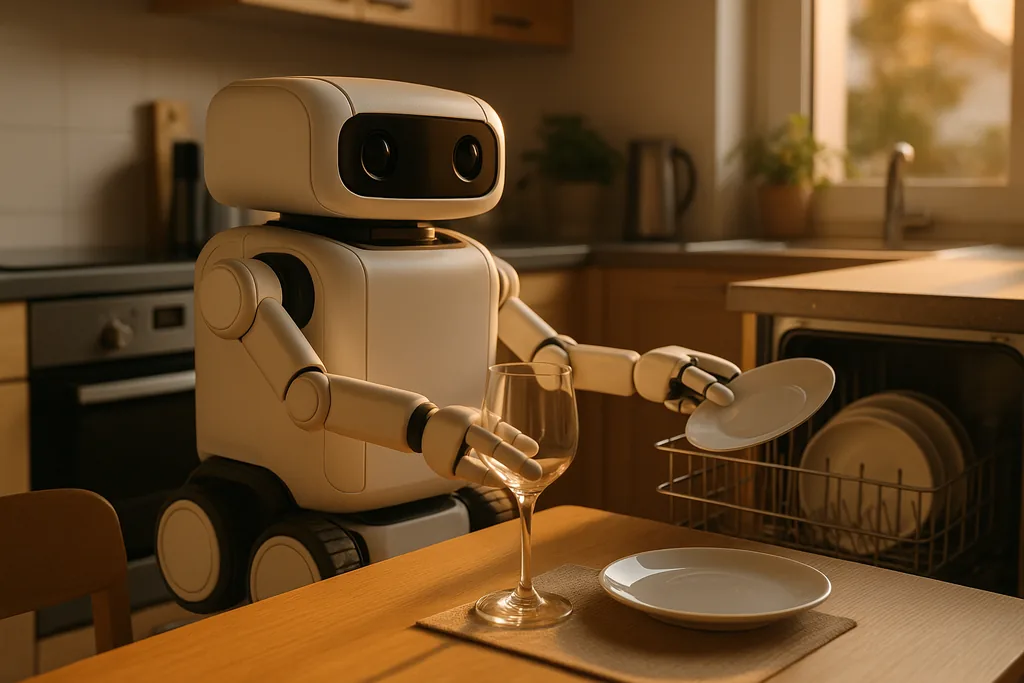
Kitchen choreography: a robot clears the table
On 25 November 2025 a short video from California start-up Sunday Robotics showed a compact, wheeled robot called Memo rolling up to a dining table, picking up plates and two wine glasses, and placing them into a dishwasher without breaking a thing. In subsequent clips Memo folded socks and operated an espresso machine. The company says the system has repeated the same tricks in more than 20 live demonstrations without incident — a small but striking milestone in a field where simple household tasks routinely defeat high-profile robots.
The machine onstage
Memo is not a human-shaped humanoid standing on two feet: it is a mobile base with an articulated arm and simple, Lego‑like hands. That design choice narrows the engineering problem — bathrooms and stairs are harder than kitchens — while keeping the goal familiar to most people: a robot that handles fragile, everyday objects that vary in shape, weight and fragility.
Most recent progress in robotics has leaned on one of two camps. One uses large-scale simulation and reinforcement learning to train controllers — an approach that has produced rapid advances in locomotion and coordinated behaviours for humanoids and quadrupeds. The other relies on teleoperation, where experts directly guide real robot hardware to collect teaching data; that is precise but expensive.
Sunday Robotics says Memo follows a different path. Rather than teleoperating expensive robots or relying on synthetic data, the company built glove-shaped devices matched to Memo's hands and distributed them to more than 500 human data collectors across the United States. People wearing the gloves perform normal household manipulations while the system records forces, grip patterns and motions. That dataset — human demonstrations mapped to the robot's actuators — trains Memo to mimic human handling in the real world.
The company argues this approach is pragmatic: each glove costs roughly $200 compared with the tens of thousands of dollars needed for teleoperated robotic hardware, and collecting natural human force measurements may bridge some of the practical gaps that have hamstrung robot hands for decades.
What Memo can — and can’t — do
In the demo Memo removes dishes and cutlery from a table and loads them into the dishwasher, lifts two wine glasses with one hand, folds soft items like socks and presses buttons on an espresso maker. Those tasks involve perception (recognising objects and where to place them), grasp planning (choosing where and how to grip), and force control (how hard to squeeze fragile glass). Each of these is still an ongoing research problem when combined in a single, general-purpose system.
Equally notable is what Memo does not claim: full generality across every household, robust navigation through cluttered homes, or autonomy for hours without supervision. The demonstrations are tightly scoped domestic tasks in controlled settings; they show a promising direction but are not the same as a robot that will take over all housework immediately.
Why this matters for robot dexterity
Robotics researchers have long pointed to manipulation of everyday objects as the bottleneck for domestic robots. Human hands are packed with tactile sensors and millions of years of proprioceptive control; replicating that in actuators and software is costly. Simulation is powerful for training locomotion policies where contact dynamics are easier to model statistically, but simulating the full tactile interaction of arbitrary kitchenware and fabrics remains a major challenge.
Practical questions and the path to real homes
There are, however, familiar hurdles before Memo‑style machines will become a common household appliance. The start-up's public material and demos indicate promising capability but fall short of independent, peer-reviewed validation. Key questions include:
- Generalisation: How well does the robot handle unfamiliar objects, greasy or wet items, and real-world messes that differ from a test kitchen?
- Safety and reliability: Even with careful force control, household environments are messy. How does the software detect and recover from failed grasps or accidental drops? What safeguards prevent tipping or spills?
- Cost and maintenance: The economics of multiple sensors, actuators, and support — and the long‑term durability of low-cost hands — will determine adoption.
- Privacy and human factors: A robot that operates in private spaces raises questions about data collection, video streams, and how owners maintain control and agency over the machine's decisions.
Sunday Robotics has sought to address some concerns publicly: cofounder Tony Zhao described Memo as a "step change in robotic AI" and said the system had not broken wine glasses across several live demos. But the broader community typically looks for independent trials, longer-term stress testing and transparent failure-mode reporting before concluding that a new approach is production-ready.
Where Memo could fit in the wider robot ecosystem
If Memo's glove-based data collection proves scalable, it could reshape how companies gather real-world manipulation datasets. Low-cost human instrumentation to teach robot hands may allow start-ups to iterate affordably on multiple prototypes, accelerating progress in kitchens, care homes and small businesses.
Next steps and a cautious outlook
Expect Sunday Robotics and rivals to expand demonstrations, publish more technical details about data collection and control architectures, and begin pilot deployments in partner homes or care facilities. Regulators and standards groups that oversee safety for domestic robots will likely pay close attention as machines leave labs and enter private spaces.
Memo's demo marks a pragmatic pivot: instead of waiting for perfect tactile simulation or breakthrough hardware, give humans inexpensive tools to teach machines how to handle fragile, everyday objects. If that hybrid of human data and targeted hardware scales, it could deliver practical help in homes sooner than some purely research-driven approaches. But as with many advances in robotics, the path from a tidy demo kitchen to millions of living rooms will be long, iterative and full of technical and social trade-offs.
Sources
- Sunday Robotics (company demonstration and technical summaries)
- Humanoid (HMND 01 Alpha project materials and demonstrations)
- NVIDIA Isaac Sim (documentation on simulation-driven robot training)