Strange math, bold claim: a paper that links conductance to time travel
Today a group of theorists posted a preprint arguing that a re-interpretation of the Landauer–Büttiker conductance formalism provides not only a deterministic account of quantum measurement but also a route to "time travel" in mesoscopic systems. The team — identified in the paper as Kanchan Meena, Souvik Ghosh and P. Singha Deo with ties to institutions including the S.N. Bose Centre and a university in Taiwan — builds its case around a locally defined partial density of states (LPDOS), the phase of the scattering matrix, and a mechanical construction of local time using Larmor-clock ideas. Their claim is striking: measurable conductance and local clocks in sufficiently small structures admit negative local densities that, according to the authors, can be interpreted as a form of deterministic time displacement.
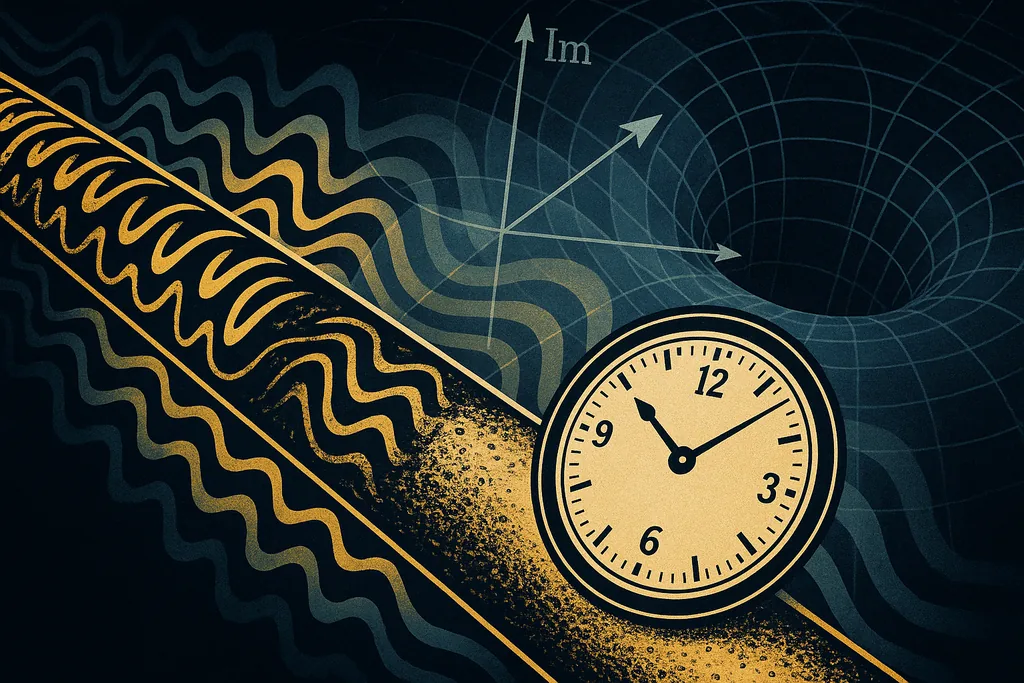
The paper re-examines standard tools from mesoscopic physics — the Landauer–Büttiker approach to electrical conductance and scattering-matrix descriptions of transport — and focuses attention on quantities defined locally inside a sample rather than on global observables. Central to their argument is the notion of a local partial density of states, which they treat as a hidden variable that fixes the outcome of measurements in a deterministic way. The technical path runs through three linked ideas: (1) how conductance depends on the phases of scattering amplitudes (conveniently visualised on Argand diagrams), (2) how local densities and Fano-resonance features reflect interference and mode structure inside tiny devices, and (3) how a physically measured local time — as obtained by a Larmor-like clock — can be expressed in terms of these same scattering-phase quantities.
Density of states, local time and the Larmor clock
From this bridge between phase, density and clock they report a surprising mathematical possibility: the LPDOS for particular partial channels can become negative. In their narrative negative LPDOS is not an artifact to discard but a physical signal: in the mechanical clock it corresponds to a local time that dilates or shifts in a way they liken to relativistic proper time. Combining these ideas, the paper asserts a logical path from local, measurable phase and density to deterministic measurement outcomes and to the formal possibility of "time travel" within the mesoscopic region.
That is a far cry from the causal paradoxes and general‑relativistic constructions usually associated with "time travel." What the preprint proposes is a formal mapping: local quantum phases and densities can be arranged such that a modelled clock variable shows counter‑intuitive time shifts. Whether such a shift implies backward causation, violation of global causality, or any ability to send information into the past is not demonstrated in the paper, and it is not obvious that the authors' operationally defined local time obeys the same constraints as relativistic proper time when coupling to the rest of physics.
Conceptual gaps and the broader context
The paper touches on two deep and distinct problems — the measurement problem in quantum mechanics and the reconciliation of quantum theory with relativity — and proposes a single local quantity, the LPDOS, as a bridge. Both themes are older than the Landauer approach itself and have attracted many competing perspectives: decoherence theory, spontaneous collapse models, Bohmian mechanics, and many‑worlds interpretations, to name a few. A local hidden variable that reproduces all quantum statistics must grapple with Bell's theorem and with experimentally observed nonlocal correlations. The manuscript does not provide a full account of how its locally defined partial states would reproduce violations of Bell inequalities or how they interact with entanglement beyond single‑device transport scenarios.
On time and causality, modern physics treats operationally defined clocks with care: proper time in relativity is tied to worldlines in curved spacetime, and quantum clocks in small systems are subject to decoherence, thermal coupling and measurement back‑action. Showing that a small mechanical clock's readout can be negative in a particular formal construction does not automatically equate to the ability to alter global causal order or to create paradox‑prone closed timelike curves. The preprint makes a formal and intriguing connection, but bridging such an idea to physical time travel would require several additional, nontrivial steps and confront well‑known conservation and thermodynamic constraints.
How the claim could be tested
But experimental confirmation of local negative densities is not the same as confirming any form of macroscopic time travel. Even if labs observe negative partial densities and associated anomalous clock signals, the community will ask: can those effects be harnessed to send information backward in time, or do they always come hand‑in‑hand with compensating processes that preserve overall causality? Designing experiments to probe the information‑flow aspect will be essential if the claim is to move beyond provocative math.
Why this matters — and how to read extraordinary claims
The paper is valuable regardless of its final outcome. It forces attention onto how local, phase‑sensitive transport quantities relate to operationally defined clocks and to the measurement puzzle in quantum mechanics. That cross‑fertilisation of ideas can stimulate concrete experiments in mesoscopic physics, and even modest empirical results — a reproducible negative partial density or an unexpected Larmor‑clock signature — would be an important contribution.
At the same time, extraordinary claims demand extraordinary evidence. The leap from local phase effects and clock readouts inside a nanostructure to statements about time travel and unification with relativity requires careful conceptual work, confrontation with Bell‑type constraints, and experiments that probe causality and information transfer, not just local densities. The next months and years will likely see theorists scrutinise the mathematical steps and experimentalists attempt to isolate the predicted signals in the lab. That is how physics turns bold ideas into accepted science or discards them as inconsistent models — and both outcomes advance our understanding.