Microclots and NETs Linked to Long COVID
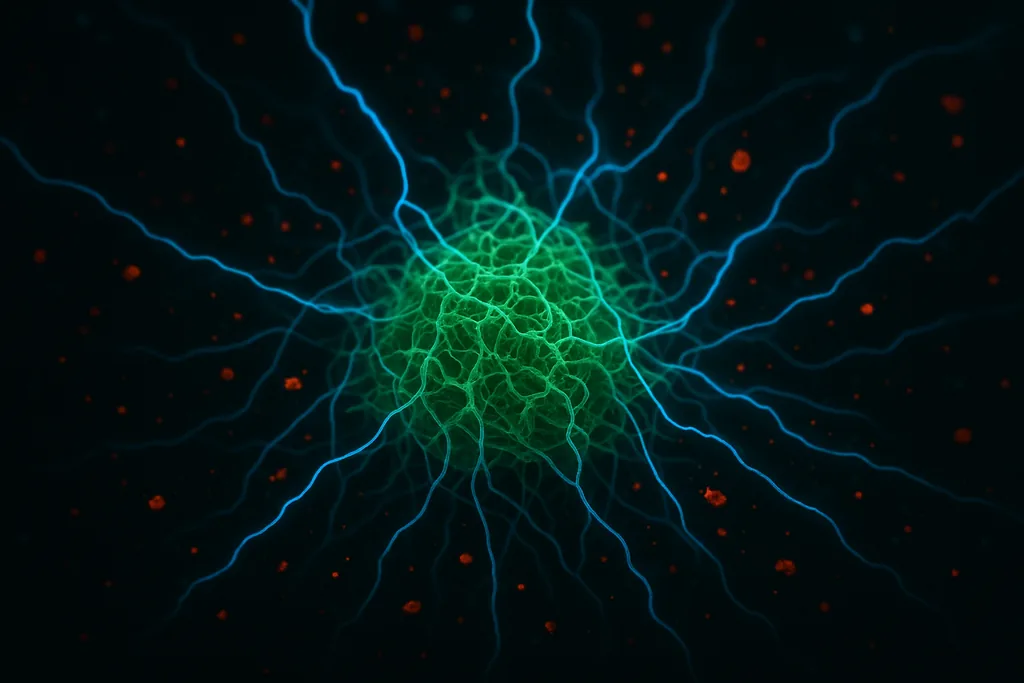
New research finds clusters of tiny fibrin 'microclots' tangled with neutrophil extracellular traps (NETs) in people with long COVID, suggesting a thrombo-inflammatory mechanism that could become a biomarker or treatment target.
Scientists working in France and South Africa have reported a striking microscopic finding in the blood of people with long COVID: tiny, sticky clots of abnormal fibrin protein that appear physically entwined with web-like structures released by white blood cells. The authors say the paired structures — known as microclots and neutrophil extracellular traps (NETs) — are far more abundant and larger in long COVID patients than in healthy controls, and could help explain persistent symptoms such as fatigue and brain fog.
Why these structures might matter
Microclots are different from the large clots that cause strokes or deep-vein thrombosis: they're microscopic aggregates of misfolded or cross-linked fibrinogen/fibrin that can circulate and lodge in the smallest blood vessels. NETs are nets of DNA decorated with enzymes that neutrophils eject to trap pathogens, but in excess they are known to promote clotting and damage surrounding tissue. If NETs become embedded in microclots they could make those clots more resistant to the body's normal fibrinolytic breakdown processes, prolonging their lifespan and exacerbating microvascular flow problems. That, in turn, could reduce oxygen delivery to tissues and help explain diffuse, lingering symptoms in some patients.
How the team studied the blood
To look for these patterns the researchers combined fluorescence microscopy with imaging flow cytometry, techniques that let them visualise clot components and measure many individual particles automatically. They stained plasma samples for amyloid-like fibrin structures and for NET markers, quantified signal intensity and particle size distributions, and ran multivariate analyses — including machine learning — to see which combinations most clearly separated patient and control samples. The imaging showed NET-related proteins physically associated with the fibrinaceous material, not merely present in the plasma.
Important caveats
- Correlation is not causation. The study demonstrates a clear structural and quantitative association between NET markers and microclots in samples from people with long COVID, but it does not prove these structures cause the condition or its symptoms. They could be a downstream consequence of other persistent immune or vascular processes.
- Sample size and generalisability. The cohorts described are modest in size and were recruited in specific research centres; larger, geographically diverse cohorts will be needed to confirm how widely applicable the findings are.
How this fits into the wider picture
What researchers want to see next
Replication in larger, independent cohorts is the obvious next step, ideally with detailed clinical phenotyping so investigators can ask whether particular symptom clusters (for example, cognitive symptoms versus cardiorespiratory complaints) map onto microclot/NET burden. Longitudinal sampling would also help determine whether these structures persist, wax and wane, or respond to interventions. Finally, mechanistic lab work — for instance testing whether NET digestion accelerates microclot breakdown in ex vivo models — could move the field from association toward causality and therapeutic proof-of-concept.
Practical takeaways for patients and clinicians
For people living with long COVID the study is another piece of biological evidence that the condition can have measurable, objective correlates in the blood. It does not yet justify routine testing for microclots outside research settings, nor does it endorse any unproven off-label therapies aimed at altering clotting or immune function without medical supervision. Clinicians and patients should view these findings with cautious interest: promising as a direction, but not a finished diagnostic test or treatment pathway.
The discovery underscores a broader lesson that long COVID is likely multifactorial — vascular, immune, and neurological processes may all contribute in different degrees across patients — and that a combination of molecular tests and imaging will probably be needed to stratify subtypes and guide treatment. If NET‑stabilised microclots hold up under further study, they could become one of those measurable subtypes.
As researchers replicate and extend these observations, the most valuable outcome would be clear, reproducible assays that link a measurable blood signature to a therapy that meaningfully reduces symptom burden. That path from bench to bedside will take time, careful trials and independent validation, but the new paper supplies a concrete hypothesis and a set of experimental readouts that other groups can test.
— Mattias Risberg is a Cologne-based science & technology reporter for Dark Matter. He holds an MSc in Physics and a BSc in Computer Science from the University of Cologne and covers biomedical research, space policy and data-driven investigations.