How 2026 could redraw our picture of near‑Earth space and the inner Solar System
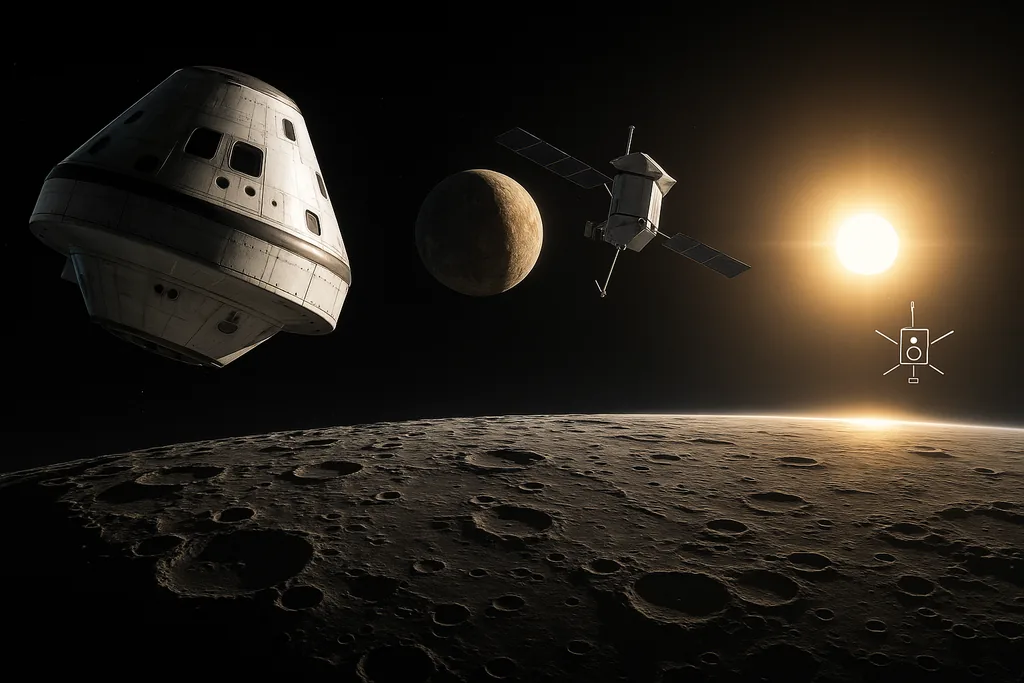
The calendar page turns and, for planetary scientists and mission engineers alike, 2026 looks set to be a year of high‑stakes tests and firsts. In quick succession the world will watch a crewed test flight around the Moon, several commercial lander demonstrations at or near the poles, a new heliophysics observatory at L1 that will map the heliosphere and — by the end of the year — the long‑awaited arrival of the European/Japanese BepiColombo spacecraft at Mercury. Each mission approaches the problem of magnetism, radiation and navigation from a different angle, and together they will sharpen how we protect people and machines in deep space, and how we understand tiny Mercury’s surprisingly active magnetic environment.
Artemis II: the first crewed step back to lunar deep space
NASA’s Artemis II is slated to be the first crewed mission in the Artemis campaign, carrying four astronauts on roughly a ten‑day trip around the Moon and back; the agency currently sets the flight “no later than April 2026” as teams complete integrated testing and pad preparations. The Orion spacecraft for Artemis II was publicly named "Integrity" by the crew in September 2025, a symbolic milestone ahead of the flight that will validate life‑support, guidance and deep‑space communications systems with people aboard. This is not a landing mission — its value lies in exercising human operations beyond low Earth orbit and in generating realistic data about radiation exposure, navigation and crew performance that will be essential for future lunar surface missions and eventual Mars planning.
IMAP at L1: mapping the heliosphere and warning systems for astronauts
The Interstellar Mapping and Acceleration Probe (IMAP) lifted off in late 2025 and will reach a Sun–Earth Lagrange point (L1) to begin full science operations in early 2026. IMAP’s instruments are designed to map energetic neutral atoms and charged particles that trace how the Sun’s magnetic wind carves the heliosphere — the magnetic bubble that protects our system from interstellar radiation. That mapping is more than academic: IMAP will provide improved space‑weather context and earlier warnings of energetic particle events, information that will be critical for Artemis-era astronauts leaving Earth’s protective magnetosphere and for satellite operators on Earth. The mission’s first science results, scheduled for 2026, should produce the first global maps from IMAP’s perspective and refine models of particle acceleration and transport across the inner Solar System.
BepiColombo at Mercury: a magnetosphere under close scrutiny
After a complex, multi‑flyby cruise, the joint European Space Agency (ESA) and Japan Aerospace Exploration Agency (JAXA) BepiColombo mission is now scheduled to enter Mercury orbit in November 2026 following a revised trajectory devised to cope with reduced ion‑thrust performance. The spacecraft carries two orbiters — ESA’s Mercury Planetary Orbiter (MPO) and JAXA’s Mercury Magnetospheric Orbiter (named Mio) — specifically configured to study Mercury’s geology and its miniature, but surprisingly dynamic, magnetosphere. Once in orbit the two platforms will separate into complementary polar tracks and begin a nominal year of science (with a likely extension), measuring magnetic fields, charged particles and surface composition in detail that no mission has achieved since the earlier Messenger probe. For scientists interested in planetary magnetism, BepiColombo promises fresh insights into how a small, iron‑rich planet sustains a global field and how that field interacts with the solar wind to create a unique near‑planet plasma environment.
Commercial lunar landers: Griffin and Blue Moon pathfinders
2026 will also be a test of the commercial architecture underpinning much of the next decade of lunar activity. Astrobotic’s Griffin Mission One — part of NASA’s Commercial Lunar Payload Services (CLPS) effort — is targeted for mid‑2026 and will attempt a south‑pole delivery of a roster of scientific and technology payloads; the mission has been refocused after earlier delays and now carries a variety of commercial and institutional experiments, including a small rover from Venturi Astrolab. These commercial landers are not just about science: they rehearse precision landing, descent plume mitigation and autonomous surface operations that future crewed missions will rely upon.
Blue Origin’s Blue Moon Pathfinder Mission 1 — a heavier, technology‑validation lander that will fly atop the New Glenn rocket — is also slated for no earlier than early 2026. That flight will exercise systems planned for later cargo and (eventually) crewed logistics, including the BE‑7 ascent/descent engine tests, cryogenic propellant handling and high‑precision landing sensors. Together these company‑led missions will demonstrate whether commercial suppliers can deliver repeatable, Artemis‑compatible cargo access to the lunar surface at scale.
Why magnetospheres matter across these missions
There’s a through‑line connecting these five missions: magnetism and particle environments are central hazards and sources of scientific opportunity. At Earth, the magnetosphere is the shield we depend on; IMAP will help us understand how that shield connects to the Sun and how transient events can breach it. At Mercury, BepiColombo will probe an extreme case — a tiny planet with a global field that behaves very differently from Earth’s and which sculpts exotic plasma dynamics close to the surface. For lunar operations, understanding local plasma and dust environments (and how rocket plumes interact with regolith) reduces landing risk and informs the design of habitats and suits. Finally, any crewed flight beyond low Earth orbit must be planned with robust space‑weather forecasting and radiation mitigation — capabilities IMAP and the growing heliophysics fleet aim to improve.
Risks, schedule slips and what to watch
Space is hard, and the 2026 timeline carries caveats. BepiColombo’s arrival was moved to late 2026 after the mission’s electric thrusters underperformed and engineers rewrote the cruise plan. NASA’s commercial CLPS program has endured rocky lessons in landing precision that reshaped payload assignments and timetables — the VIPER rover, for example, was put under review and elements of its hardware have been reassigned or repurposed as NASA manages costs and schedule risk. Nevertheless, those programmatic decisions are part of a larger, iterative effort to build a resilient lunar and inner‑solar‑system exploration architecture. For each mission we list here, the technical milestones to watch are the launch window (for placed or delayed missions), the arrival and instrument commissioning phases, and the first data releases, which usually contain the first clues that a longer science program will be transformative.
Taken together, these missions make 2026 a hinge year: a test of crewed operations beyond Earth, a new era of heliospheric mapping that will aid space‑weather forecasting, and a close look at Mercury’s compact, weird magnetosphere. If they all succeed they will not only deliver headline discoveries but will also reduce risk, sharpen hardware and operational practices, and prepare the way for sustained human and robotic presence throughout the inner Solar System.
Sources
- NASA (Artemis II and IMAP mission pages and updates)
- European Space Agency (BepiColombo mission pages)
- Japan Aerospace Exploration Agency (JAXA BepiColombo/Mio updates)
- Astrobotic Technology (Griffin mission press materials)
- Blue Origin (Blue Moon Pathfinder mission filings and mission summaries)