Musk: 3I/ATLAS Could Threaten Humanity
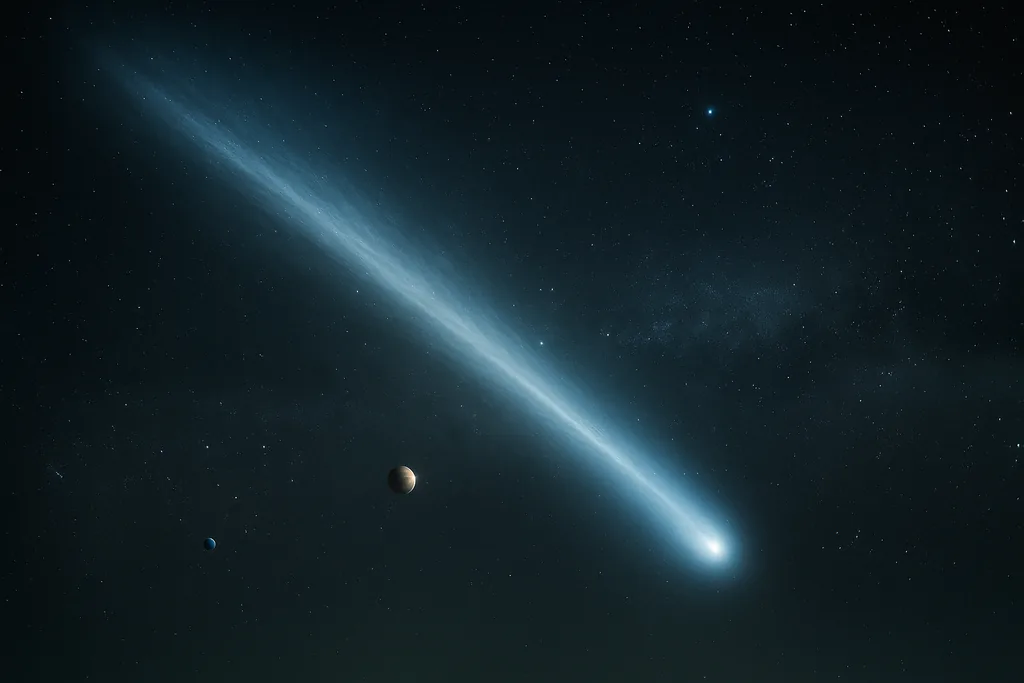
Elon Musk adds a high-profile warning to the 3I/ATLAS debate
On a recent appearance on a popular long‑form podcast, Elon Musk weighed in on the swirl of headlines about the interstellar visitor known as 3I/ATLAS. Musk described the object as plausibly natural but warned that, if it ever collided with Earth, its mass and speed could make it an existential hazard — “it would, like, obliterate a continent… maybe worse,” he said, adding that such an impact could kill most of humanity. These comments were speculative and framed as hypotheticals, yet they amplified public anxiety about an object that astronomers are racing to understand.
What is 3I/ATLAS?
Why the fuss? Observations that don’t fit a tidy picture
Observers have reported several unusual characteristics: a coma unusually rich in carbon‑dioxide gas, detection of nickel emission lines in the coma before iron showed up, and complex photometric and polarimetric behaviour as the object neared perihelion. These features are intriguing because they differ from many well‑studied Solar System comets and invite careful analysis rather than immediate conclusions about origin. High‑sensitivity infrared observations from space telescopes have been a central part of the dataset shaping these claims.
Is there evidence of manoeuvring or a radio beacon?
Some commentators have pointed to apparent non‑gravitational accelerations or anomalous brightening and suggested those as possible signs of an engineered craft. Most professional groups have countered that observed deviations can arise from asymmetric outgassing, changing activity as volatile ices sublimate, or measurement uncertainties. At present the mainstream working hypothesis in the professional literature remains that 3I/ATLAS is a natural, active comet — albeit an unusually composed one — and not an alien spacecraft. Several teams emphasise that unusual does not equal artificial.
How serious would an impact be?
Musk’s blunt description of a continent‑obliterating strike reflects simple ballistics: an object a kilometre or more across, traveling at tens of kilometres per second, would release immense kinetic energy on impact — orders of magnitude greater than the largest human weapons and comparable to the scales associated with past global catastrophes. That is why planetary defence is a legitimate subject of scientific and policy planning. Crucially, none of the current orbital solutions place 3I/ATLAS on a collision course with Earth, and public statements from space agency leadership have reassured the public that there is no threat to life on Earth from this object as it stands.
Why high‑profile comments matter
When a well‑known technology entrepreneur and space company founder speaks about an exotic astronomical object, two effects occur simultaneously: the topic reaches a far larger audience, and speculation competes with sober science for public attention. That can be beneficial — it brings scrutiny and resources — but it also riskily conflates hypothetical worst‑case thinking with the best-available orbital and spectroscopic data. Scientists working on 3I/ATLAS have urged caution, requesting that public discussion follow the pace of peer review and calibrated measurement rather than sensational leaps.
Where the scientific story is heading
- Detailed spectroscopy and imaging: Instruments on space telescopes and large ground facilities will continue to refine the object’s chemical fingerprint and dust properties, which help discriminate formation scenarios.
- Trajectory and dynamics: Improved astrometry will tighten constraints on any non‑gravitational forces and on the object’s mass and size limits.
- Cross‑checks from multiple spacecraft: Opportunistic observations from planetary orbiters that had views during flybys (for instance near Mars) provide extra geometry and can rule out systematic errors in Earth‑based data.
These lines of work will determine whether 3I/ATLAS is an exotic but natural planetesimal, or whether gaps in our understanding require more radical hypotheses. So far, the preponderance of high‑quality data still favours a natural explanation, but researchers publicly acknowledge the object’s unusual chemistry and morphology as genuinely interesting puzzles.
What policymakers and the public should take away
Three pragmatic points matter. First, extraordinary claims require extraordinary evidence: unusual observational signatures justify close attention, not instant proclamation of alien origin. Second, planetary defence remains an important, long‑term policy priority — the physics that makes a large interstellar rock dangerous is the same regardless of where it came from. Third, public figures can help focus attention and funding, but scientific judgement depends on reproducible data and careful modelling, not on viral soundbites. In short: take the risk seriously as a topic for research and preparedness, but treat alarmist headlines with scepticism unless and until the orbital and spectroscopic record demands them.
Final thought
3I/ATLAS is a reminder that our Solar System is not a closed box: material comes and goes, and occasionally we see visitors that test the limits of our models. Elon Musk’s comments draw attention to a real physical hazard — high‑energy impacts — but they don’t change the current data: astronomers are watching 3I/ATLAS closely, and right now it poses no known threat to Earth. The coming months of analysis will be decisive for understanding whether this interstellar traveller is a chemically peculiar comet — or something that forces us to rethink our assumptions about small bodies from other star systems.