NASA Alert: X‑Class Solar Flares Threaten Infrastructure
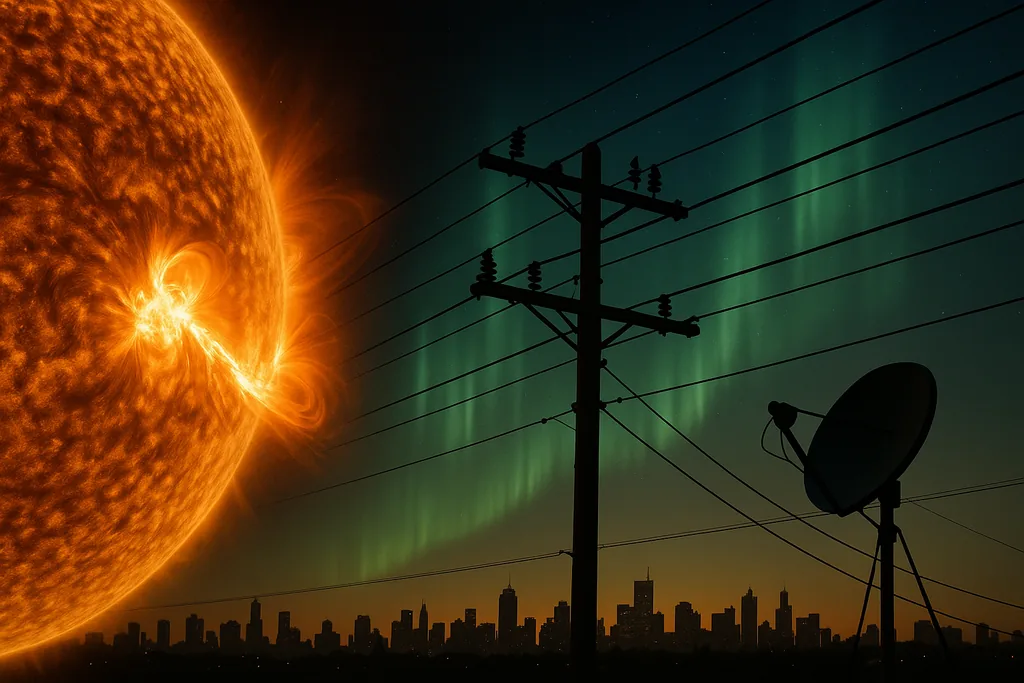
Sun in a stormy mood: why forecasters are on alert
Space agencies have been tracking a spate of powerful X‑class solar flares in recent months and have issued warnings about their potential to disturb technology on and above Earth. Instruments such as the Solar Dynamics Observatory have recorded bright, short‑lived bursts of extreme ultraviolet and X‑ray radiation from active sunspot regions; when those eruptions are accompanied by coronal mass ejections (CMEs) they can drive geomagnetic storms that reach the planet in hours to days.
In plain terms: an energetic flare lights up the Earth’s upper atmosphere almost instantly with broadband electromagnetic radiation, while a CME — a cloud of magnetised plasma — can slam into the magnetosphere later and produce sustained effects. NASA summed up the immediate risk in plain language: "Flares and solar eruptions can impact radio communications, electric power grids, navigation signals, and pose risks to spacecraft and astronauts." The recent alerts reflect that combination of immediate and delayed hazards.
How flares and CMEs affect infrastructure
Solar events affect human systems in several different ways because they produce different kinds of energy. Two behaviors are most important:
- Electromagnetic flash: High‑energy photons from an X‑class flare arrive at Earth in about eight minutes and increase ionisation in the ionosphere. That disrupts shortwave (HF) radio and can degrade GNSS (GPS) signals used for navigation, surveying and timing—sometimes for minutes to hours.
- Plasma and magnetic clouds: A CME is a huge blob of charged particles plus magnetic field. If its magnetic orientation and speed are unfavourable, it can compress and disturb Earth’s magnetosphere. That drives currents in the upper atmosphere and induces geomagnetically induced currents (GICs) on long conductors at ground level, such as power lines and pipelines.
The technological consequences are layered. Satellites can suffer surface charging, radiation hits to electronics, and increased drag when the thermosphere heats and expands; crews and electronics on high‑altitude aircraft are exposed to elevated radiation; and terrestrial power grids can experience transformer saturation, voltage regulation problems and, in extreme cases, large blackouts.
How severe could this be — and how likely?
Not every X‑class flare produces the same consequences. X‑class is simply the label for the most intense category on the solar classification scale; an X5 flare is roughly five times stronger than an X1, and each numeric step is multiplicative. The difference between a dramatic headline and real world damage depends on three things: whether a CME is launched, the CME’s speed, and the orientation of its magnetic field when it arrives at Earth.
National and international space‑weather services use a geomagnetic storm scale from G1 (minor) to G5 (extreme). Historical context helps: the Carrington Event of 1859 — the benchmark extreme storm — produced telegraph failures and aurora seen near the equator. More recently, a geomagnetic storm in March 1989 collapsed the Quebec grid within minutes, leaving millions without power. Those are upper‑bound examples; most flares and CMEs cause shorter, regional disruptions, not civilisation‑threatening disasters.
Forecasting firm estimates and computer simulations make clear that a merged or "cannibal" CME — when a faster ejection catches and compresses an earlier one — can amplify the impact. Such mergers are one reason forecasters sometimes upgrade expected storm severity as multiple eruptions travel through the heliosphere.
What operators and agencies can do now
The good news is that modern grid operators, satellite companies and airlines do not wait for calamity. Space‑weather prediction centres issue watch and warning products based on solar imagery, coronagraphs and in‑situ monitors at the Sun‑Earth L1 point. When a threatening CME is detected, utilities can take mitigation steps: temporarily reconfigure grids, reduce load on vulnerable transformers, and delay sensitive switching operations. Satellite operators can suspend non‑essential maneuvers, put spacecraft into safe mode, and adjust attitude to reduce charging risk. Airlines can reroute polar flights or avoid HF‑dependent routes while aviation regulators and companies take precautions.
Early notice matters. Electromagnetic effects from a flare are essentially instantaneous, but the bulk plasma of a CME typically takes 18 to 96 hours to arrive — a window that allows pre‑emptive action where detection is clear. Monitoring assets are therefore critical: continuous solar imaging, coronagraphs that watch CMEs leave the Sun, and upstream solar‑wind and magnetic‑field monitors give operators the few hours to days of lead time they need.
What people are likely to notice?
For most members of the public, the most visible sign of a strong geomagnetic storm is a bright aurora at much lower latitudes than usual. People at mid‑latitudes may see spectacular night‑time displays. The other common experience is disruption to HF radio — ham operators, ship and aviation communications and some remote‑area services may notice temporary blackouts. Short, local GNSS degradations are also possible; that can affect smartphone navigation and precision timing temporarily, though such interruptions are usually intermittent and patchy.
Power outages from space weather are possible but rare, and they usually require a combination of factors: a strong CME, vulnerable grid topology, and the right geographic conditions that favour large induced currents. Utilities in high‑latitude countries and regions with long transmission lines are typically most exposed.
Why warnings matter — but headlines shouldn't be panic triggers
Warnings from space agencies are designed to prompt preparedness, not alarm. The Sun is entering or in the peak phase of its 11‑year cycle, when strong flares are statistically more likely; that raises the baseline of risk. But even during a stormy solar maximum most events do not spiral into cascading, long‑term disasters. The system of monitoring, modelling and operational mitigations built up over decades is effective at reducing impact.
That said, the episodes serve as a reminder of an underappreciated vulnerability: modern society depends on long‑span conductors, satellites and global timing that are all sensitive to space weather. The combination of increasingly congested low‑Earth orbit, just‑in‑time supply chains and a small number of critical grid transformers means the stakes are higher than they were a century ago. Continued investment in monitoring, hardening critical infrastructure and coordinated response planning remains a prudent priority for governments and industry alike.
In short: recent X‑class activity is a valid reason for utilities, satellite operators and aviation authorities to prepare; for most people, the likely immediate effects are temporary — vivid aurora and intermittent radio or navigation interruptions — while the rare, extreme scenarios remain low probability but high impact, which is why the alerts are taken seriously.