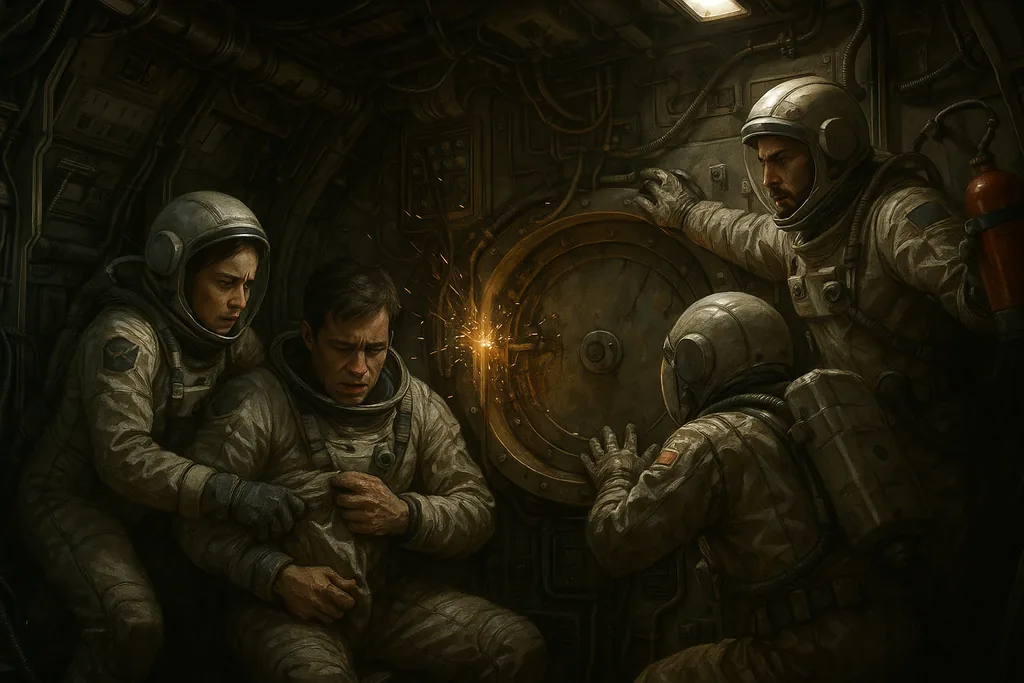
How nine quiet dangers in space can become suddenly lethal
On January 10, 2026, a popular feature listed nine frightening ways the void beyond Earth can kill an astronaut. The short list is accurate — but bare — because each item hides a cluster of physical processes, engineering trade-offs and medical unknowns that mission planners and engineers spend years trying to mitigate. Below is a practical, sourced guide to those hazards: what they actually do to a human body or a vehicle, how crews defend against them today, and why some risks remain stubbornly hard to eliminate. The summary that follows synthesizes NASA risk reports, technical papers on shielding and fire safety, and recent examples of in-orbit incidents to show how real each threat is and how it might become catastrophic in a mission context.
Vacuum and rapid decompression
Exposure to vacuum — from a torn suit, an exploded airlock or a catastrophic hull breach — produces almost immediate physiological failure through hypoxia and barotrauma. The gas in the lungs and body cavities expands; if an astronaut holds their breath the expanding air can burst lung tissue. Without rescue, loss of consciousness occurs within seconds and irreversible brain injury follows within a couple of minutes. The phenomenon called ebullism (boiling of body fluids at low pressure) causes swelling and painful tissue effects, but core-body freezing is not the immediate killer because heat loss by radiation is relatively slow. Modern mission designs focus on preventing depressurization, supplying redundant pressure barriers and training crews to exhale immediately if sudden decompression occurs.
Radiation: solar storms and galactic cosmic rays
Space radiation is a two‑headed problem. Short, intense solar particle events (SPEs) can deliver high doses quickly and produce acute radiation syndrome if a crew is outside robust shielding during an event. The other hazard is chronic exposure to galactic cosmic rays (GCRs): high-energy heavy ions that slowly chip away at tissue and DNA, increasing long‑term cancer risk and possibly causing degenerative changes in the cardiovascular and central nervous systems. Shielding helps against SPEs, but GCR particles are so energetic they generate secondary cascades in shielding materials that remain difficult to block without prohibitive mass. NASA and radiation labs now study mixed-field exposures and are developing storm shelters, biological countermeasures and better dosimetry to manage both acute and late risks.
Micrometeoroids and orbital debris (MMOD)
Pieces of paint, tools, dead rocket stages and natural micrometeoroids travel at several kilometers per second in orbit. Even millimeter-sized fragments carry tremendous kinetic energy; they vaporize on impact, producing a plasma cloud that can punch through thermal blankets, solar arrays and, in the worst case, pressure hulls. A multilayer Whipple-style shield remains the standard mitigation for many vehicles, but shields add mass and are designed around the size range of likely impacts. The accumulation of debris — the so-called Kessler syndrome — would raise collision rates and make some orbits unusable. Recent in-orbit incidents where modules or capsules were struck and mission returns delayed underline the everyday reality of this risk.
Fire and toxic atmosphere inside a closed vehicle
Fire in microgravity behaves differently: flames are more spherical and smoldering can produce persistent, toxic aerosols. On a small habitable vehicle, fires consume oxygen, create toxic combustion products and can disable electronics or life-support systems. Lithium-ion batteries, ubiquitous on modern spacecraft, present a particularly difficult hazard because thermal runaway can be self-sustaining and release corrosive gases. Space agencies run extensive fire-safety testing, restrict flammable materials, and plan fire-suppression systems and post-fire clean-up procedures, but the possibility of an onboard conflagration remains among the most dangerous short-notice emergencies.
Launch and ascent failures
The hour of ascent concentrates extreme mechanical loads, vibration, sonic shocks and stored chemical energy in engines and propellant tanks. A structural or engine failure at the wrong moment can produce explosive depressurization or thermal exposure that is survivable only with rapid abort systems. Historical accidents remind us that seemingly tolerable design choices — a shedding of foam, an under‑managed separation event, or a combustion instability — can cascade into an unrecoverable failure. Modern architectures attempt to minimize single-point failure modes with redundant systems and escape towers or integrated launch-abort capabilities, but the physics of getting to orbit remains unforgiving.
Reentry heating and structural breakup
Returning through an atmosphere converts orbital kinetic energy into heat. Any breach in thermal protection lets superheated gas penetrate structure and quickly erode load-bearing components. The Space Shuttle Columbia accident remains a stark case study: a foam strike at launch damaged heat-resistant panels, and the latent breach later allowed entry heating to destroy the wing structure, making recovery impossible. For crewed vehicles, reentry failure generally leaves little margin: once structural failure begins under reentry loads, survival is unlikely. That is why inspection, damage tolerance and contingency planning for reentry are central to vehicle certification.
Microgravity physiology and slow medical collapse
Prolonged exposure to microgravity does not kill an astronaut within minutes, but it slowly degrades many body systems in ways that could become mission‑ending. Bone density falls and calcium is excreted in urine, increasing kidney‑stone risk; muscles atrophy and cardiovascular deconditioning make orthostatic intolerance likely after return; vision changes and intracranial pressure shifts have appeared in long‑duration crews; and immune function and wound healing are altered. For missions beyond immediate return — lunar stays or a trip to Mars — these slow processes can interact and amplify, turning manageable conditions into compounded medical emergencies unless countermeasures such as exercise regimens, dietary controls and pharmaceutical interventions are rigorously applied.
Isolation, confinement and human factors
Psychological and social stresses are not exotic physics but they are lethal to a mission’s safety culture when they erode teamwork, attention and judgement. Crews in small habitats face chronic sleep disruption, sensory monotony, interpersonal friction and the stress of being far from immediate medical evacuation. Those stresses increase the chance of human error, poor maintenance, and risky improvisation under pressure — all pathways that can convert a technical anomaly into a life-threatening situation. Mission designs increasingly include behavioural health support, simulated pre-mission conflict training and improved communications, but distance and delay (for deep-space missions) remain hard limits.
Life‑support and equipment failure: CO2, contamination and repairs
Life-support systems are complex assemblies of pumps, scrubbers, valves and sensors; a stuck valve, failed scrubber cartridge or unnoticed leak can raise carbon dioxide or contaminate the cabin with solvents and combustion products. Some failures are diagnosable and repairable in the short term, but others — structural punctures, cold-welded fittings or inaccessible electrical faults — require time-consuming improvisation. Research into in-situ repair techniques, materials that won’t cold-weld in vacuum, and modular redundancy aims to reduce the number of single-fault fatalities, but on a small planetary habitat or a vehicle in deep space, a prolonged failure of life support is an existential threat.
Where engineering meets medicine
Each of the nine hazards is manageable in isolation; the real problem is combinations and surprises. A micrometeoroid strike can puncture a coolant loop and trigger an electrical fire. An SPE during an EVA can coincide with a suit tear; a CO2 scrubber failure can interact with reduced immune function to let an infection spread. That interplay is the core focus of contemporary space-safety work: reducing the probability of multi‑failure sequences, hardening systems against cascading effects, and improving rapid diagnosis and crew autonomy. The critical insight from NASA’s human research and technical work is that margin — mass for shielding, spare capacity for life support, redundancy for command and control — is expensive, and trade-offs must be chosen carefully for each mission profile.
Practical takeaways
- Short-term lethal events (compression, fire, acute radiation) require prevention and fast, well-practiced emergency response.
- Slow hazards (GCRs, bone loss, psychological decline) need long-term countermeasures and mission design that recognises cumulative risk.
- Many failures arise from interactions between systems; resilience requires both component hardening and cross-system planning.
Spaceflight is risky because it exposes fragile human biology and delicate electronics to regimes outside terrestrial experience. The technology exists to make missions survivable, but only if engineers, medical researchers and mission planners build in enough margin and prepare for the unlikely combinations. As human activity in orbit and beyond grows, the pressure to accept tighter mass budgets and to reuse older hardware will push these trade-offs into public view — and make the sober, technical work of hazard mitigation more important than ever.
Sources
- NASA Human Research Program evidence reports (radiation, physiological risks, EVA/decompression)
- NASA Technical Reports Server (spacecraft fire safety and spacecraft operations reports)
- Acta Astronautica (papers on in‑situ repair and cold‑welding in vacuum)
- ScienceDirect / Elsevier research on micrometeoroid and hypervelocity impact shielding