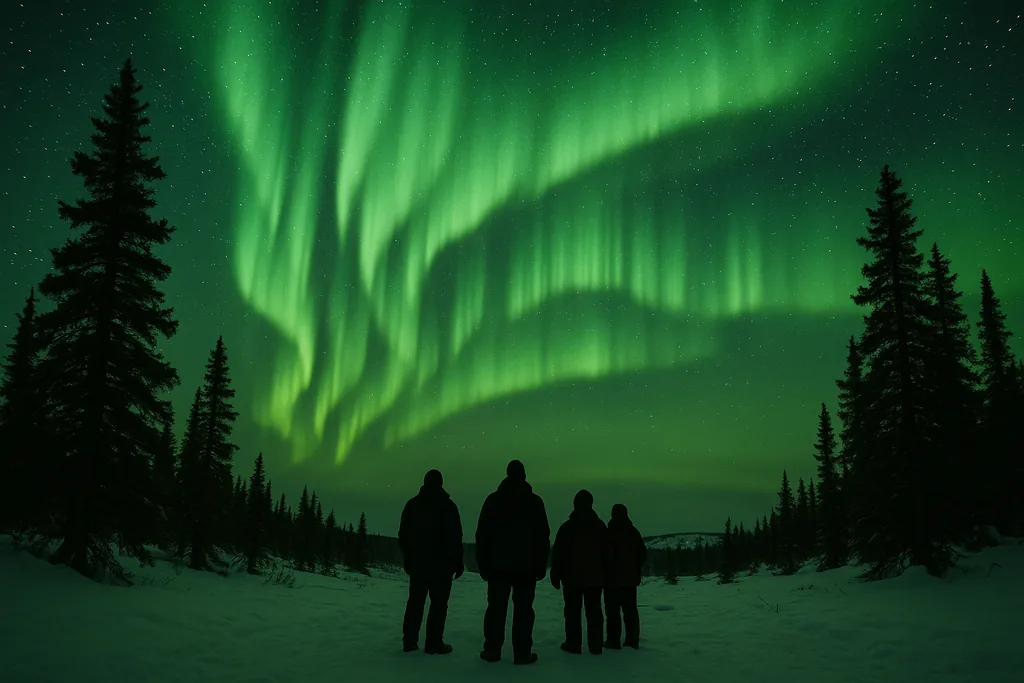
Northern Lights Possible Tonight as Fast Solar Wind Persists
Tonight, December 22, skywatchers from the Arctic Circle down into parts of the northern United States and Canada should be on alert: a steady stream of fast solar wind is continuing to stir Earth’s magnetosphere and could fuel visible auroras overnight into December 23. Space weather forecasters say conditions remain favourable for at least minor geomagnetic storms, with displays most likely at high latitudes but occasional extensions into mid-latitude skies if the solar wind and magnetic conditions line up.
Fast solar wind and the geomagnetic picture
The current aurora odds reflect a prolonged flow of fast solar wind sweeping past Earth. That flow can come from a coronal hole — a region on the Sun where open magnetic field lines let particles escape — or from the aftermath of a coronal mass ejection. Observations and recent forecast products put the incoming wind speeds well above the slow background: models and operational bulletins have shown values in the several-hundred-kilometres-per-second range, with occasional gusts that push speeds toward the higher end of typical high-speed streams.
What determines whether those particles light up the night is the orientation of the interplanetary magnetic field (the Bz component) when the wind arrives. If the Bz swings southward for a sustained interval, energy transfers efficiently into Earth’s magnetosphere and geomagnetic activity jumps — raising the planetary Kp index and widening the auroral oval toward lower latitudes. Forecasters have been watching a pattern that keeps the magnetosphere unsettled to active at times: that is enough to produce showy northern lights for observers under dark skies, and a chance that auroras will appear farther south than usual for brief periods.
Where and when to look tonight
High-latitude locations remain the safest bet: northern Canada, Alaska, Iceland and Scandinavian countries typically sit directly under the auroral oval and will see the best, most persistent displays if current conditions hold. Forecast maps issued by operational space weather centres and real-time Kp monitoring are the quickest way to see whether the oval is expanding into mid-latitudes.
On nights like this, aurora reports often trickle down into the northern tier of the continental United States — overnight viewers in states from the Pacific Northwest across to the northern Plains may get lucky if activity spikes. Broad forecasting services this evening listed up to ten U.S. states as having at least a chance of auroral visibility overnight into Dec. 23, though the exact set of states that see anything depends on the strength and orientation of the wind and local sky conditions.
Timing: auroras most commonly brighten around local midnight to the early-morning hours, but active periods can occur any time after dark and sometimes come in short bursts. For a live readout, check planetary Kp values and the real‑time auroral oval products from official space weather providers before heading out.
Practical tips for seeing and photographing the aurora
Successful aurora viewing is a mix of timing, darkness and patience. Pick a site away from streetlights and heavy urban glow, face north (for Northern Hemisphere viewers), and allow your eyes 20–30 minutes to adapt to the dark. Even a faint, high-latitude aurora can be surprisingly photogenic; conversely, a strong geomagnetic event can produce dynamic curtains that shift on timescales of minutes.
Smartphone cameras can capture bright displays, but for the best results bring a camera on a tripod with manual controls. Practical starting settings: a wide-angle lens, aperture as wide as your lens allows (f/2.8 or lower if possible), ISO in the 800–3200 range depending on your sensor’s noise performance, and exposures of 5–20 seconds. If the aurora is fast and bright, shorten exposures to freeze structure; if it’s faint, lengthen exposures but watch for star trails. Remote shutter releases or two‑second timers reduce vibration. Warm clothing, spare batteries (they drain faster in cold), and a headlamp with a red filter make long watches comfortable and safe.
Possible space impacts and what forecasters watch next
Most aurora-producing events this week are expected to top out at G1 (minor) or G2 (moderate) geomagnetic storm levels. Those conditions can create dazzling displays without causing widespread infrastructure problems, but forecasters keep an eye on secondary effects. Minor storms sometimes disturb high-frequency radio links used by aviation and can cause subtle GPS errors; they can also increase drag on low-Earth-orbit satellites and, for operators of sensitive electrical infrastructure, are a reminder to monitor systems for unusual behaviour.
Operational centres watch a few key inputs in real time: solar wind speed and density, the total interplanetary magnetic field strength, and especially the Bz component. They also track coronagraph imagery and modelled CME arrivals from solar observatories; a sudden CME or a sustained southward Bz could push activity higher than current predictions and produce aurora at much lower latitudes.
Why this week has been active
The Sun is still producing intermittent pulses of activity as regions of complex magnetic field and coronal holes rotate into favourable positions. Over the past days, instrumental records and daily sun‑activity summaries have shown recurring high-speed streams and occasional eruptive events — a combination that keeps Earth’s near-space environment more disturbed than the quiet baseline. That layered pattern — coronal-hole wind plus lingering ejecta — is what has delivered multiple nights of auroras to high latitudes recently and set the stage for tonight’s chance.
If you plan to watch, check the latest official forecast and live monitoring products shortly before you go out; conditions can change on timescales of hours. And if you do see the display, a clear, cold winter night and a camera on a tripod will help you bring a lasting image home.
Sources
- NOAA Space Weather Prediction Center (operational forecasts and alert products)
- NASA Goddard Space Flight Center (SDO solar imagery and analysis)
- NOAA GOES satellite imagery and instruments
- National Solar Observatory / GONG (ground-based solar observations)