Quantum Simulations Start to Resemble the Universe
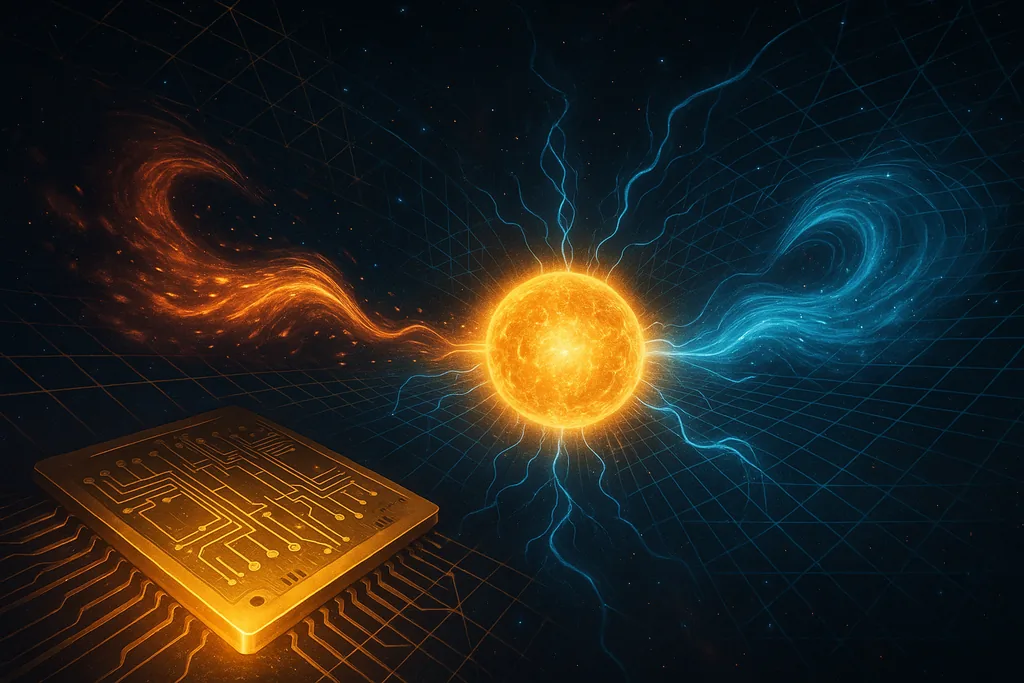
Small quantum machines, big cosmic ambitions
Over the past year a wave of papers has shown that programmable quantum processors can now reproduce the real‑time dynamics of simple quantum fields — the same mathematics used to describe particle collisions, the quark‑gluon soup of the early universe, and the extreme matter inside neutron stars. These experiments do not yet reproduce full three‑dimensional quantum chromodynamics, but they demonstrate scalable circuit designs and error‑mitigation strategies that push quantum hardware into regimes where qualitatively new phenomena appear.
Teams have run scattering experiments and wave‑packet collisions on commercial superconducting devices supplied through IBM’s quantum cloud, using processors named for research testbeds and families in IBM’s fleet. Those runs stretched from dozens to over a hundred qubits and relied on carefully compressed circuits to reach thousands of two‑qubit gates — long enough to see post‑collision physics emerge in the measured observables.
What exactly did they simulate?
The recent efforts focus on simplified but physically meaningful models: one‑dimensional lattice gauge theories and scalar field theories that capture key processes of particle physics. In these setups researchers prepare localized wavepackets that mimic incoming particles, evolve them in time under the interacting field Hamiltonian, and then read out how energy, charge and particle content spread after the collision. The results include elastic and inelastic scattering, particle production, and regimes where the post‑collision state either delocalizes or remains localized depending on tunable parameters in the model.
How they made the circuits scale
Two technical moves make these experiments noteworthy. First, teams developed compact circuit ansätze that represent vacuum states and localized excitations with far fewer gates than a naive digitization would require. These variational compression techniques and wavepacket‑creation routines mean the same logical simulation can be stretched to larger lattices without linearly exploding gate counts. Second, researchers combined mid‑circuit tricks for preparing entangled W‑type states, feedforward steps, and carefully chosen Trotter decompositions of time evolution to reach late times after the collision — the window where particle production and scattering scars show up. Those algorithmic improvements are what let runs use tens to a few hundred qubits while still producing physically meaningful signals.
On‑device realities: gates, noise and mitigation
These experiments pushed present‑day superconducting hardware to its limits: runs reported thousands of two‑qubit gates and two‑qubit gate depths in the tens to low hundreds. At that scale raw device noise would wash out the signal, so the teams layered in error‑mitigation techniques tuned to local observables. One approach — marginal distribution error mitigation — reconstructs low‑order statistics from noisy measurements; others use zero‑noise extrapolation and operator renormalization. By validating the mitigated results against classical matrix‑product‑state simulations at short to intermediate times, the groups showed that the quantum hardware is already providing faithful snapshots of non‑equilibrium field dynamics.
What was observed — echoes of the early universe and dense stars
Although the models are lower dimensional, the simulations reproduce behaviors that matter for high‑energy and astrophysical contexts. The runs showed inelastic particle production — energy turning into new excitations in the field — a process analogous to particle creation in high‑energy collisions and, at a conceptual level, to how a hot, dense early universe produced matter from energy. In lattice gauge‑theory runs the teams could tune a topological parameter (a so‑called Θ‑term) and a fermion mass to switch the post‑collision dynamics between a delocalized regime and one with clear localized remnants, reminiscent of confinement and string‑breaking effects studied in particle physics. Those are the same mechanisms that control quark binding and particle multiplicities in heavy‑ion collisions and that influence the equation of state inside neutron stars.
Why this matters — and what it doesn’t yet do
Classical methods are powerful, but they struggle with certain real‑time quantum problems and with dynamics far from equilibrium. Quantum processors naturally evolve quantum states, so they promise a direct path to simulating time‑dependent processes that are exponentially costly on classical machines. The recent demonstrations show proof of principle: digital quantum simulators can prepare interacting wavepackets, scatter them, and read out nontrivial post‑collision signatures that agree with classical predictions where those exist, and that extend into regimes where classical approximations become hard.
That said, the experiments are not yet simulations of full QCD inside a real neutron star or the full 3‑D Big Bang plasma. Most runs use truncated electric‑field representations, reduced spatial dimensions, or simplified gauge groups. The next steps are clear: better qubits, longer coherence, and eventually error correction so circuits can represent the full Hilbert space of three‑dimensional gauge theories at physically relevant energies. Hardware roadmaps from major vendors suggest steady progress toward larger, lower‑error devices and dedicated testbeds for error‑corrected quantum simulation over the late 2020s.
Outlook: from snapshots to experiments
For now the field is building a new kind of laboratory. Instead of detectors surrounding a collider, scientists stitch quantum circuits that reproduce a field’s dynamics and then probe the output with targeted measurements. The immediate scientific payoffs are twofold: first, access to qualitative, non‑perturbative phenomena in controllable models; second, rapid iteration between algorithm design and device experiments to refine the hardware‑software interface for truly large simulations.
Within five to ten years, if the current trends in algorithm compression, error mitigation and hardware scaling continue, we should expect quantum simulations that inform quantitative questions in hadron physics, dense‑matter astrophysics and early‑universe dynamics — not by replacing accelerators or telescopes, but by offering a complementary, intrinsically quantum view of processes that are otherwise opaque to classical computation.
Final thought
The recent IBM‑backed runs do not yet deliver a digital recreation of a neutron star core or the entire hot plasma of the Big Bang. What they do deliver is a technological and conceptual milestone: quantum processors can now simulate collisions and post‑collision field dynamics in ways that were only theorized a few years ago, and those snapshots already carry the fingerprints of the complex physics we associate with the universe’s most extreme moments. As hardware and algorithms improve, these snapshots will stitch together into longer, richer movies of quantum matter under extreme conditions.