Quantum Teleportation Over Live Internet Fiber
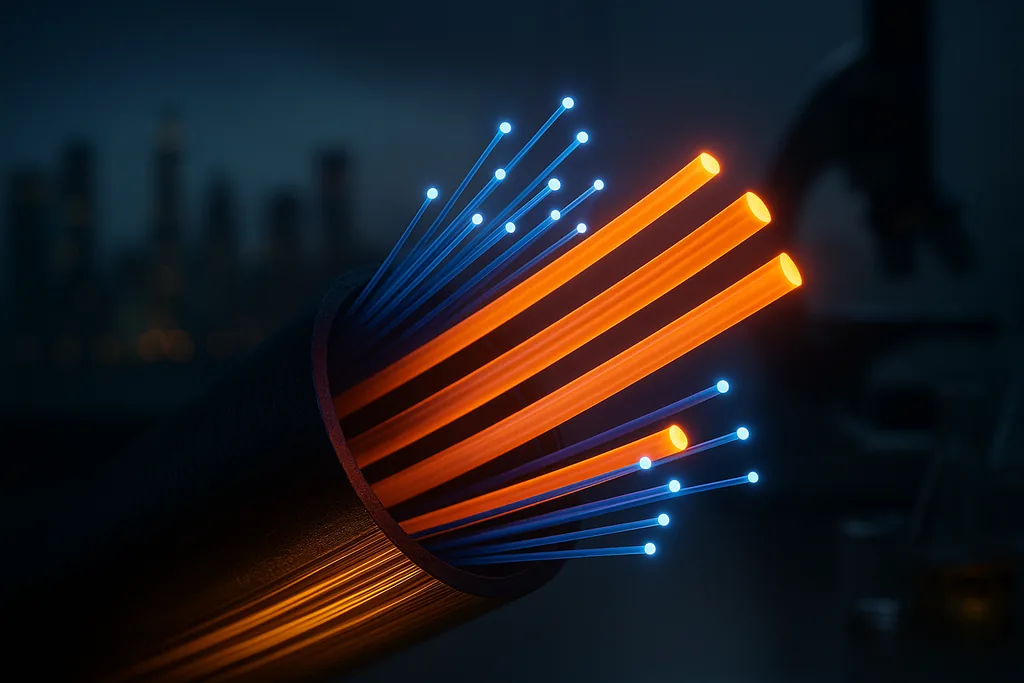
How scientists moved quantum states through the same cables that carry your web traffic
Last year, researchers pulled off what once sounded like science fiction: they teleported the quantum state of a photon across a working internet fiber that was simultaneously carrying high‑speed classical data. Rather than building entirely new, dedicated lines for quantum experiments, the team used techniques familiar to telecom engineers — wavelength allocation, narrow filtering and timing tricks — to protect delicate quantum signals from the noise generated by nearby internet traffic. The result: reliable quantum state transfer over tens of kilometres of fibre already in service.
What 'quantum teleportation' actually means here
Quantum teleportation does not move matter or energy. In practical terms it transfers the information that defines a quantum state from one particle (or place) to another, without the state traversing the intervening space in a classical sense. The protocol uses three ingredients: a pair of entangled particles shared between sender and receiver, a joint measurement (a Bell state measurement) that links the unknown input state with one half of the entangled pair, and the classical transmission of the measurement result so the receiver can complete the transfer. Because the classical result must be sent normally, teleportation cannot violate causality or be used for faster‑than‑light messaging, but it is a foundational tool for quantum networks.
Why this felt ‘impossible’ — and how the team overcame it
The core technical problem was noise. Standard telecom fibres carry large amounts of optical power in the so‑called C‑band; that bright light scatters and produces background photons across the spectrum, which can swamp single photons used as qubits. The breakthrough came from deliberately placing quantum signals into a different window of the fibre’s spectrum (the O‑band), and then applying tight spectro‑temporal filters plus coincidence detection to reject noise. The experiment performed a Bell state measurement near the midpoint of a 30.2‑kilometre link that was also carrying a 400‑Gb/s classical channel, and demonstrated teleportation fidelities above the classical limit despite the heavy traffic. Those practical design choices — wavelength engineering, narrowband filters and timing‑based heralding — are what made teleportation on a live fibre feasible.
Why using existing internet technology matters
Dedicated ‘quantum’ fibres are expensive and slow to roll out at scale. Showing that quantum and classical signals can coexist inside the same cable means network operators could potentially add quantum services without digging up streets or building parallel networks. That could accelerate deployment for use cases such as distributed quantum sensing, secure key distribution and — eventually — quantum computers that link across a network. In short, reusing the installed fibre plant dramatically lowers the bar for real‑world quantum networking.
Not the only advance: chips, long links and memories
This teleportation result is one notable milestone in a fast‑moving landscape. Other teams are tackling complementary problems: for example, engineers recently built a compact silicon “Q‑Chip” that bundles classical control information with quantum signals so they can be routed using standard internet protocols on a live carrier network — an important step toward integrating quantum traffic into existing network stacks and management tools. That work shows a path for practical, chip‑scale control of quantum channels on commercial fibre.
At the same time, different groups have pushed the distance of quantum communications on real telecom fibre: a large demonstration sent coherent quantum messages across more than 250 kilometres of deployed fibre between data centres, using room‑temperature semiconductor detectors and clever phase‑stabilisation techniques to preserve quantum coherence over long spans. These longer‑reach experiments complement the teleportation work by showing that real‑world infrastructure can support a range of quantum protocols at metro and intercity scales.
Finally, teleportation to and from stationary quantum memories — essential for building repeaters that extend quantum links beyond the limits of direct transmission — is also advancing. Recent experiments demonstrated teleportation of telecom‑wavelength photonic qubits into solid‑state erbium‑ion ensembles, bringing together the memory and the fibre‑compatible photons needed for practical quantum repeaters. Integrating such memories with live networks and the wavelength engineering used in the telecom‑coexistence experiments is a logical next step.
Where this does — and doesn’t — change the picture
- Short‑term: The new demos reduce the infrastructural hurdle. Expect pilots linking critical institutions, banks or research sites in the next few years that combine classical traffic with quantum key distribution and short‑range teleportation links.
- Longer‑term: A global quantum internet will still need robust quantum repeaters, standardisation and scalable quantum memories. Teleportation over shared fibres does not replace repeaters; rather, it suggests repeaters can be deployed on top of existing fibre routes.
- Operational challenges: Carrying quantum channels alongside unpredictable commercial traffic requires careful network management: wavelength planning, dynamic filtering, routing policies and new monitoring tools will be needed before operators can run quantum services at scale.
What to watch next
Researchers will be combining elements from these demonstrations: chip‑scale control that speaks IP, teleportation protocols that tolerate live network noise, long‑distance coherent links that use semiconductor detectors, and quantum memories that store teleported states. Together, these advances point toward metropolitan‑scale quantum services in the near term and wider networks as repeater hardware and standards mature. The experiments show that the key barrier — the need for entirely new hardware paths — is no longer absolute. Instead, the challenge is now engineering: turning laboratory recipes into robust, manageable services that telcos can operate alongside their existing traffic.
For physicists and network engineers alike, the message is clear: quantum networking is leaving the isolated lab bench and learning to speak the language of the internet. That shift may be the most consequential outcome of these experiments — a pragmatic route for the quantum revolution to ride on top of the world’s already humming fibre plant.