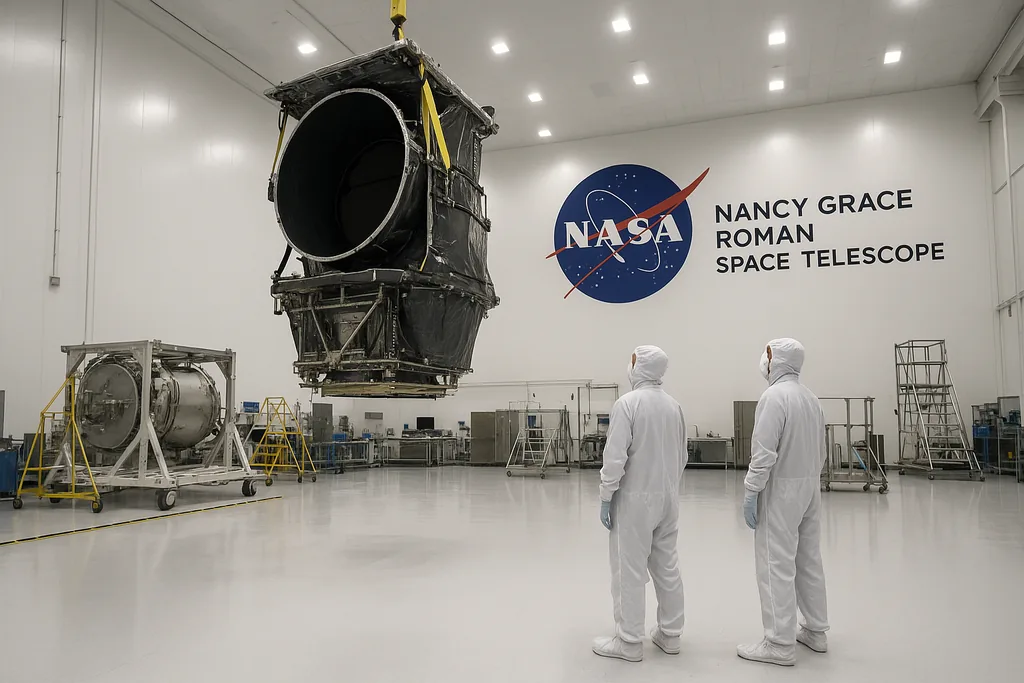
On Nov. 25 technicians in clean-room suits joined the inner and outer portions of NASA’s Nancy Grace Roman Space Telescope, completing the mechanical assembly of the observatory in the largest clean room at Goddard Space Flight Center in Greenbelt, Maryland. NASA announced the milestone in early December as Roman prepares to move into a final round of environmental and functional tests before shipping to the launch site.
What was finished — and when it will fly
The completed observatory unites two major subsystems: the telescope and its instrument carrier, a structure that keeps optics and detectors precisely aligned. With integration done, teams will run end‑to‑end electrical, thermal‑vacuum and vibration testing designed to replicate the stresses of launch and space. After those tests Roman is due to be shipped to Kennedy Space Center for launch preparations in summer 2026; NASA currently lists a formal launch target of May 2027 while also saying the team is on track for an earlier, fall‑2026 opportunity. A SpaceX Falcon Heavy is the planned launcher.
Two instruments, many science goals
Roman carries two very different instruments that together make it a dual‑purpose mission. Its Wide Field Instrument (WFI) pairs a Hubble‑quality 2.4‑meter mirror with a camera that sees a field hundreds of times larger than Hubble’s, enabling wide, deep surveys of stars and galaxies. That breadth is why Roman is expected to generate an enormous data set — the mission team projects discoveries spanning hundreds of millions of stars, billions of galaxies, and unprecedented numbers of distant worlds.
Alongside the broad survey work, Roman will carry a Coronagraph Instrument (CGI), a purpose‑built technology demonstrator that tries to block and suppress starlight so much fainter planets close to their host stars can be seen and characterised directly. CGI is not a mature exoplanet facility like a future flagship would be, but it is intended to validate the tricks — deformable mirrors, wavefront sensing and advanced coronagraph masks — that let astronomers see a planet a billion times dimmer than its star. Those techniques are essential for the direct imaging and spectroscopy of Earth‑like planets in the habitable zones of nearby stars.
How Roman advances the search for life
Roman is not being billed as the mission that will definitively detect life on another world, but it is an operational stepping stone. The telescope’s microlensing and survey programs will find large populations of exoplanets, including colder and more distant planets that other missions miss. The coronagraph will for the first time test in space some of the high‑contrast imaging hardware and calibration techniques mission designers say a future Habitable Worlds Observatory or similar flagship will need to detect biosignature gases in the thin atmospheres of Earth analogues. In that sense Roman can help answer whether the instruments, materials and algorithms needed for that future search will work outside a laboratory environment.
Why the timing matters now
Roman arrives at an inflection point. Ground‑based surveys and space missions have catalogued thousands of exoplanets, and observatories such as James Webb are already probing the atmospheres of warm, transiting worlds. But the most compelling question — how common are truly Earth‑like planets with atmospheres that bear signs of life — requires both discovery of suitable targets and instruments capable of separating a faint planetary spectrum from the glare of a nearby star. Roman will supply large numbers of new targets through its microlensing and wide‑field surveys while testing the high‑contrast optics needed for follow‑on missions. The work Roman does over its first few years will therefore shape designs and priorities for the next generation of life‑search telescopes.
Cost, politics and the practical risks
Roman’s path to completion has not been entirely smooth. The mission cost is reported at roughly $4.3 billion for development, manufacturing, launch and five years of operations; political debates about NASA's budget have at times threatened the program. Congressional support repeatedly preserved the mission through earlier cancellation attempts, and recent budget proposals have again put pressure on NASA science spending. These fiscal and policy headwinds underline that Roman’s scientific success will depend as much on sustained funding and careful operations as on engineering performance.
From an engineering perspective, most of Roman’s hardware has shown robust behaviour in ground tests so far, and program managers emphasise that the mission escaped the kinds of crippling schedule slips and surprise hardware faults that afflicted some earlier flagship telescopes. Nevertheless, the observatory faces the normal risks of launch, deployment of aperture covers and solar arrays, and the inevitable fine‑tuning of optics in space. The teams at Goddard, JPL and partner institutions are prioritising methodical testing to reduce those risks before the launch window opens.
What scientists will do first
If Roman launches on schedule and reaches its halo orbit a million miles from Earth, the immediate work will be commissioning and early science. The coronagraph team has a planned set of exercises occupying several months of the first year to map instrument behaviour and demonstrate starlight suppression goals; once validated, CGI time will be opened to the broader community under a technology‑demonstration model. Meanwhile, wide‑field surveys will start to accumulate the kind of fast, broad‑area imaging that lets researchers search for microlensing events, rare transient phenomena, and planetary candidates that other telescopes can follow up. Those data sets will feed proposal calls and focused campaigns for years to come.
Beyond Roman: the road to a true 'alien‑hunting' telescope
For now, the clean‑room milestone marks a tangible moment: the hardware exists. What remains is an exacting sequence of tests, an on‑time launch, and the slow, patient work of turning raw photons into new knowledge about planets beyond our Solar System — and perhaps, one day, about life itself.
Sources
- NASA Goddard Space Flight Center (Nancy Grace Roman Space Telescope construction and mission pages)
- NASA Jet Propulsion Laboratory (Roman mission news)
- Space Telescope Science Institute (mission operations and science planning partners)
- Caltech/IPAC (Roman science team participation and instrument contributions)