Physicists observe a new temporal phase: the 'rondeau' time crystal
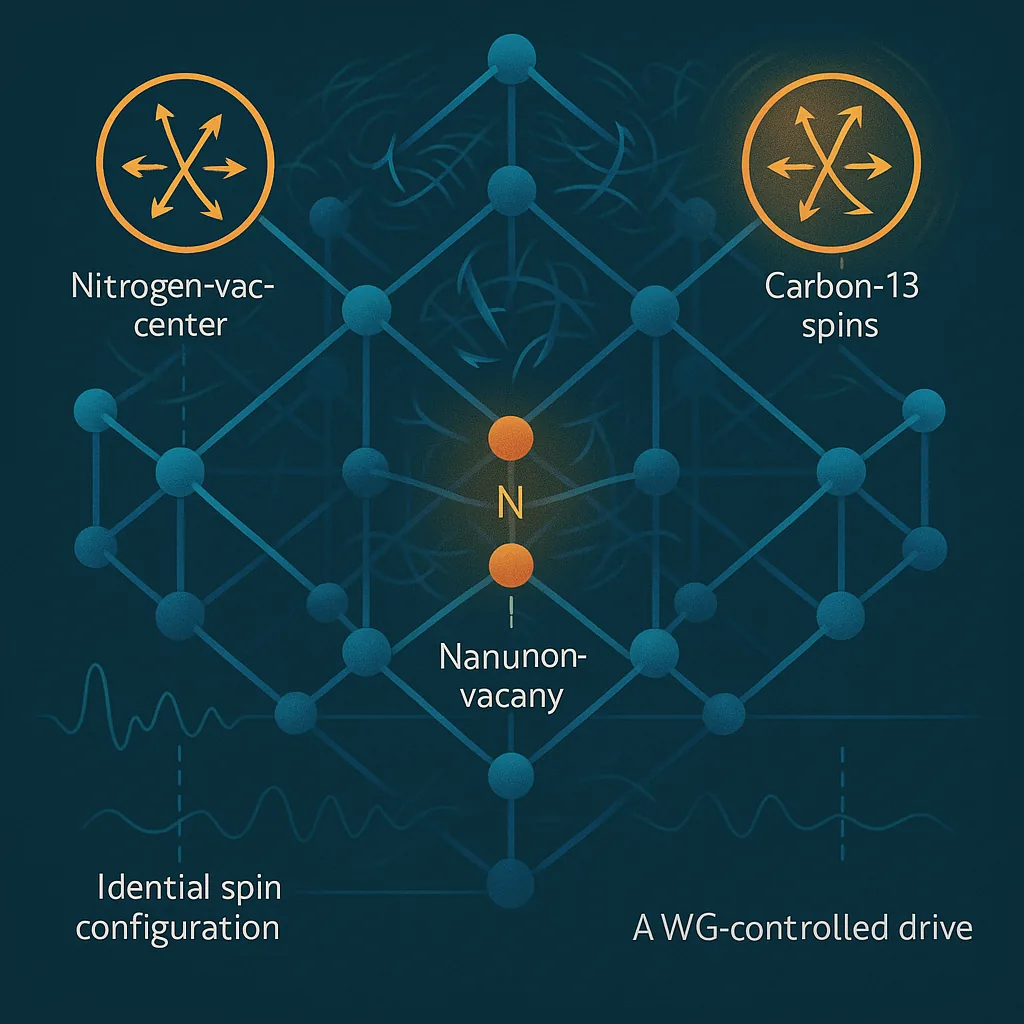
An experimental diamond quantum simulator produced a stable stroboscopic temporal order dubbed a 'rondeau' crystal: repeatable snapshots once per drive cycle amid intentionally varied short-time micromotion.
Physicists observe a new temporal phase: the 'rondeau' time crystal
Summary
Researchers report an experimental realization of a temporal phase they name the "rondeau" crystal. The system shows a stable, repeatable pattern when sampled once per driving cycle, while permitting deliberately varied, short-lived disorder between those sampling points. The experiment used carbon-13 nuclear spins in diamond and engineered microwave pulse sequences to stabilise the rhythm.
What is a time crystal?
A time crystal is a nonequilibrium phase in which a driven many-body system exhibits persistent temporal order that breaks the time-translation symmetry of the drive. In this case, the rondeau crystal combines long-lived, cycle-to-cycle repetition with controlled intra-cycle variation.
Experimental platform and methods
The experiment used a diamond quantum-simulator platform containing nitrogen-vacancy (NV) defects coupled to naturally occurring carbon-13 nuclear spins. Optical and microwave control were applied to hyperpolarise the carbon-13 ensemble and to read out collective spin dynamics with high fidelity.
Researchers programmed engineered drive sequences — including strictly periodic, quasiperiodic and intentionally randomized intra-cycle structures — using an arbitrary waveform generator to control microwave pulse timing and shape. By measuring the collective spin response across many drive cycles, the team identified long-lived stroboscopic order despite noisy micromotion within individual cycles.
Key observations
- When observed once per drive cycle, the collective spin configuration repeated with high fidelity, demonstrating stroboscopic order.
- Disorder introduced within each cycle did not destroy the long-time repeating pattern when measurements were taken stroboscopically.
- Stroboscopic lifetimes exceeded four seconds in some runs, corresponding to observation over more than one hundred drive periods and enabling spectral analysis of the dynamics.
Significance and potential applications
Limitations and future directions
The demonstration is a proof of principle rather than a ready technology. It relied on careful hyperpolarisation, low-noise microwave control and precise readout. Although coherence times were long for a many-body, room-temperature solid-state ensemble, they remain short compared with engineered qubit memories. Future work could investigate other host materials, alternative spin species and improved control electronics to extend lifetimes and enhance sensitivity.
Broader implications
Conceptually, the rondeau crystal illustrates that temporal symmetry breaking can support layered structure: stable order on coarse time scales coexisting with deliberate disorder at finer scales. This mirrors phenomena in spatial materials where some degrees of freedom are ordered while others are disordered, and it suggests new ways to organise information and coherent behaviour in driven quantum systems.
Outlook
The observation of a rondeau time crystal offers a new platform for studying nonequilibrium phases and for developing control techniques that exploit temporal structure. Turning these findings into practical sensing or information-processing tools will require further improvements in materials and control to achieve longer coherence times and greater robustness.