Sand Batteries: A Challenge to Lithium’s Reign
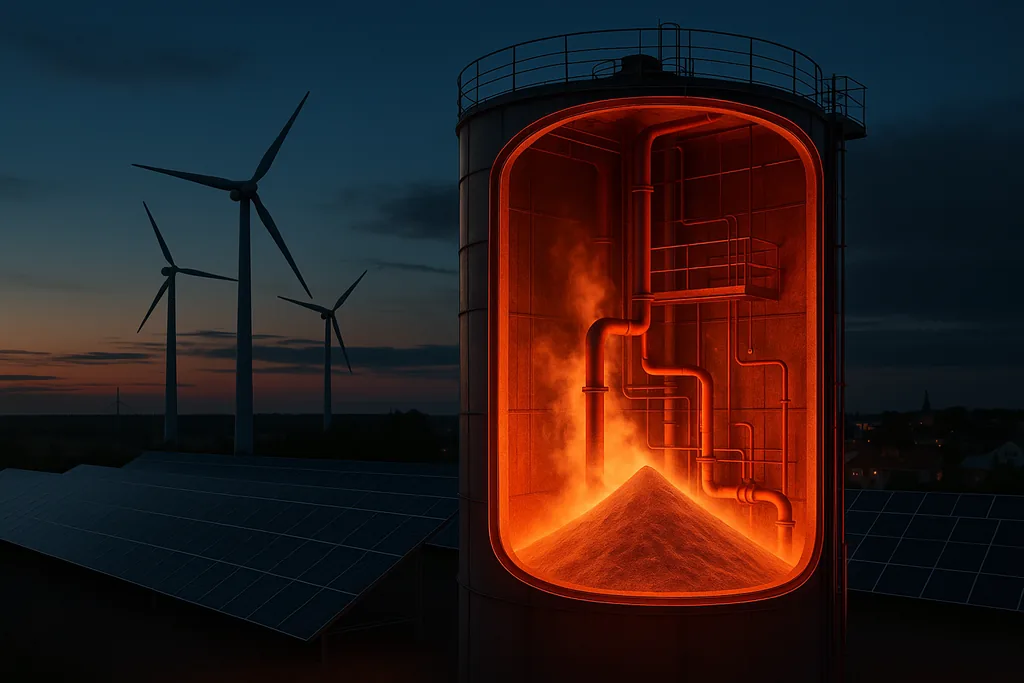
Could sand make batteries obsolete? Not everywhere — but in more places than you might think.
For decades, lithium-ion cells have dominated conversations about energy storage. They power phones, cars and a growing share of the grid. Now a family of technologies that store energy as heat in cheap, inert solid particles — often described as 'sand batteries' — is moving from lab demos to commercial projects. Proponents argue these systems could displace chemical batteries for long-duration storage and industrial heating, and a string of recent demonstrations has turned that possibility into a concrete business case.
How a sand battery works
At its simplest, a sand battery is an insulated container filled with a flowable solid — silica sand, crushed soapstone or similar granular materials — that is heated using electricity from wind or solar. The charged particles are stored in silos at high temperature (models and prototypes have explored temperatures up to about 1,100–1,200 °C). When energy is needed, hot air or another working fluid is passed through the particles to extract heat and either deliver it directly for district heating and industrial processes or drive a power cycle to make electricity.
The system relies on a handful of mechanical innovations: efficient electric heaters for charging, a way to move and store hot particles with low losses, and a particle-to-gas heat exchanger that can transfer heat quickly without destroying the grains. Research teams have prototyped laboratory-scale components and developed computational models to show how these elements can be engineered to work together at commercial size.
Where sand batteries outperform chemical cells
- Cost of materials: Sand or crushed stone costs a few tens of dollars per ton — orders of magnitude cheaper than the mineral feedstocks used in lithium-ion cells.
- Duration and scale: Thermal stores excel when you need to hold energy for many hours or days. Lithium-ion systems are usually optimized for short-duration firming (two to four hours), while sand-based systems are being designed for long-duration energy storage (LDES) — typically 10–100 hours. This matches the needs of seasonal demand swings and industrial process heat.
- Materials and supply chains: These systems avoid the concentrated geopolitical and environmental pressures tied to cobalt, nickel and other battery minerals.
- Industrial heat: Because sand batteries store heat directly at high temperatures, they can replace fossil-fuel burners in factories or district heating networks without an intermediate electricity conversion step, improving overall usefulness in decarbonisation strategies.
Those advantages are why some researchers describe particle thermal energy storage as a new generation of storage beyond the limits of molten-salt systems and short-duration batteries. Models and early prototypes indicate attractive economics for applications that require large capacity over long periods.
Real-world moves: demos and the first commercial scale plants
The U.S. Department of Energy’s flagship renewable lab has been a visible engine of this work. A team there has prototyped particle systems, published peer-reviewed analyses and planned a demonstration installation at their Flatirons campus intended to show 10-to-100-hour operation and validate components at scale. The lab’s public reporting highlights the technology’s promise and the targeted timeline for a ground-breaking demonstration during 2025.
Meanwhile, commercial deployments focused on heat rather than electricity have already reached town-scale. In Finland, a company built an industrial sand-based thermal store that now supplies district heating for a municipality; the installation has a reported storage size on the order of 100 MWh of thermal energy and was commissioned in mid-2025. That plant demonstrates how the concept can be used today to cut fossil-fuel consumption in heating networks.
Not a silver bullet — the realistic limits
It is important to be precise about where these systems make sense. If your target is a mobile device, a smartphone or an electric car, chemical batteries still dominate because they deliver electricity directly with high energy density and compact form factors. Sand and particle storage are bulky and stationary; their strength is cost-effective, long-duration capacity and high-temperature heat, not volumetric energy density.
When the question is electricity-in to electricity-out, particle systems do face conversion losses. Laboratory and modeling work from research teams estimate that while the thermal energy retained in the storage silo can remain above 95% over several days, the round-trip electricity-to-electricity efficiency — once you heat the particles and later convert heat back to electricity through a turbine or Brayton cycle — is commonly modeled in the 50–55% range for full systems, after accounting for parasitic losses. That is lower than a lithium-ion pack’s electrical round-trip efficiency, but the trade-off is lower capital cost per megawatt-hour of stored capacity and the ability to economically store energy for much longer periods.
Other engineering challenges remain. Particle abrasion, maintaining fluidization and heat-exchanger durability at high temperatures are active areas of research. The technology does require new industrial infrastructure, operational practices and permitting paths, meaning scaling it across many markets will take time and investment.
What this means for the grid and industry
Viewed in the context of decarbonisation, sand and particle thermal storage change the conversation about where and how society should deploy storage. For balancing seasonal or multi-day variability and for replacing fossil heat in industry, these systems present a lower-cost route than simply building huge fleets of chemical batteries. For short-duration, high-power tasks — frequency response, EV fast-charging peaks or mobile applications — batteries will remain the sensible choice.
In practice, a decarbonised system will rely on a portfolio of storage technologies: fast electrochemical batteries for seconds-to-hours response, pumped hydro or compressed air where geography permits, and long-duration thermal or flow-storage systems where duration and cost matter. The recent NREL research and the Finnish commercial projects don’t make batteries obsolete, but they do expand the set of economically viable tools grid operators and industrial planners can use.
Next steps and what to watch
Expect near-term activity in three areas: first, engineering demonstrations that validate long-duration electrical round-trip performance at megawatt scale; second, industrial deployments that displace burning for process heat and district heating; and third, market and policy pilots that test how these assets participate in electricity markets and capacity services. Publicly funded demonstrations scheduled for 2025 and the commissioning of commercial sand batteries in 2025 are already providing the evidence base engineers and investors need to move from experiments to wider rollouts.
For grid planners and energy strategists this is an invitation to think beyond the cell. Chemical batteries will remain essential for many uses, but thermal particle storage adds a low-cost, long-duration option that could materially reduce the amount of scarce battery metal required to achieve deep decarbonisation.
James Lawson is a science and technology reporter at Dark Matter specialising in energy, space and emerging computation. This story synthesises laboratory papers, national-lab reporting and early commercial deployments to explain how particle thermal storage complements — and in some cases substitutes for — conventional batteries.