Secret SpaceX Satellites Emitting Wrong‑Way Signals
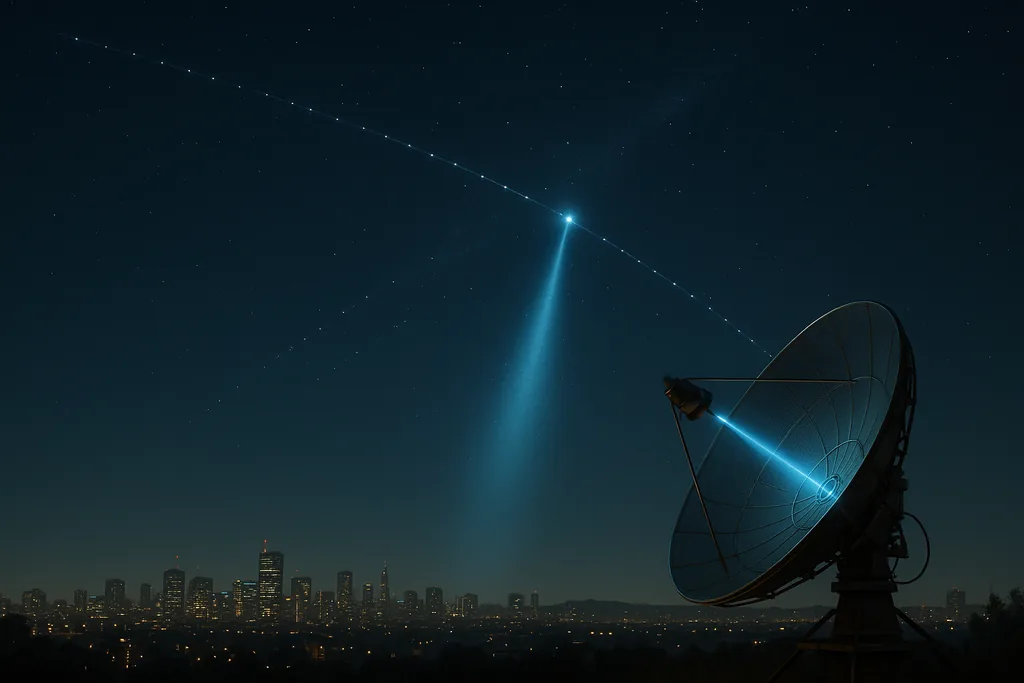
How a hobbyist caught a surprising signal
When Canadian amateur satellite tracker Scott Tilley flipped his radio to an uncommon band late one evening, he expected nothing. Instead he recorded a steady downlink where there should have been silence. The signal, he found after checking positions with other observers, came from a subset of SpaceX satellites operating under the Starshield program—an unpublicized arm of the company that serves U.S. government customers. The discovery, published by Tilley and shared with the wider tracking community, set off fresh scrutiny over what the satellites are transmitting and whether the emissions conform to agreed international rules.
Wrong band, right away
What makes the recordings unusual is the radio band involved. The transmissions were observed in the 2025–2110 MHz range, a slice of spectrum typically earmarked for uplinks—short bursts of ground-to-space traffic used to send commands or data up to a spacecraft. Tilley, and the group of amateur trackers he collaborated with, concluded that the satellites were sending data back to Earth in that band—effectively doing downlinks on uplink frequencies. That mode of operation falls outside routine expectations and the allocations coordinated by international spectrum authorities.
Who are the transmitters?
Starshield is the classified sibling of the Starlink constellation: a set of SpaceX-built satellites sold or leased to U.S. national-security customers for imagery and communications tasks. Reporting over the past two years shows a multi‑hundred‑satellite program funded under contracts with U.S. agencies. The satellites that Tilley identified are cataloged in public tracking databases but have not been openly described in technical detail by the operator or the government.
How the signal was documented
Tilley recorded short audio-like captures and shared his findings on an open research repository so that other satellite operators and amateur observers could inspect the evidence. The recordings showed consistent structure across dozens of satellites, suggesting coordinated use of the same unconventional band rather than random leakage from a single device. Tilley and others emphasize that the discovery was accidental—made while he was testing equipment on a frequency that is normally quiet from orbit.
Why experts are worried
There are two immediate technical concerns. First, using a band reserved for uplinks as a downlink risks creating interference with legitimate ground‑to‑space traffic. In congested low Earth orbit, a stray downlink could be picked up by another satellite’s receiver or by mission control, potentially degrading communications or complicating command sequences. Second, regular emissions in a normally quiet band make the satellites' positions and activity easier to detect; that can reveal the location of classified assets and raise operational-security questions. Experts who have examined the data say there is no public evidence yet that other missions have been harmed, but the potential is real.
Context: Starlink's radio footprint
This episode echoes earlier findings about unintended electromagnetic emissions from the broader Starlink family. Radio astronomers using low‑frequency arrays detected emissions from first‑generation Starlink satellites, and follow‑up work has shown the second generation can be even brighter in some bands. Those studies focused on leakage and broad‑band pollution that can interfere with radio‑astronomy experiments—not deliberate downlinks sent on the wrong allocation. Still, the pattern underscores how quickly a new class of mass‑produced objects in low Earth orbit can reshape the radio environment that astronomers and satellite operators rely on.
Legal and procedural questions
Radio frequencies used in space are coordinated through international mechanisms intended to prevent harmful interference. National regulators and the International Telecommunication Union maintain records of which frequency bands are assigned for uplink, downlink and other services. Deviating from a registered plan without notifying other users is problematic because it undercuts the negotiated order that keeps signals from colliding. Observers note that classified programs sometimes operate under different procedures, but that raises the question of how secrecy and spectrum stewardship should coexist in an increasingly congested space domain.
What we still do not know
- Why Starshield satellites would be configured to transmit on an uplink band rather than on standard downlink allocations.
- Whether the practice is intentional, an engineering shortcut, or a temporary test mode.
- Whether any operators have registered concerns or logged anomalous command failures that could be traced to these emissions.
Neither SpaceX nor the government agencies associated with Starshield have publicly explained the signals or disputed Tilley’s measurements. The absence of comment is common with classified programs, but it leaves the technical community without authoritative clarification at a time when many different actors are pushing hardware into low Earth orbit.
What comes next
At a minimum, the discovery will likely prompt a mix of private inquiries and public questions. Satellite operators routinely monitor spectrum use and report harmful interference through national regulators; if an operator were to experience degraded performance, a formal complaint could trigger investigations and, in some jurisdictions, enforcement. Astronomers and radio‑observatory operators will continue to measure and model emissions to quantify risk to science facilities. More broadly, the episode revives policy debates about how to reconcile classified national‑security activities with the transparency that spectrum coordination requires.
Why this matters
Final thoughts
Scott Tilley’s accidental detection is a reminder of the role hobbyists and small independent observatories play in monitoring the space environment. It also shows how quickly new behaviours can surface when private and public interests intersect in orbit. Whether the transmissions reflect a purposeful tactic, an operational shortcut, or an unresolved engineering issue, they will force conversations about transparency, responsibility and the technical safeguards needed to protect a crowded and contested domain hundreds of kilometres above Earth.
Mattias Risberg is a Cologne‑based science and technology reporter for Dark Matter. He covers satellites, space policy and the technical challenges that arise when commercial and government programs share the sky.