Skin Cells Reprogrammed into Human Eggs
Scientists make eggs from skin — but not yet ready for patients
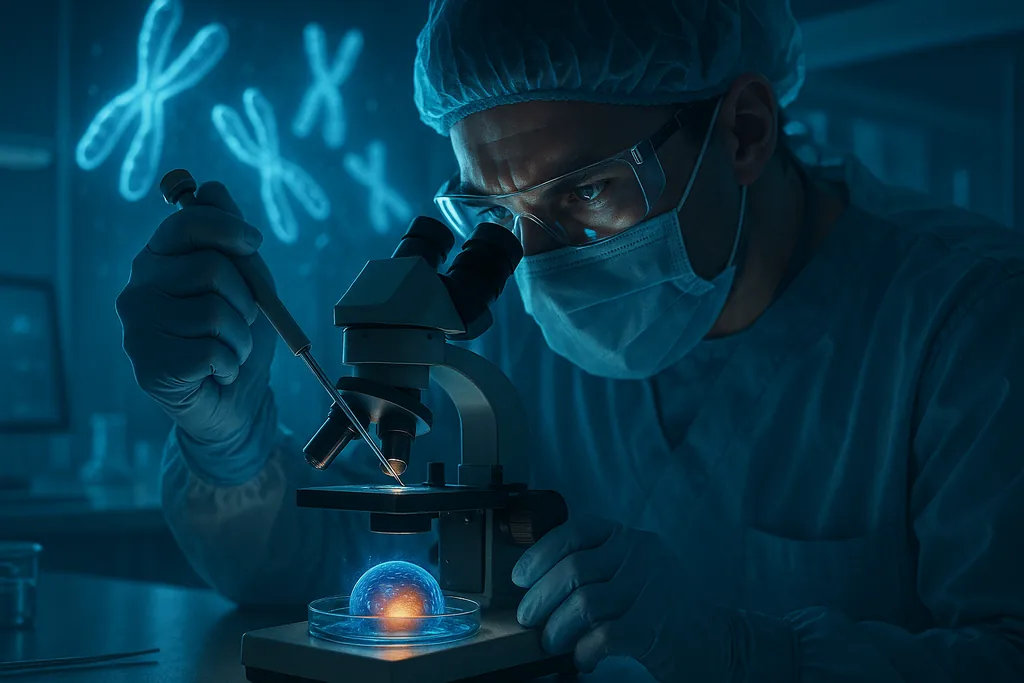
In late September 2025 a team at Oregon Health & Science University published an experimental study showing that nuclei taken from adult human skin cells can be placed into donor eggs and coaxed to behave like reproductive cells. The group used somatic cell nuclear transfer — the same basic laboratory trick behind cloning — together with a deliberately induced reductive division the authors call "mitomeiosis" to discard roughly half the chromosomes and produce eggs that could be fertilized in vitro. The experiment produced early embryos in the lab, but those embryos carried widespread chromosomal abnormalities and were not grown beyond the preimplantation stage.
How the method works, in plain language
Normal body (somatic) cells carry two full sets of chromosomes. Gametes — eggs and sperm — carry one. To produce an egg from a somatic nucleus the researchers removed the nucleus of a mature donor egg and replaced it with the nucleus from a skin cell. The egg cytoplasm then forces the transplanted nucleus into a metaphase-like state. Instead of the standard mitotic or meiotic routes, the team induced an experimental reductive division ("mitomeiosis") and used an activation protocol to allow half the chromosomes to be extruded into a polar body while the rest remained in a haploid-like pronucleus. That pronucleus could then be fertilized with sperm in the laboratory. The authors describe how a selective cyclin‑dependent kinase inhibitor (roscovitine) and electroporation were needed to overcome an arrest and permit the reductive division to proceed.
What they achieved and what went wrong
The team reported producing 82 reconstituted oocytes that were then fertilized. Most arrested early; about 9% made it to the blastocyst stage six days after fertilization — the point at which embryos are typically considered for transfer in IVF clinics. Crucially, genomic sequencing revealed that chromosome segregation during mitomeiosis was essentially random: some embryos retained near-haploid complements, some kept a full diploid set, and many carried unbalanced or missing chromosomes. Those aneuploidies and mosaic patterns explain why none of the laboratory embryos were suitable for transfer or further development. The authors and university press materials stress this is a proof of concept, not a clinical technique, and estimate many years of work remain before safety and efficacy could be considered for people.
Why this is scientifically interesting
The result is noteworthy because it demonstrates that human somatic genomes can be forced into a reductive, gamete-like state inside an egg cytoplasm — something many researchers considered extremely difficult or impossible. It is a distinct path from the more widely discussed route to lab-made gametes that uses induced pluripotent stem cells (iPSCs) and then differentiates those cells into germline progenitors. Somatic cell nuclear transfer (SCNT) bypasses the long developmental timeline required to convert iPS cells into oocytes and leverages the mature egg's cytoplasm — which carries maternal factors necessary for early embryonic reprogramming. Still, the study shows those maternal factors alone do not guarantee faithful chromosome pairing and recombination, processes that in natural meiosis help ensure balanced chromosome sets.
Technical hurdles that matter
- Random segregation and no recombination: Sequencing showed homologous chromosomes segregated randomly without the crossover recombination that meiosis uses to pair and exchange DNA between homologs, which undermines genomic integrity.
- Aneuploidy and mosaicism: Many embryos had too few or too many chromosomes or mixtures of cell lineages carrying different chromosome counts, both of which typically prevent normal development.
- Low efficiency: Only a small fraction of manipulated eggs formed blastocysts, and most arrested at very early cleavage stages. Further work is required to raise both precision and yield.
Potential applications, and why the timeline is long
If the underlying problems could be solved, the technique could in principle create genetically related eggs for people who lack viable oocytes—such as some cancer survivors, older women whose eggs no longer produce healthy embryos, or individuals in same‑sex partnerships seeking a genetically related child. But the authors and independent experts have been careful to emphasize the distance between a laboratory proof of principle and any clinical use. They point to the chromosomal errors and regulatory and ethical complexities and estimate that at least a decade of preclinical research would be needed before any human trial might even be considered, assuming such trials were permitted. Institutional review and ongoing oversight governed the study itself.
How this fits into global work on in vitro gametogenesis
Researchers around the world pursue different routes to lab‑made gametes. Some groups aim to make eggs from iPS cells using stepwise differentiation and complex co‑culture with ovarian somatic cells; others have demonstrated functional oocytes in mice using entirely in vitro methods. Mouse work shows full-term development is possible in principle, but translating those recipes to human biology has been stubbornly difficult because human germ cell development is slower and differently regulated. The new SCNT/mitomeiosis approach is an alternative path that highlights both the creative technical options and the steep biological roadblocks in this field.
Ethics, regulation and public debate
Any method that produces fertilizable human eggs raises legal and ethical questions about embryo research, reproductive use, and the social implications of engineered gametes. Commentators and policy bodies have called for broad public engagement, transparent oversight and clear regulatory frameworks before attempts are made to use such techniques in reproduction. The authors note their study was carried out under institutional review board supervision and a data‑safety committee, but they also acknowledge societal debate will be necessary as the science moves forward.
Bottom line
The OHSU study demonstrates a creative, technically novel route that can produce human eggs containing genomes derived from adult skin cells — a milestone in laboratory reproductive biology. But the noisy signal in the chromosomes — random segregation, aneuploidy and low efficiency — is a clear reminder that proof of concept is far from proof of safety or readiness. The path from a lab result to ethical, regulated clinical use runs through substantial biological work and extended social and regulatory discussion. For now, the paper is best read as an important experimental advance that opens more questions than it yet answers.