Starlink begins a preemptive descent
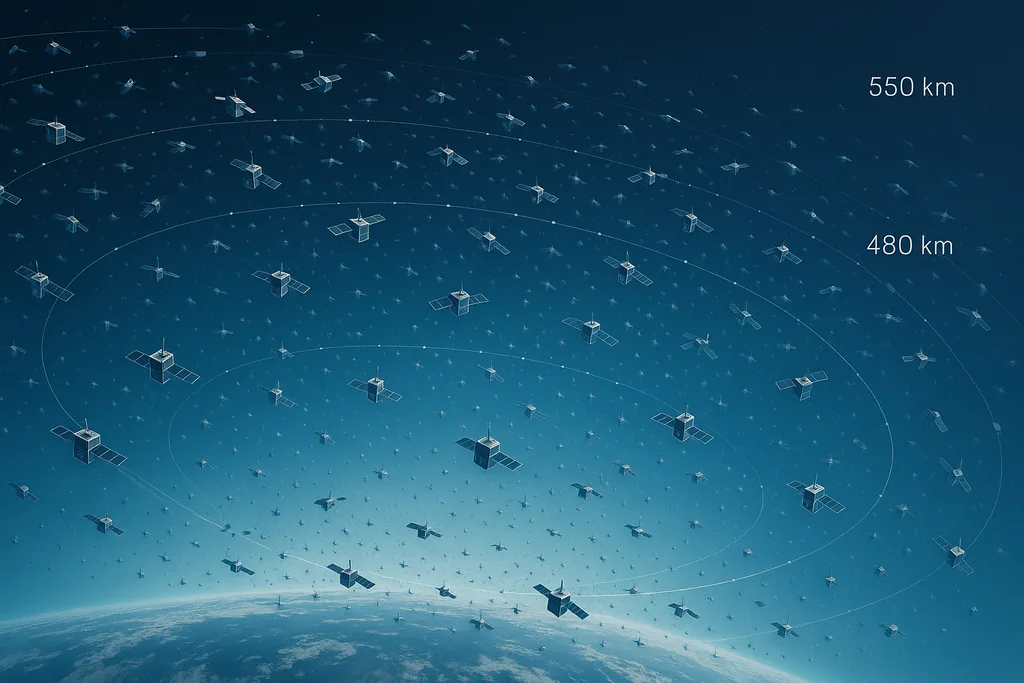
On January 1, 2026, Michael Nicolls, vice‑president of Starlink engineering, announced on X that SpaceX will lower all Starlink satellites currently orbiting near 550 kilometres down to roughly 480 kilometres over the course of 2026 — a programme Nicolls described as a "significant reconfiguration" intended to improve space safety. The change will affect about 4,400 satellites in the layer that has hosted many of Starlink's operational spacecraft and was framed by the company as a way to reduce collision risk and shorten how long defunct craft remain in orbit.
What triggered the decision
The move follows two alarming episodes in December 2025: a very close approach in which a newly launched Chinese spacecraft passed within an estimated 200 metres of a Starlink satellite, and a separate Starlink anomaly in mid‑December that appears to have involved an internal energetic event and produced a handful of trackable debris fragments before the satellite tumbled and reentered the atmosphere. SpaceX has said the close pass highlighted persistent gaps in cross‑operator coordination, while the malfunction underscored why faster automatic removal of failed hardware can matter for overall orbital hygiene.
How lower altitude improves safety
Lowering the orbital shell changes the physics and the operational geometry in ways that can make collisions less likely and failures less durable. In a nutshell: below about 500 km there are currently fewer large debris objects and fewer planned new constellations, so the statistical chance of encountering an external object falls. Separately, atmospheric drag is stronger at lower altitudes; during a forthcoming solar minimum that drag will still be greater at 480 km than at 550 km, which SpaceX says will cut the ballistic decay time of a defunct satellite by more than 80% in that environment — dropping a satellite's uncontrolled lifetime from years to months and therefore lowering the window in which it might become a hazard. Those are the principal safety arguments Nicolls laid out.
Operational mechanics and customer impacts
Executing a coordinated descent of thousands of satellites is an operational challenge that touches propulsion usage, collision‑avoidance planning, and customer service. SpaceX says the reconfiguration will be staged throughout 2026 and tightly coordinated with other operators and U.S. authorities to avoid creating new conjunctions while satellites relocate. Flying a bit closer to Earth can also modestly reduce signal latency and increase signal strength for a given ground terminal and beam‑forming configuration, potentially improving service in dense customer areas — a point company leadership has flagged as a secondary benefit. Nonetheless, moving many spacecraft consumes propulsive life and requires careful timing so that the constellation geometry still provides continuous coverage as shells shift.
Technical tradeoffs and risks
Lower altitude is not a panacea. Satellites closer to Earth experience higher atmospheric drag and temperature cycling, which can increase fuel usage for station‑keeping and shorten operational life if not managed. The manoeuvre must be choreographed to avoid squeezing satellites into denser relative geometry within the 480 km layer — a compression that, if mismanaged, could raise local conjunction rates. The plan's safety gains depend on accurate tracking, predictable satellite behaviour, and other operators sharing timely orbital data; gaps in any of those elements would blunt the expected benefits.
Industry coordination and geopolitics
Space traffic management is a patchwork today: operators largely rely on shared tracking data and voluntary deconfliction; there is no single global authority with binding rules for commercial constellations. Nicolls explicitly cited a lack of ephemeris sharing after the Chinese rideshare launch as a proximate reason for pressing the case to move satellites into a thinner, supposedly safer layer. That episode illustrates how technical safety choices are entangled with international diplomacy and national‑security concerns — China and other states have pushed back at times, arguing commercial constellations themselves create novel risks. The descending of thousands of satellites therefore becomes a unilateral mitigation step with visible cross‑border implications.
Astronomical and public‑interest consequences
Lowering large numbers of reflective objects closer to Earth will change how the night sky looks from the ground. Satellites at lower altitude can appear brighter for brief passes because of geometry, and denser orbital layers increase the chance multiple satellites will be visible along a single track. Astronomers and dark‑sky advocates have repeatedly warned that megaconstellations already complicate long‑exposure observations and optical surveys; compressing shells will require renewed attention to mitigation practices such as darker satellite coatings, operational blackout windows during critical observations, and better predictive flagging of passes for observers. The move thus shifts part of the responsibility for preserving the night sky back onto operators and regulators.
How regulators and militaries will figure
SpaceX says it has coordinated the plan with U.S. regulators and space‑domain authorities; public reporting indicates the company discussed the shift with U.S. Space Command and other domestic agencies. Those conversations are important because large orbital reconfigurations can temporarily change traffic patterns and strain shared tracking resources. Militaries and civil agencies that maintain catalogs of tracked objects must be kept in the loop so conjunction analyses remain accurate across operators. For the wider community, this episode stresses the urgency of improving both technical systems for automatic deconfliction and international modalities for sharing ephemeris data in near‑real time.
What to watch in 2026
Key indicators to follow as the programme unfolds include: whether the descent actually follows the phased timeline SpaceX outlined; whether the compressed 480 km shell produces more or fewer close approaches per month; how much additional propellant the manoeuvres consume and whether that affects replacement cycles; and whether other operators emulate the strategy or instead spread satellites to other altitudes. Independent trackers and national space agencies will be able to measure debris trends and conjunction counts to judge if the initiative delivers the stated safety improvements. If it does, the move could become a template for operator‑led mitigation during the low point of the solar cycle; if it does not, it will sharpen calls for binding international rules.