Stealth Solar Storm Hits Earth Unexpectedly
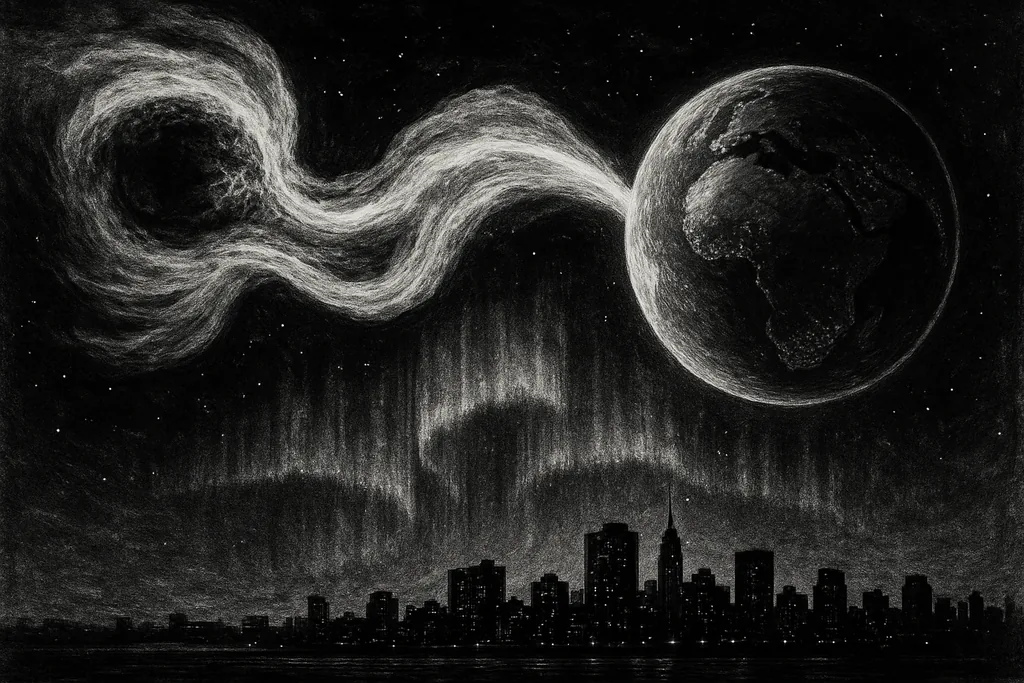
Quiet on the Sun, a Ripple at Earth
On November 20, 2025, instruments monitoring the near-Earth solar wind registered a sudden, short-lived disturbance that arrived with virtually no advance notice. Forecasters noted an unusual spike in the interplanetary magnetic field and a modest uptick in solar wind speed — the kind of signature you see when an unheralded coronal mass ejection (CME) slips past our planet without the dramatic fireworks that normally flag such eruptions.
What actually arrived?
Data showed the ambient magnetic field briefly climbing to levels several times above its background value and solar wind speeds hovering well above typical quiet-Sun numbers. Observers described the pattern as a high-speed stream from a coronal hole with a likely "embedded transient" — the operational phrasing for a weak, slow CME that was not obvious in solar imagery but nevertheless changed conditions near Earth. The disturbance did not escalate into a major geomagnetic storm, but it was enough to nudge auroral ovals farther equatorward than usual in places.
Auroras where you don't usually expect them
The subtle arrival coincided with eyewitness reports and photographs of northern lights from locations outside their typical high-latitude bands. Observers in parts of North America and northern Europe recorded red and purple displays, and the timing of those observations lines up with the transient signature recorded in the solar-wind monitors. For forecasters and skywatchers this was a reminder: even small, unseen disturbances can produce visible effects on the ground.
What makes a CME "stealthy"?
Why they slip through the net
- No bright flare: The eruption mechanism often doesn't include a bright solar flare that would trigger alerts.
- Low optical contrast: The cloud forming the CME can be faint against the background corona and therefore hard to spot in coronagraph data.
- Slow and diffuse: Many stealth CMEs expand slowly and are embedded inside broader solar-wind structures, masking their identity until they interact with Earth's magnetosphere.
How common are these stealth eruptions?
Stealth CMEs are not brand-new phenomena; researchers have been investigating them for a decade and more. Several studies and a broad review of Earth-affecting solar transients show that stealth events become relatively more likely when the Sun moves toward the declining phase of its 11-year activity cycle, when quiet-Sun magnetic configurations are more prevalent. That phase makes forecasting harder because the usual visual cues on the solar disk become rarer.
Practical impacts — why we should care
Although the November 20 event was modest and produced no reported damage, stealth CMEs can still matter. When an otherwise quiet CME carries a strongly oriented magnetic field — especially if its north-south component points south — it can couple efficiently with Earth's magnetic field and trigger larger geomagnetic storms. Those storms can disturb satellite electronics, affect radio communications, change high-frequency aviation links, and in extreme cases induce currents in long terrestrial conductors. The unpredictability of stealth events increases operational risk because they short-circuit standard early-warning chains that rely on clear solar imagery.
Fixing the blind spots
Scientists point to several approaches that can reduce the stealth problem. Multi-angle observations — for example, views from spacecraft positioned away from the Sun-Earth line — improve the chance of seeing faint, slowly evolving ejecta. Combining remote sensing with improved models of the low-coronal magnetic field and real-time in-situ solar-wind monitoring can also help identify embedded transients sooner. There is also interest in applying machine-learning techniques to subtle multi-wavelength signals that human analysts might miss. None of these is a silver bullet, but together they narrow the window of surprise.
What this means for operators and the public
For satellite operators, power-grid managers and airlines, the practical message is simple: stealth events sharpen the case for resilient design and operational contingency. Forecast teams will continue to flag likely impacts when small transients appear in solar-wind monitors, and routine mitigation steps (changing satellite modes, assessing HF radio plans, and readying grid operators) remain sensible even for short-lived, modest storms. For the public, the takeaway is more benign: rare patches of aurora can appear when you least expect them — and on nights like November 20 they can produce unexpectedly beautiful skies.
Looking ahead
The November 20, 2025 disturbance is a timely reminder that not all space weather announces itself with a bang. As the solar cycle evolves, forecasters and researchers will be watching both the visible signs on the Sun and the whispering changes in the solar wind. Improving detection of stealth eruptions is an active area of research because the cost of being surprised — whether for satellites, airlines or power infrastructure — can be high. For skywatchers, though, a little surprise now and then just means an extra chance to catch the lights.
James Lawson is an investigative science and technology reporter at Dark Matter, based in the UK. He holds an MSc in Science Communication and a BSc in Physics from UCL.