Physicists outline tabletop analogue to witness particle creation from vacuum
Physicists outline tabletop analogue to witness particle creation from vacuum
Summary
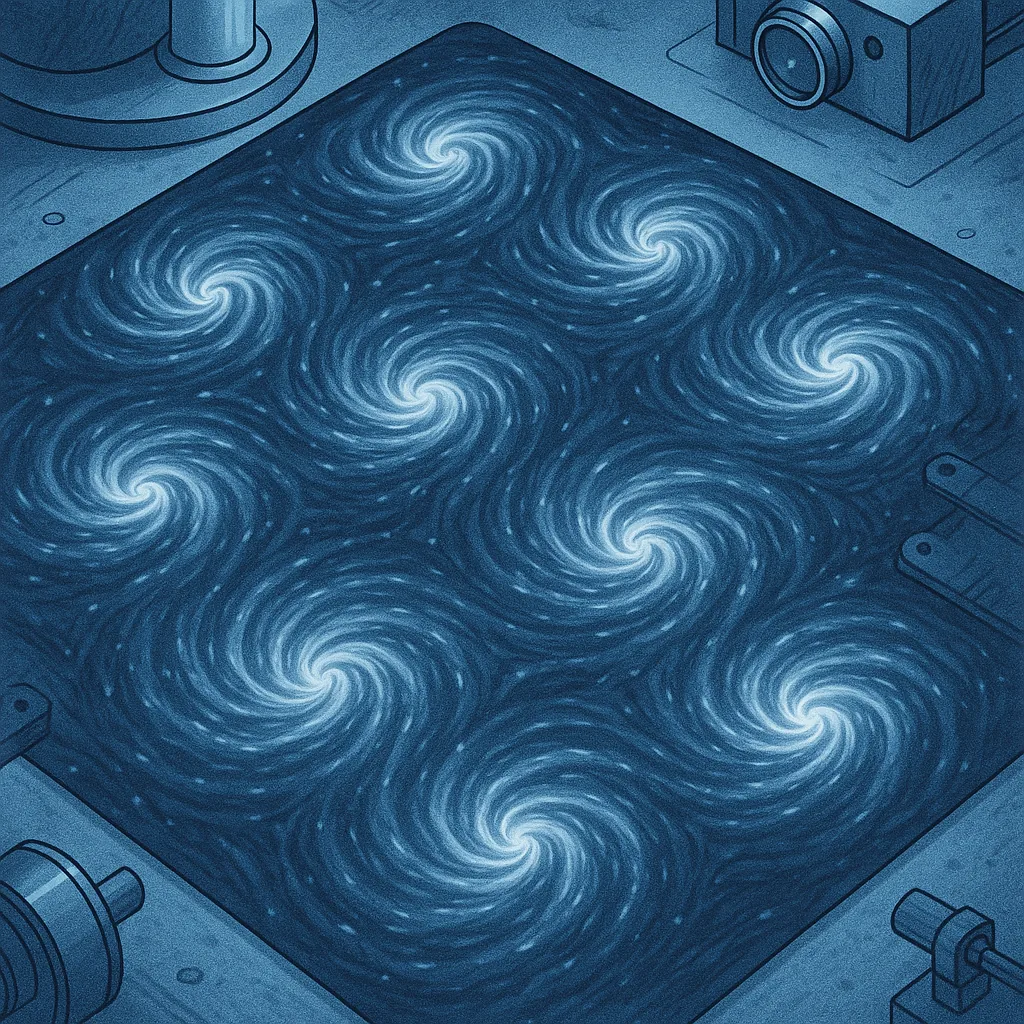
A group of theoretical physicists argues that a thin film of superfluid helium can serve as an analogue system for the Schwinger effect, the prediction from quantum field theory that a sufficiently strong field can convert vacuum fluctuations into real particle–antiparticle pairs. In the superfluid film, the analogous process would produce vortex–antivortex pairs that could be produced and observed in a cryogenic laboratory rather than requiring the extreme electromagnetic fields needed to create electron–positron pairs.
Why this matters
- Experimental accessibility: Thin superfluid helium films and cryogenic techniques are standard in many low-temperature laboratories, making direct tests more practical than recreating the astronomical field strengths of the original Schwinger scenario.
- Probing tunnelling dynamics: The analogue offers a controlled setting to study nucleation and tunnelling phenomena that are otherwise difficult to access in high-energy or cosmological experiments.
- Cross-disciplinary insight: Because similar mathematical structures appear across quantum field theory, condensed matter and cosmology, tabletop observations could inform models of early-universe transitions and related nonequilibrium phenomena.
Key theoretical advance: variable vortex mass
How an experiment could look
In a laboratory implementation, a thin superfluid helium film would be cooled and prepared under controlled conditions, and a time-dependent drive or gradient would be applied to create an effective force analogous to a strong field. Under those conditions, the film could nucleate bound vortex–antivortex pairs; their creation and dynamics could be detected using established low-temperature imaging and diagnostic techniques sensitive to flow, density variations or local excitations.
Limitations and caveats
Analogue systems reproduce key mathematical features but do not replicate all physical ingredients of quantum electrodynamics. The superfluid lacks electric charge, relativistic dispersion and other properties of electrons and positrons, so quantitative extrapolations to electron–positron creation are not direct. The proposal is valuable both as an analogue of vacuum tunnelling and as a contribution to understanding vortex dynamics within condensed matter.
Outlook
The proposal gives a concrete, experimentally accessible route to study tunnelling-driven nucleation in a condensed-matter system. Successful observations would test aspects of nonequilibrium field dynamics and could strengthen links between laboratory experiments and broader quantum-field phenomena.