The 10‑Second Phone Charge: Hype vs. Reality
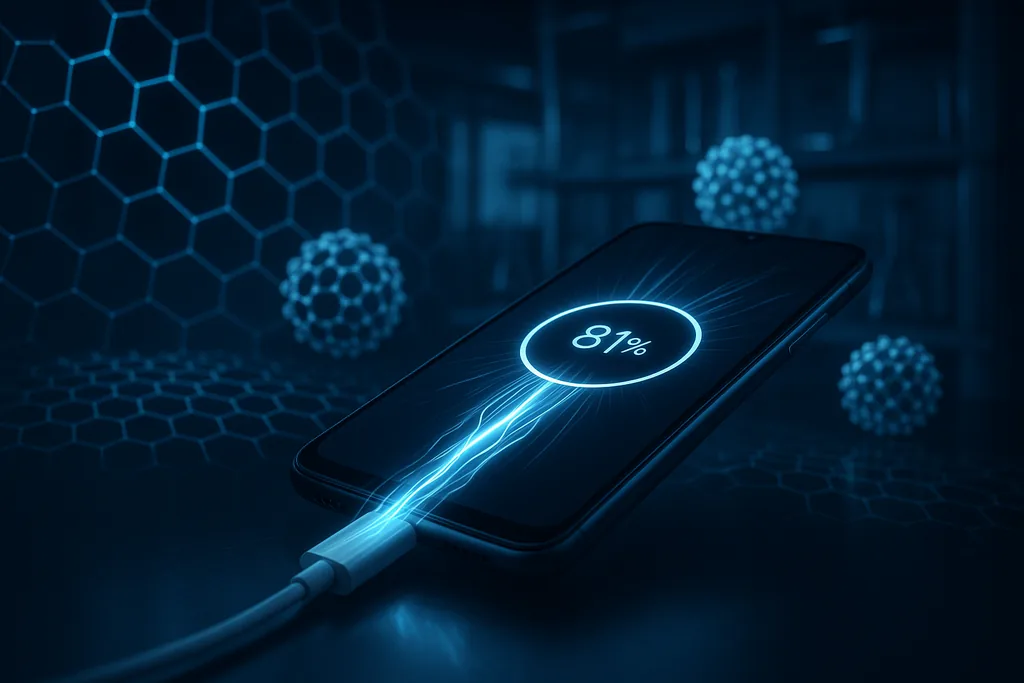
What people mean when they say “charge a phone in 10 seconds”
Headlines promising a full smartphone charge in ten seconds circulate every few years. They usually spring from two places: striking lab demonstrations of tiny prototype cells and optimistic claims about new materials or charging architectures. Those results are real in the laboratory sense, but they do not mean your next phone will be replenished in the time it takes to tie your shoes.
Lab flashes and real devices are very different
Some of the earliest striking demonstrations came from experiments that made battery electrodes out of nanoscale structures. In one high‑profile case researchers showed that a very small test cell could be recharged in about ten seconds by giving ions many short, fast pathways to travel through. That experiment proved a materials concept—fast ion transport and high surface area can drastically shorten charge times for a tiny cell—but it did not scale to an industrial smartphone pack at the time.
Materials breakthroughs that actually move the needle
Other research directions have produced more immediately practical prospects. Work on graphene‑based electrodes created a three‑dimensional “graphene ball” structure that helps batteries accept current much faster and tolerate higher temperatures; the authors argued the technique could reduce full charge times from an hour to the order of minutes in larger cells. That kind of materials engineering improves the trade‑off between energy stored and the rate at which you can put energy in.
Industry demos: minutes, not seconds
When companies demonstrate “fast charging” for cars or phones today, they typically mean minutes rather than seconds. In 2024 a battery company and an automaker showed a roadworthy car charged from 10% to 80% in about ten minutes using purpose‑built cells and very high‑power chargers. Those demonstrations are important: they show fast chemistry can work in real vehicles, not just in single cell test rigs—but the power levels involved and the engineering around thermal control are orders of magnitude larger than what shoppers plug into their phones.
Why ten seconds is such a steep hill
Two simple physical facts explain why a full 10‑second phone charge is challenging. First, energy has to flow into the battery, and power is energy per unit time. A typical modern smartphone battery stores on the order of 10–20 watt‑hours (Wh). To put 15 Wh into a battery in 10 seconds would require an average power of roughly 5.4 kilowatts, not counting conversion losses—more than a typical household microwave and far above what a USB plug or phone connector can deliver comfortably. Second, that power becomes heat whenever systems are imperfect: resistive losses in the cable, electrodes and electronics will heat the cell unless managed at scale.
Infrastructure and safety limits
Pushing kilowatts through a tiny phone connector raises practical problems. Cables, connectors and the phone housing would need to handle extreme currents and heat. Battery chemistry itself also limits how fast a cell can be charged without degrading rapidly or forming dangerous structures (like lithium dendrites that can short a cell). Charging protocols and battery management chips can moderate these effects, but they cannot eliminate the underlying physics. As a result, manufacturers and standards bodies place caps on charging currents to balance speed, lifetime and safety.
Technical paths that could make multi‑minute charging normal
Researchers and startups pursue several parallel strategies that could cut charging times from hours to minutes.
- Nanostructured electrodes: Increasing electrode surface area and shortening ion pathways lets a cell accept more current without huge voltage drops; that’s the idea behind nanoballs, graphene layers and other micro‑architectures. Successful lab examples prove the approach works at small scale.
- New anodes and electrolytes: Silicon‑rich or silicon‑dominant anodes and lithium‑metal architectures pack more capacity and can accept faster charging if the electrolyte and interfaces are engineered to prevent dendrites and side reactions. Some solid‑state designs also aim to remove liquid electrolytes that can degrade under aggressive fast charge cycles. Recent university research and spin‑out companies have highlighted lithium‑metal solid‑state cells that tolerate thousands of cycles while charging far faster than legacy cells.
- Hybrid supercapacitor–battery systems: Supercapacitors store energy electrostatically and accept charge in seconds, but they hold far less energy per volume than batteries. Hybrids try to combine the capacitor’s power density with the battery’s energy density so a device can take a quick top‑up and then trickle energy into the battery over minutes without overheating.
- System‑level engineering: Fast charging at scale needs matching chargers, thermal management, software controls and safety certification. For EVs this means high‑power charging stations and cooled battery packs; for phones it would mean rethinking connectors and enclosure materials as well as charging infrastructure at cafés and homes.
What fast‑charge reality looks like for consumers
Because of the power and heat constraints, the realistic near‑term improvements for phones are incremental: shorter top‑ups (for example, large percentage gains in 5–15 minutes), higher effective battery lifetime through better chemistry, and faster wireless or wired charging measured in minutes rather than seconds. Companies that aim at extreme fast charging for cars expect to make practical systems available in the next few years; those lessons may trickle down to pocket electronics, but not instantly.
Why the cautious headlines matter
Sensational headlines help sell clicks but obscure two important truths: first, that small‑scale lab results and cellular phone demonstrations are not the same as a globally producible consumer product; and second, that making batteries accept energy faster without shortening their life or making them unsafe requires coordinated advances in materials, cell design, thermal engineering and charging infrastructure.
Bottom line: minutes, then better longevity
A future where topping up a phone in a few minutes is routine is plausible within a decade if current materials and packaging progress continue. A true ten‑second full charge, across the board and safely, remains highly unlikely without a radical shift in how energy is delivered and stored—because it runs straight into power, heat and safety physics. For users, the near‑term payoff will be faster top‑ups, better battery longevity and fewer battery‑anxiety moments—practical improvements that matter more than a flashy stopwatch claim.
— Mattias Risberg, Cologne