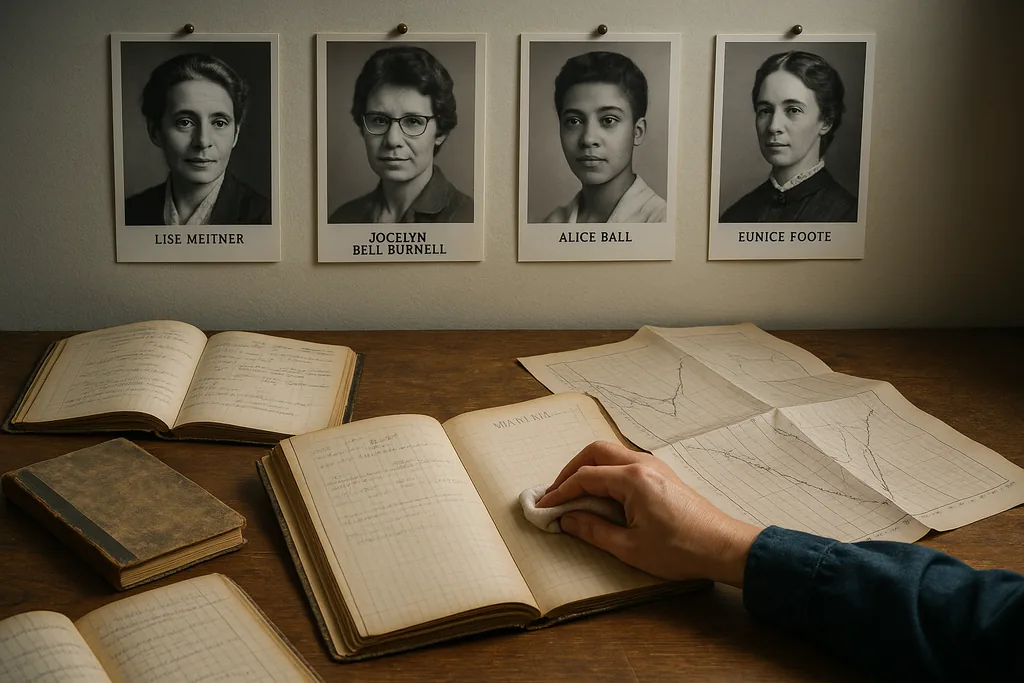
They built the lab, then lost the story
In classrooms and museum plaques this month, familiar names are getting new footnotes. Textbooks still often present nuclear fission, pulsars, the greenhouse effect and early leprosy therapies with a neat set of discoverers — usually men. But a wave of historical recovery that surfaced again today traces a different pattern: the experiments were sometimes designed, run or interpreted by women whose work was sidelined, misattributed or quietly purged from official accounts.
The Matilda Effect, in context
The pattern has a name. In 1993 historian Margaret Rossiter coined the term "Matilda Effect" to describe the systematic denial of recognition to women scientists — named after 19th‑century suffragist Matilda Joslyn Gage, who had insisted that women did invent and discover. Rossiter’s work showed that this is not a handful of anecdotes but a reproducible bias across institutions and centuries: prizes withheld, publications hidden or delayed, and credit shifted to better‑placed male colleagues.
That structural erasure shows up in three overlapping ways. First, institutional gatekeeping — universities, academies and funding bodies routinely excluded women, or treated their work as secondary. Second, authorship and credit norms that privileged supervisors or senior men even when students or junior colleagues did the experimental heavy lifting. Third, social framing and media coverage that turned women into "human interest" distractions rather than lead investigators.
Stories that keep resurfacing
Across eras and disciplines the pattern looks familiar. The Austrian‑born physicist Lise Meitner led the experiments and supplied the theoretical interpretation that explained nuclear fission; Otto Hahn received a Nobel Prize and the popular credit. In climate science Eunice Newton Foote published experiments in 1856 showing carbon dioxide traps heat, but contemporary accounts described her as a "lady" experimenter and later histories elevated John Tyndall as the founder of the field. In astronomy, Jocelyn Bell Burnell found the first radio pulsars in 1967 while scanning miles of chart recorder paper; the Nobel committee later recognised her supervisor, Antony Hewish. In medical chemistry, Alice Augusta Ball devised an injectable, water‑soluble derivative of chaulmoogra oil that became the most effective early treatment for leprosy - then colleagues removed her name from the method after her premature death.
These are not isolated cultural misreadings. Esther Lederberg’s breakthroughs in bacterial genetics were foundational to later Nobel‑level work; Rosalind Franklin’s X‑ray images were critical to the structure of DNA; both are repeatedly cited as cases in which credit and prize culture refused to follow the actual evidence chain.
How the erasure happens
The mechanisms are mundane and institutional. Authorship conventions in the 19th and 20th centuries - and in some cases today - left students, technicians and postdocs off bylines. Supervisors and administrators held sway over who saw internal reports and who had access to publication venues. Scientific journalism and conference practice historically filtered women into soft‑profile roles: articles would ask female researchers about family life, or describe them as "novelties," while treating technical questions to men.
Racism compounds the problem. Alice Ball’s story shows how race and gender intersected: archival records, local press habits and assumptions about identity helped suppress her name for decades. In such cases, rediscovery depends on patient archival work and the willingness of institutions to correct the record.
Correcting names on plaques is not only a matter of fairness; it reshapes who chooses science and how research careers develop. Role models that reflect real diversity increase the likelihood that talented students from underserved backgrounds will see science as open to them. Accurate attribution also matters for the historical tracing of ideas: who first conceived a concept, who ran the decisive experiment, and which lab practices produced reproducible results — those are the signals historians and policymakers use to understand how science actually advances.
There are practical downstream effects as well. Prize committees, hiring panels and funding agencies use reputational records - citations, notable awards, and published first authorships — when making decisions. Centuries of biased recognition thus feed into contemporary disparities in grant success and leadership roles.
How the record is being rewritten
Over the last two decades, researchers and civic actors have pushed back. Historians comb archives, librarians digitise lab notebooks, and community researchers assemble databases of neglected scientists. In several cases that led to public corrections: plaques and days of commemoration, plaques added to university buildings, and the inclusion of previously omitted names on institutional friezes. Some funders and prize bodies have begun discussing more transparent documentation of contributions when they award honours.
Individual choices matter too. In a striking recent example, an accomplished astrophysicist who had been excluded from a Nobel prize later used a large prize award to establish graduate scholarships specifically for women, minorities and refugees entering physics - a material response aiming to change the pipeline rather than merely annotate history.
Practice changes that could reduce future erasure
Historians and scientists point to concrete policy interventions. Clearer authorship statements and contribution declarations — already standard in some journals — should follow through across all fields. Prize committees and academies can require documentation of who built, ran and analysed critical experiments. Funders can prioritise the recovery and digitisation of primary lab records so that credit flows to the archived evidence rather than institutional memory. And curricula need updating: teaching the true complexity of discovery, not a set of heroic names, gives students a realistic model of teamwork and responsibility.
These are modest technical fixes compared with the cultural work required: equal access to mentorship, safer lab conditions for all, and media coverage that treats women scientists as scientists first. But the technical fixes make it harder for good work to be lost in the noise.
What recovery looks like
Recovering missing names is often a detective story. In the case of Alice Ball it took community historians and retired researchers to stitch together scattered departmental files and newspaper mentions; that archival recovery eventually led to commemorations at her university and new public awareness. For Eunice Foote, republication of her 1856 paper and contextual essays have placed her within the prehistory of climate science rather than marginal curiosity. For Meitner and Franklin, scholarly biographies and museum reinterpretations have forced many institutions to reframe exhibits and teaching.
That work also shows the limits of retroactive fixes: recognition decades later does not change the careers denied, but it can change the culture that produces the next generation of scientists.
Correcting the historical record is not mere nostalgia. It is a necessary step to rebuild a meritocracy that actually measures contribution rather than reifying privilege. In science — where reproducibility and provenance are central — the provenance of ideas matters. Names attached to methods and measurements are not just decorations; they are part of the evidence trail that makes science self‑correcting.
Sources
- Cornell University (Margaret Rossiter; Women Scientists in America series)
- American Association for the Advancement of Science (AAAS Proceedings; 1856 presentations)
- Smithsonian Institution (archival research and essays on early climate and gender)
- University of Hawaii (archives and archival restoration relating to Alice Ball)
- University of Bologna / Academy of Sciences (Laura Bassi papers)
- History of Science Society (Rossiter Prize and related scholarship)
- Institute of Physics and Royal Astronomical Society (institutional records and honours)