Time Travel, Explained: Science, Limits, Possibilities
Why time travel still excites physicists
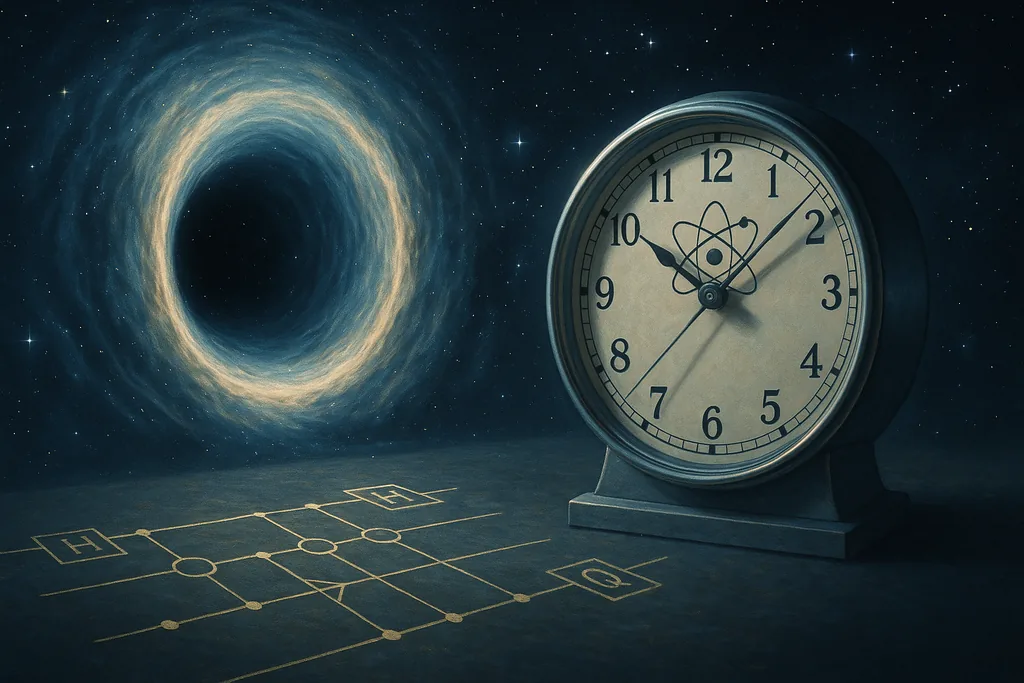
Talk of time machines sounds like science fiction, but the question has pushed some of the deepest physics of the 20th and 21st centuries. General relativity—Einstein’s geometric theory of gravity—permits mathematical solutions in which a world line can loop back on itself. Quantum theory, in turn, raises its own puzzles about causality and information if such loops exist. Over the past three decades researchers have moved from purely theoretical constructions to tabletop experiments that probe the interplay between quantum mechanics and time. The result is a clearer map of what physics allows in principle, what it forbids in practice, and what experiments are now able to test.
What the equations permit: closed timelike curves and exotic spacetimes
In relativity language, “time travel” usually means the existence of closed timelike curves (CTCs): world lines that return to their own past. Several exact solutions to Einstein’s equations contain CTCs. They include rotating-universe solutions, certain idealised rotating cylinders, and theoretical traversable wormholes whose two mouths are arranged so that different clocks at the mouths read different times. Metrics designed for faster-than-light motion—so-called warp drives—also connect to CTCs in many constructions.
These solutions are mathematically consistent, but they come with severe physical caveats. Most violate energy conditions that, in everyday situations, guarantee positive local energy density. To create a traversable wormhole or an Alcubierre-style warp bubble requires forms of stress-energy with “negative” energy density—exotic matter or quantum vacuum effects concentrated in extreme ways. These demands push the constructions into regimes where known physics becomes uncertain.
The physics that might protect causality
Many physicists view the mathematical existence of CTCs as a hint that we are missing an essential dynamical principle. One influential idea is that quantum effects back-react on spacetime to prevent macroscopic causality violations: when a would-be time machine forms, vacuum fluctuations and energy build up in a way that destabilises the setup. The intuition is that the laws that govern matter and quantum fields may conspire to keep paradoxical scenarios from forming—an idea sometimes summed up as a “chronology protection” mechanism.
Even without a full quantum theory of gravity, semiclassical analyses suggest there are practical barriers: the energy and engineering requirements look astronomical, and stability against quantum fields is doubtful. In short, while general relativity allows many exotic geometries on paper, the microphysics and energetic cost probably block their realisation.
Quantum twists: two ways to think about quantum time travel
When quantum mechanics is combined with the idea of CTCs, surprising conceptual possibilities arise. Two broad frameworks have been developed to model how quantum systems would behave if parts of their world lines looped back in time.
These two pictures are mathematically different and lead to different physical and informational consequences. Crucially, neither model requires us to actually build a time machine in spacetime; both serve as thought experiments and, in some cases, as prescriptions that can be simulated in the lab.
Computation, paradoxes and surprising payoffs
Studying CTCs has yielded unexpected insights into computation. If CTC-like behaviour were available as a physical resource, it would radically alter computational power: certain models show that access to time-loop resources could let machines solve problems considered intractable today. That result has helped researchers probe the boundaries of computational complexity and sharpen our understanding of what physical laws imply for information processing.
On the paradox front, quantum formulations often avoid classical contradictions. Instead of a single inconsistent history, the quantum prescription demands a self-consistent fixed point of the evolution, or else uses probabilistic postselection to remove paradoxical branches. These fixes trade paradoxes for other counterintuitive features—nonlinearity, cloning-like effects, or changes in allowed correlations.
Laboratory simulations: ‘time travel’ for quantum experiments
Here the field has moved beyond pure speculation. Quantum optics and circuit-based experiments can simulate aspects of hypothetical time loops using entanglement, teleportation and postselection. Recent experiments implemented teleportation-based simulations of time-loop protocols and demonstrated practical advantages: for example, they showed how a probabilistic “send-your-input-back” trick can sometimes improve the information a metrologist extracts from a single probe. These results do not make time machines real, but they show that CTC-inspired protocols can be useful tools in quantum sensing and measurement.
Meanwhile, precision clocks have reached sensitivities where relativistic time differences across centimetres or even millimetres are measurable. Optical atomic clocks and proposals for proper-time interferometry bring the quantum and relativistic descriptions of time into experimental reach. This lets laboratories test, in controlled ways, whether the evolution of quantum clocks in different gravitational potentials follows the classical proper-time picture or whether genuinely quantum features of time appear.
What a traveller would actually face
Even in speculative models where CTCs exist, detailed analyses of matter and thermodynamics suggest unpleasant constraints. Some theoretical work argues that systems that loop through their own past would have to reset internal degrees of freedom so that entropy and recorded memories return to their initial states by the end of the loop. In other words, a voyage around a closed timelike curve could erase the traveller’s memories and reverse entropy increases, making the subjective experience of time travel stranger than any fiction.
So is time travel possible?
Short answer: not in any way useful to humans. Long answer: the fundamental equations of gravity and quantum mechanics still admit paths and models that resemble backward time travel, but every physically plausible route runs into constraints—energy conditions, quantum instabilities, Planck-scale unknowns or thermodynamic oddities. What experiments are doing instead is far more productive for science: they’re probing the boundary where quantum theory and relativity meet, using ideas inspired by time-travel thought experiments to build better sensors, to test quantum causality, and to stress-test our theories.
Why this matters
Questions about time travel are not just speculative curiosities. They force physicists to attack the interface of quantum theory, thermodynamics and spacetime structure. That work drives advances in precision timekeeping, in quantum information, and in conceptual clarity about causality and information. Even if tourists from the future never arrive, the research inspired by time-travel puzzles is reshaping how we measure and manipulate time itself.
— Mattias Risberg, Dark Matter