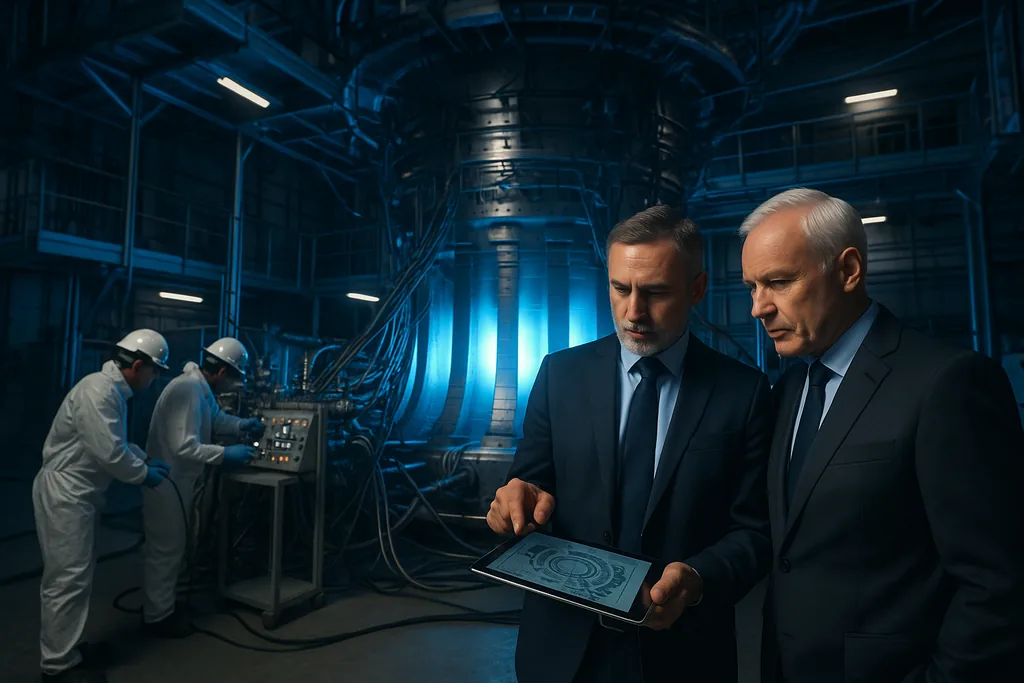
An audacious merger lands on the energy map
On December 19, 2025, Trump Media & Technology Group (TMTG), the public company best known as the parent of Truth Social, unveiled a headline‑grabbing agreement to merge with TAE Technologies in a roughly $6 billion all‑stock deal. The newly combined company — led by TAE chief Michl Binderbauer and TMTG CEO Devin Nunes as co‑CEOs — announced an aggressive timetable: identify a site and begin construction in 2026 on what the partners describe as the world’s first utility‑scale fusion power plant, initially targeting about 50 megawatts of electrical output, with later plants aimed at 350–500 MW.
Deal terms and leadership
The structure of the transaction mixes science and media capital in unusual fashion. TMTG has pledged up to $300 million in cash to support TAE’s development programs and the transaction is reported as an all‑stock merger that converts TAE into a publicly traded fusion company. TAE arrives with a long investor list and significant private capital: the company has raised close to $2 billion from backers that have included major corporate venture arms and venture funds, and it holds an extensive patent portfolio. Prior private valuations placed TAE in the low billions.
Operationally the companies say the combined executive team will merge TAE’s technical leadership with TMTG’s access to capital markets and public listing. The arrangement immediately thrusts a fusion startup into the glare of public markets and political scrutiny — a high‑visibility test of whether private fusion technologies can accelerate toward commercial deployment when backed by large, nontraditional investors.
TAE’s promise and the technology gap
Fusion is often framed as the "holy grail" of energy: light nuclei fuse to release energy without the long‑lived fission waste or meltdown risks that accompany conventional nuclear power. TAE Technologies has pitched its approach as one of several private efforts advancing plasma physics, materials science and control systems that make the long‑standing scientific dream feel closer than in prior decades.
Yet the central engineering challenge remains unchanged: no private company or government project has yet demonstrated a commercially viable, continuously operating fusion plant that produces a sustained net energy surplus delivered to a grid. Many elements need to converge — plasma confinement at engineering scale, materials that tolerate extreme heat and neutron flux, systems for fuel handling and maintenance, and cost reductions through repeatable manufacturing — before a reactor can be considered a practical power plant rather than a scientific demonstration.
Ambition meets AI demand
One explicit rationale in the merger announcement is a market story: the explosion of artificial intelligence workloads has sharpened demand for cheap, reliable power in data centers. The companies argue that fusion plants, once scaled, could supply large, round‑the‑clock baseload electricity attractive to hyperscalers and to industrial customers. That narrative connects two very hot investment themes — next‑generation energy and generative AI — and helps explain why investors and acquirers are willing to back a risky, capital‑intensive path to scale.
But connecting a 50 MW pilot plant to the power needs of AI clusters is a multi‑stage proposition: pilots must first demonstrate sustained net output; developers then need to show replicable engineering, predictable operation and a clear pathway to financing for larger units. That timeline is uncertain and measured in years rather than months.
Political optics and regulatory questions
The deal’s timing raises thorny governance questions. Industry groups have recently lobbied the U.S. Department of Energy for large public investments in fusion; these conversations now take place against the backdrop of a major commercial venture tied to the business interests of a former president. Critics warn the arrangement could create difficult optics around federal support, oversight and procurement decisions. Proponents counter that private capital is essential to de‑risk and accelerate fusion and that companies should be judged on technical and safety performance, not ownership alone.
Separately, regulatory hurdles remain. Even if a fusion device demonstrates technical success, it will need to pass safety reviews, siting approvals and interconnection studies with local grid operators. Those processes can be lengthy, especially for novel technologies whose regulatory frameworks are still evolving.
Financial risk and market reaction
The announcement instantly moved markets: the transaction reportedly sent TMTG’s share price sharply higher on the news, underscoring investor appetite for perceived transformational narratives. Still, the economics of building a first‑of‑a‑kind fusion plant are daunting. The $6 billion headline figure reflects valuation and market expectations created by the merger; it is not the same as a guaranteed construction budget for the plant itself. TMTG’s cash commitment, while meaningful, covers early‑stage work rather than the full cost of multiple utility‑scale units.
Technical and timeline uncertainties
Even optimistic forecasts from private fusion firms rarely promise steady commercial output within a single calendar year. The announced target to begin construction in 2026 for a 50 MW plant is ambitious and will hinge on rapid progress in engineering design, securing a site, permitting and supply‑chain readiness for specialized components. Crucial technical milestones include demonstrating net energy gain in a production‑relevant operating cycle, solving materials endurance problems at reactor walls, and integrating plant systems that allow continuous or near‑continuous electricity delivery.
There is also a workforce and supply‑chain dimension: scaling fusion requires specialized components and a skilled engineering base. That challenge is part technical, part industrial policy — and part reason governments and large corporations have been stepping into the space with complementary funding and industrial partnerships.
What to watch next
In the coming months, the transaction will be judged on a handful of concrete markers: the merger’s finalized legal and financial filings; selection of a host site and the status of permitting; the release of engineering milestones and independent technical assessments; and any formal requests or awards of federal funding tied to the new entity. Observers will also track how federal agencies handle conflict‑of‑interest concerns and whether the fusion project secures partnerships with utilities or technology companies that might anchor offtake for future plants.
At stake is more than one company’s success. If a private fusion firm can demonstrate a credible, scalable path to dispatchable, low‑carbon power, it would reshape electricity markets, decarbonization strategies and the geopolitics of energy supply chains. If it fails, the episode will be an instructive case of how hype, politics and capital intersect around transformational but high‑risk technology.
The TMTG‑TAE tie‑up is a bold experiment: marrying speculative technology development with high‑profile public markets and a politically charged corporate identity. Whether that combination accelerates fusion toward commercial reality — or exposes the limits of market optimism in the face of hard physics — will become clearer as the companies deliver technical proof points and move from press announcements to construction sites.
Sources
- TAE Technologies (company filings and technology announcements)
- Trump Media & Technology Group (corporate filings and merger disclosures)
- U.S. Department of Energy (fusion program funding and policy documents)