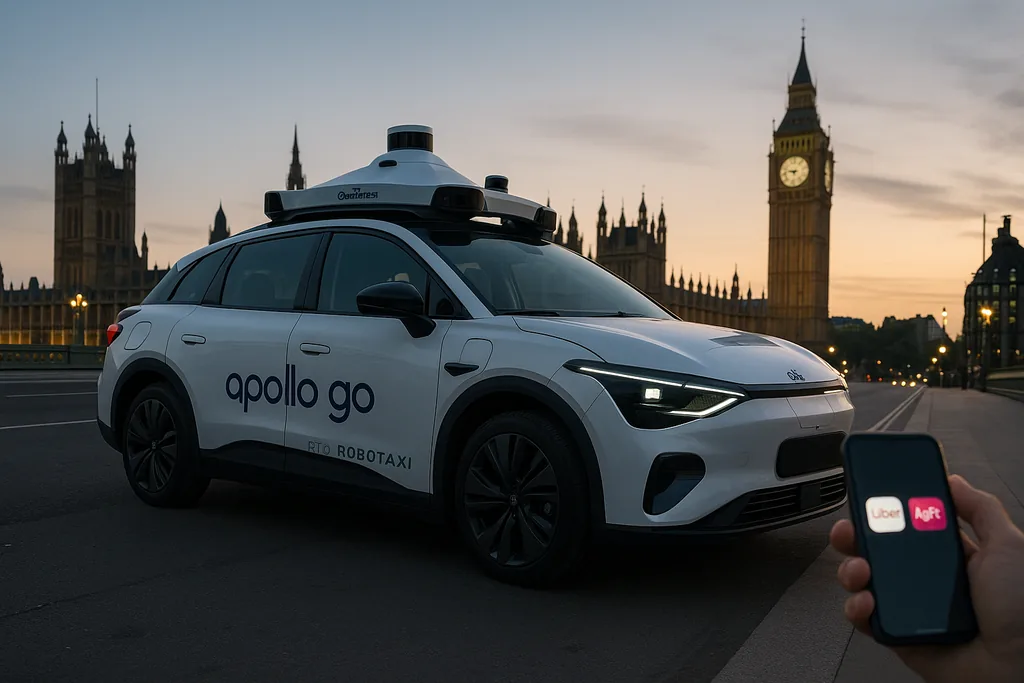
London's streets are about to host a new test: fleet-scale robotaxis
On 22 December 2025 Reuters reported that Uber and Lyft have struck partnerships with Chinese search‑and‑AI giant Baidu to begin driverless taxi trials in the United Kingdom in 2026. The deal will bring Baidu's Apollo Go RT6 vehicles onto ride‑hailing platforms in London, joining a growing field of autonomous vehicle (AV) tests in the city. The announcement follows a broader push by start‑ups and established players — including Wayve, Waymo and others — to move from closed test tracks to real urban services.
London as a regulated testbed
Companies making AV bets have been moving quickly to find jurisdictions that offer regulatory clarity. The UK has become especially attractive following recent legislation and government guidance that clarifies who carries liability when an automated vehicle is in control. That shift — reflected in the Automated Vehicles Act 2024 and accompanying Department for Transport materials — moves legal responsibility from an individual occupant to an authorised operator in certain circumstances, creating an operational model that companies say allows them to scale testing beyond narrow trial sites.
For operators, that legal framework reduces one of the thorniest uncertainties of urban robotaxi deployment: who pays when software makes the wrong decision. For London, hosting supervised trials creates opportunities to shape the rollout and learn about safety, traffic interaction and public acceptance in a busy, mixed‑use city.
The partnership and the technology
The headline partners mix two kinds of capability. Baidu brings a mature robotaxi platform in the form of Apollo Go and the RT6 vehicle, which is already used in commercial and pilot services in China. Uber and Lyft bring access to scale through their ride‑hailing platforms, customer bases and dispatch systems. Separately, Wayve — a London‑based start‑up that builds a ‘mapless’, end‑to‑end AI driving system — is also planning London trials in 2026 backed by roughly $1 billion in investment from Uber and SoftBank according to reporting in the bundle.
That combination highlights two approaches to autonomy. Baidu and other big teams (including Waymo) tend to rely on richly detailed HD maps and high‑definition sensor stacks to localise and plan precisely. Mapless approaches, championed by Wayve, use large neural networks trained on driving data to generalise across environments and reduce dependence on per‑mile mapping work. Each model has trade‑offs: map‑heavy fleets can be very precise inside their mapped zones but require ongoing map upkeep, while mapless systems promise broader geographic reach but face harder generalisation and verification challenges in complex cities.
Commercial strategy: platforms over full‑stack ownership
For ride‑hailing companies the economics matter. Building a full AV stack and a robotaxi fleet is capital‑intensive: industry reporting has placed per‑vehicle hardware and integration costs in the hundreds of thousands of dollars. Partnering lets Uber and Lyft integrate robotaxis into their marketplaces without buying and operating every vehicle themselves. It is a middle path between owning the entire stack and simply buying capacity from third‑party fleets.
Uber has previously invested in AV technology firms and signalled it will continue funding research; analysts following the company have noted that AV investment affects margins but could unlock a lower‑cost mobility model over time. Bernstein analyst Nikhil Devnani reiterated a buy rating on Uber in mid‑December and raised a price target, reflecting confidence in Uber's ability to grow bookings even as it invests in AV initiatives.
Risk, safety and the public test
Moving to London streets turns laboratory problems into public policy questions. Even with operator liability rules in place, regulators, insurers and city authorities will be watching how the vehicles interact with pedestrians, cyclists, emergency vehicles and the complicated choreography of urban driving. Recent trials by Waymo in London have been supervised, and the new wave of partnerships is expected to follow similarly cautious staged deployments: supervised testing, geofenced operation areas, and progressive enlargement of service footprints depending on performance.
Public acceptance will matter as much as technical performance. Incidents in other cities have shown that the optics of any crash or software failure can quickly slow or stop deployment. Operators will need to demonstrate robust monitoring, rapid human intervention capability and transparent performance reporting to win regulators' and citizens' trust.
Geopolitics and a race for European markets
The new partnership also has geopolitical overtones. It represents a direct face‑off between US‑based platforms and Chinese AV technology in a major European capital. Investors have taken note: Baidu's autonomous efforts have become a focal point for some analysts and funds, and global capital flows are following the technology as well as the regulatory openings in places like the UK.
For the UK, the arrival of competing AV stacks is a chance to attract investment and shape standards; for firms it is an opportunity to demonstrate superiority in ride reliability, cost per mile and safety metrics in the same urban environment. That head‑to‑head comparison is rare: most large‑scale AV tests to date have been constrained to different cities, different regulations and different traffic cultures.
Near‑term milestones and what to watch
- Vehicle rollouts: Baidu's Apollo Go RT6 is expected on ride‑hailing apps in 2026; Wayve's mapless trial is also slated for 2026 under Uber/SoftBank backing.
- Operational model: whether trials will use remote supervision, on‑board safety drivers, or fully driverless runs in limited zones will indicate confidence levels.
- Regulatory feedback: how UK regulators and city transport authorities respond to incident reports and performance statistics will shape the speed of expansion.
- Market integration: whether operators use robotaxis to supplement existing driver supply or create dedicated robotaxi services will determine economic impacts on drivers and pricing.
The commercial promise of lower per‑ride costs and 24/7 availability drives enthusiasm, but the route from pilot to profitable, city‑wide service remains uncertain. Trials in London will produce hard data on how robotaxis handle real dense urban traffic, and that information will matter to cities weighing permits, to insurers setting premiums, and to competitors deciding where to invest next.
For now, the announcement is a clear signal: the AV industry is moving from isolated experiments toward coordinated, platform‑based trials in legislatively favourable cities. London will be one of the first places where Chinese, US and European stacks can be compared on the same streets — and that competitive pressure could accelerate both engineering improvements and regulatory conversations across Europe.
Sources
- Automated Vehicles Act 2024 (United Kingdom legislation)
- UK Department for Transport — guidance on automated and autonomous vehicles