UN Confirms 3I/ATLAS as Official Planetary-Defence Exercise
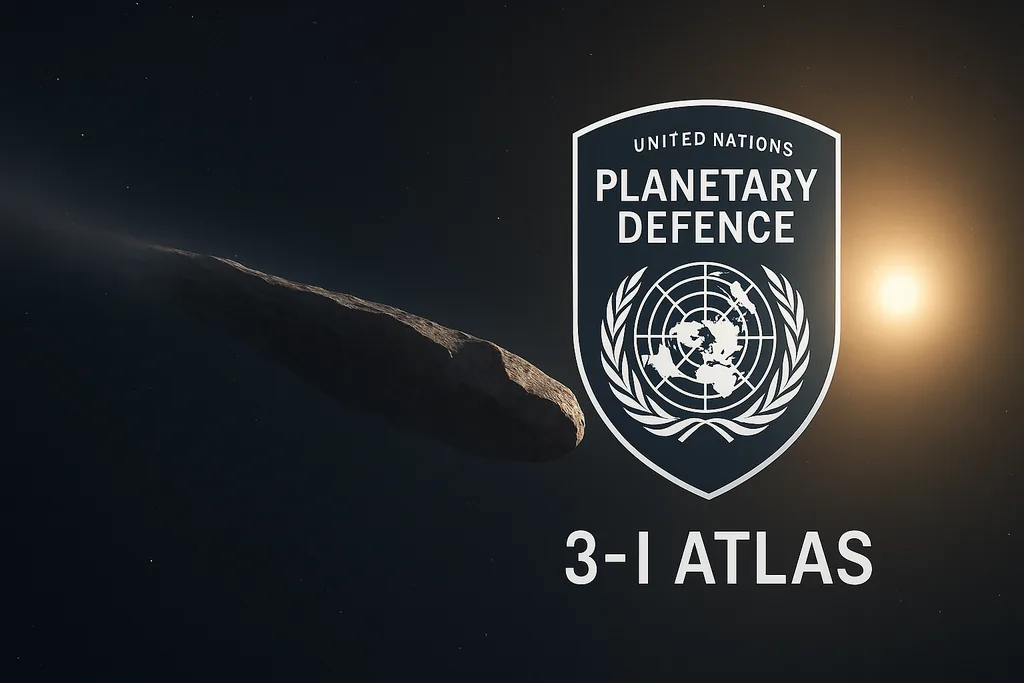
The UN has formally designated the interstellar comet 3I/ATLAS as the focus of a global planetary-defence drill, turning an unusual cosmic visitor into a real-world test of humanity’s asteroid-response infrastructure.
A rare interstellar visitor becomes an unexpected stress test
Interstellar objects are demanding enough when they simply pass through the Solar System. They move faster, behave less predictably, and carry the fingerprints of physics shaped somewhere far beyond the Sun’s reach. But 3I/ATLAS — discovered in July 2025 and immediately recognised as an interstellar comet — has now been assigned an additional role.
A newly circulated United Nations document confirms that 3I/ATLAS has been folded into a full planetary-defence observing campaign, coordinated through the International Asteroid Warning Network (IAWN) and overseen by the United Nations Office for Outer Space Affairs (UNOOSA).
This makes 3I/ATLAS the centre of the 8th global observing exercise since the UN established its formal planetary-defence structure in 2014.
The announcement settles weeks of public speculation, where confusion and conspiracy theories briefly outpaced scientific communication. The truth is simpler and far more interesting: the world is using this interstellar comet to practise how it would respond to something genuinely dangerous.
A drill grounded in reality, not fiction
Despite online rumours, 3I/ATLAS poses no threat to Earth. Its closest approach in December 2025 will still leave it more than 270 million kilometres away — comfortably beyond any hazard zone.
Yet that distance is largely irrelevant to the exercise. Planetary defence is not about reacting to imminent catastrophe; it’s about ensuring global coordination functions before a crisis exists.
This is why 3I/ATLAS is valuable. Its interstellar trajectory, active coma, and variable brightness create a perfect storm of observational difficulties — the sort of real-world messiness that simulations can’t fully reproduce.
And unlike fictional drills, this campaign involves the same institutions that would respond to a genuine threat:
- IAWN — detection, tracking, impact-probability calculations
- SMPAG — space-agency coordination for potential deflection missions
- UNOOSA — intergovernmental and diplomatic governance
The stakes may be low for Earth, but they are high for the systems designed to protect it.
Why this comet is the perfect technical challenge
Where most asteroids appear as point-like objects in telescope images, comets behave like living things. Their bright comae, asymmetric gas jets, and evolving tails often distort the precise centroid measurements needed for accurate orbit determination.
An IAU circular issued after 3I/ATLAS’s discovery emphasised this problem: features like the coma can “systematically pull centroid measurements off their central brightness peak”. For planetary defence, where days can matter, such biases are unacceptable.
3I/ATLAS adds additional difficulty:
- an interstellar trajectory unfamiliar to most models
- a high relative speed
- variable brightness
- residual ejecta from its previous stellar system
For researchers, these are headaches. For planetary defence planners, they are opportunities.
A two-month window of coordinated global observation
The official UN-sanctioned campaign runs from 27 November 2025 to 27 January 2026, following a structured flow of workshops, registration, and mid-campaign reviews.
Campaign Timeline
- Registration Deadline: 7 November 2025
- Astrometry Workshop: 10 November 2025
- Kick-Off Notice: 25 November 2025
- Observing Window Opens: 27 November 2025
- Mid-Campaign Check-In: 9 December 2025
- Observing Window Closes: 27 January 2026
- Close-Out Teleconference: 3 February 2026
During this period, observatories — from university telescopes to national facilities — will contribute measurements. The goal is both scientific and procedural: refine astrometric techniques, benchmark analysis pipelines, and evaluate whether the international coordination behaves as intended.
Strengthening the system designed to protect Earth
Planetary defence is less dramatic than Hollywood suggests. It is mostly a bureaucratic, methodical process of monitoring, modelling, verifying and communicating. Exercises like this ensure that the machine actually works when needed.
The involvement of SMPAG highlights that deflection planning is now treated as a mature policy topic rather than science fiction. UNOOSA’s participation underlines the importance of cross-border cooperation, data transparency and shared responsibility.
3I/ATLAS may be a harmless tourist from another star system, but the planetary-defence infrastructure treating it as a training target is very real. And in a world where unexpected objects occasionally slip through detection networks, practising on a difficult comet is not an overreaction — it’s good governance.
A glimpse of the future of planetary defence
Once 3I/ATLAS swings past the Sun and begins its outbound journey, it will eventually vanish back into interstellar space, leaving only the archived dataset behind. But the impact of this campaign will persist:
- improved astrometry techniques
- better modelling of extended cometary bodies
- refined coordination protocols
- more accurate orbit predictions under uncertainty
- a clearer understanding of real-world performance limits
Planetary defence is still a young field, but it is maturing quickly. The 3I/ATLAS campaign demonstrates that nations are no longer waiting for a “near miss” to test their readiness. They are doing it now — with the objects that nature provides.
