An extraordinary burst that would not stop
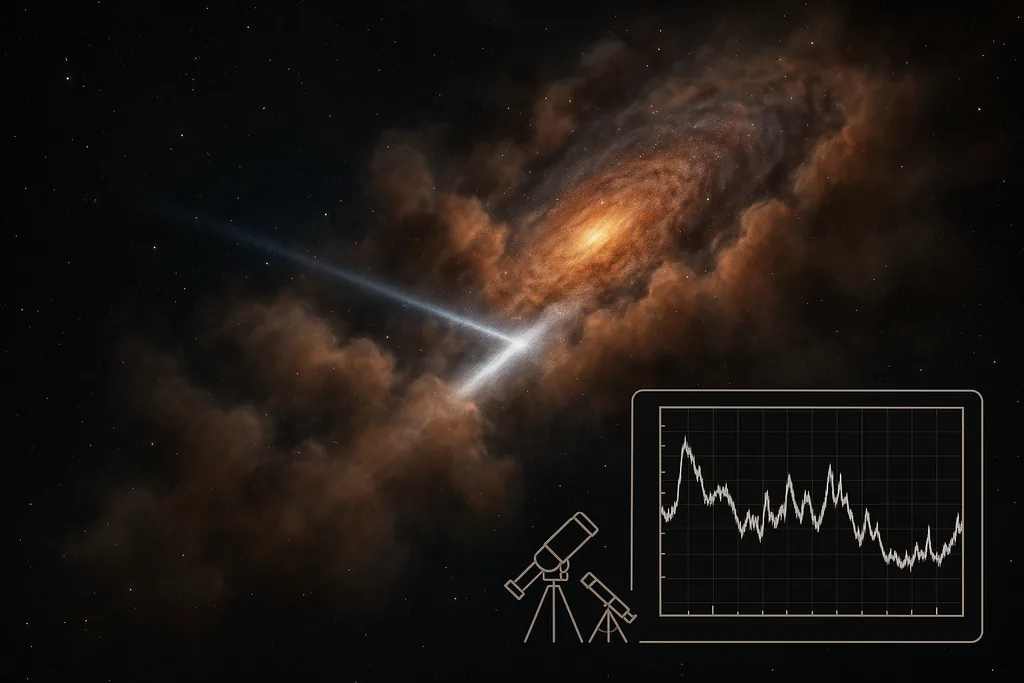
On 2 July 2025 NASA's Fermi Gamma‑ray Space Telescope flagged what at first looked like another routine flash from deep space. Instead of the brief, seconds‑long flash typical of gamma‑ray bursts, the detector recorded a source that pulsed on and off for roughly seven hours — a blistering, intermittent beacon now catalogued as GRB 250702B. The signal, later localised to a dusty galaxy about 8 billion light‑years away, carried a mix of intense gamma rays and other high‑energy emission that has left researchers reaching for explanations beyond the usual playbook.
An event outside the models
Gamma‑ray bursts (GRBs) come in two broad classes: short bursts lasting less than two seconds, and long bursts that typically last from a few seconds up to a few minutes. GRB 250702B broke those bounds spectacularly. The on‑and‑off pattern and multi‑hour duration are unlike anything the community has treated as a textbook case. "This was the longest gamma‑ray burst that humans have observed — long enough that it does not fit into any of our existing models for what causes gamma‑ray bursts," said Jonathan Carney, the lead author of the study describing the event, in material accompanying the paper published in The Astrophysical Journal Letters on 26 November 2025.
Fermi's discovery prompted an intensive campaign of follow‑up observations. Ground‑ and space‑based facilities including the Gemini telescopes in Chile and Hawaii, the European Southern Observatory's Very Large Telescope, the W. M. Keck Observatory and the Hubble Space Telescope were trained on the field. Because the host environment is rich in dust, optical light was largely extinguished; astronomers relied on infrared and high‑energy X‑ray measurements to locate the event and study its environment.
Those observations converged on a host galaxy with heavy dust attenuation at a cosmological distance of about 8 billion light‑years. Modelling of the burst and its afterglow indicates that material was ejected at relativistic speeds — at least 99 percent of the speed of light — focused into narrow jets aimed, by chance, nearly toward Earth. The combination of energetic jets and dense circumstellar material is part of what makes interpretation so difficult: the signal had to escape a thick shroud of gas and dust to be visible to our instruments.
Three leading but inconclusive scenarios
The research team presented three broad scenarios that could, in principle, produce such an extended high‑energy outburst, but emphasised that none fits the data cleanly yet.
- Prolonged collapsar (massive star death): In the standard long‑GRB model a very massive, rapidly rotating star collapses to form a black hole or magnetar that drives jets through the star. If the central engine remains active for far longer than expected — perhaps because accretion of stellar material proceeds in an unusual, prolonged fashion — that could sustain gamma‑ray emission for hours. But current collapsar calculations struggle to maintain the required engine power on such long timescales.
- Black hole feeding on a star (tidal disruption‑like event): A supermassive black hole tearing apart a star (a tidal disruption event) can produce long high‑energy flares, but those systems normally sit at galaxy centres and have different spectral and timing signatures than classical GRBs. A smaller black hole swallowing a compact star, or an atypical tidal disruption in an off‑nucleus location, could produce prolonged activity, but the available data do not yet confirm that geometry.
- Helium‑star and black hole merger: In this picture a compact black hole spirals into the core of a massive helium star, igniting explosive accretion when it reaches the central regions. That interaction can, in some numerical experiments, produce extended episodes of jet activity as the black hole burrows through and ultimately consumes the core. The scenario is attractive because it naturally connects long durations with a concentrated, dusty stellar envelope — but it remains speculative until simulations can match the detailed light curve and spectra observed.
Why the signal is important beyond the headline
GRB 250702B matters because it tests the limits of how compact objects — neutron stars and black holes — interact with their surroundings. Each of the candidate explanations probes a different physical regime: the late‑time behaviour of accreting black holes in collapsing stars, the dynamics of stellar disruption and fallback, and the hydrodynamics of compact object mergers inside stellar envelopes. A single, well‑observed outlier can force theorists to refine models or add physical ingredients previously ignored.
Practically, the event also exposes how vital coordinated, rapid follow‑up is. Fermi's gamma‑ray detection set the clock running, but only a global suite of optical/infrared telescopes and space observatories could characterise the host and the extinction that hid the burst in visible light. Radio and neutrino facilities were not prominent in the initial reporting; the authors and other groups are likely to comb archival radio data and schedule target‑of‑opportunity observations because radio counterparts can trace expanding shock fronts and constrain the energy budget at late times.
Next steps and open questions
Researchers will continue to search for similar long‑duration bursts in archival and incoming data, and to perform dedicated simulations aimed at reproducing the pattern of pulses and the spectrum across wavelengths. If GRB 250702B represents an extreme tail of known progenitor behaviour — a collapsar with unusually long engine activity — then the event tells us something about the variability of massive star deaths. If instead it represents a different kind of progenitor altogether, such as a rare merger or tidal event, it opens a new channel for high‑energy transient astronomy.
Sources
- The Astrophysical Journal Letters (paper on GRB 250702B)
- NASA — Fermi Gamma‑ray Space Telescope
- Gemini Observatory (Chile and Hawaii)
- European Southern Observatory — Very Large Telescope
- W. M. Keck Observatory
- Hubble Space Telescope
- NOIRLab / NSF / AURA