Universe May End in 33 Billion Years
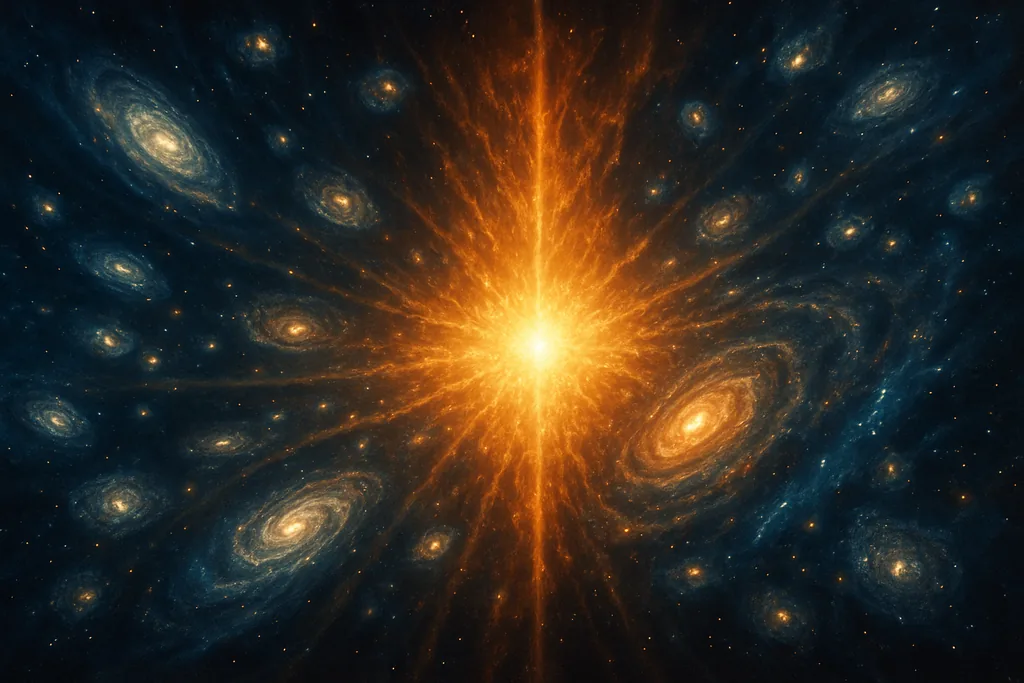
The work blends observational results from wide cosmological surveys with a specific theoretical framework. The research group fitted a model where an ultralight axion‑like field interacts with the familiar cosmological constant (the Λ in ΛCDM). Their best‑fit parameters, when combined with recent measurements of the dark‑energy equation of state, favour a negative effective cosmological constant in that model. A negative Λ drives gravitational attraction to win on cosmological scales, producing a reversal of expansion and a final "big crunch." The authors report a benchmark lifespan of about 33 billion years for the universe in that model.
Why the new data matter
For two decades the standard cosmological picture has been simple and robust: a positive cosmological constant produces accelerated expansion that continues indefinitely, leading to a cold, empty future often called the "big freeze." But recent releases of large data sets — notably those mapping baryon acoustic oscillations, supernova distances and the large‑scale clustering of galaxies — have opened the possibility that the dark‑energy equation of state w might differ from the constant value w = −1 expected for pure vacuum energy. Several independent analyses have found mild but non‑negligible tensions with a pure cosmological constant, and those tensions are what let dynamical models such as the axion proposal produce a qualitatively different late‑time fate.
What role do axions play?
Numbers and timescales, put plainly
- The age of the universe today: ~13.8 billion years.
- Modelled total lifespan in the axion + negative Λ scenario: ~33 billion years since the Big Bang.
- Expansion would continue to a maximum in roughly 11 billion years; the contraction phase would then begin and culminate in a crunch in about 20 billion years from now.
Important caveats
The result is attention‑grabbing, but it is far from a settled verdict about cosmic destiny. First, the inference of a negative cosmological constant arises within a specific model that includes an extra degree of freedom (the axion). Different parametrisations or models can fit the same data without requiring Λ<0. Second, current measurements of the dark‑energy equation of state indicate hints of dynamical behaviour at the level of a few sigma in some combinations of data sets, but those tensions are modest and model‑dependent; they are not yet universally accepted as definitive evidence that vacuum energy is time‑varying. Third, degeneracies in cosmological parameter estimation — where different combinations of parameters produce similar observables — mean that alternative explanations remain plausible. In short: interesting and plausible, but provisional.
Other possible cosmic endpoints
Cosmologists continue to weigh several qualitatively different late‑time scenarios, including:
The axion + negative‑Λ crunch is one on this menu — distinct and dramatic, but not exclusive. Each scenario depends on assumptions that ongoing observations and theory will test.
Why this matters — and what comes next
Pinning down the fate of the universe is more than an exercise in cosmic trivia: it probes the deepest unknown in contemporary physics, the nature of dark energy and its relation to fundamental fields. The proposal to date the end of everything to a few tens of billions of years is an example of how rapidly improving data sets let theorists turn previously philosophical questions into quantitative hypotheses that can be checked.
Over the next few years a suite of experiments and surveys will sharpen the picture: additional data releases from DESI, re‑analyses of Type Ia supernova samples, and observations from Euclid, SPHEREx and the Vera Rubin Observatory are expected to reduce parameter uncertainties and test whether dynamical dark energy is genuinely required. If repeated, model‑independent reconstructions of the dark‑energy history keep pointing away from a pure cosmological constant, the axion‑type mechanisms will demand closer attention; if not, the standard ΛCDM picture will regain its primacy.
Bottom line
The claim that "everything will disappear" on a specific date is an overstatement when divorced from context. A new, well‑documented theoretical analysis shows that, within a plausible axion‑plus‑cosmological‑constant model matched to recent survey data, the universe could reverse and end in a big crunch in roughly 33 billion years. But that conclusion depends critically on model choices and on data that remain under active scrutiny. The coming decade of observations will be decisive in telling us whether this dramatic conclusion moves from speculative possibility to robust prediction — or whether the cosmos has a different, quieter destiny in store.
James Lawson is a science journalist at Dark Matter who covers physics, space and emerging technologies. He has an MSc in Science Communication and a BSc in Physics from University College London and is based in the United Kingdom.