A tiny shove, a big question
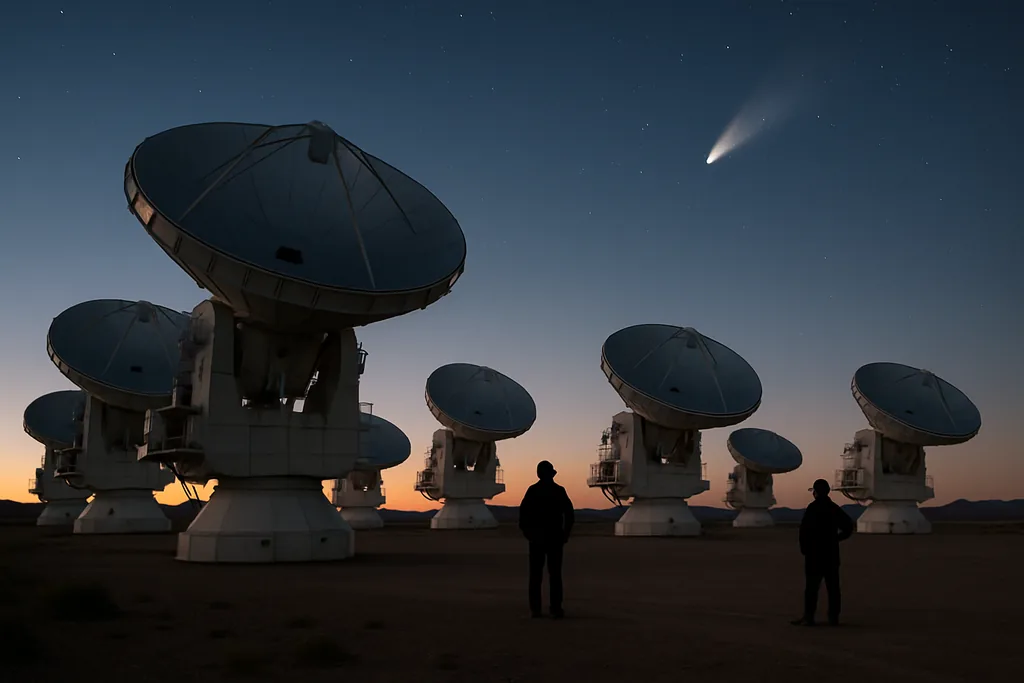
Late this autumn telescopes and spacecraft tracking the interstellar visitor 3I/ATLAS reported something subtle but important: the object has moved slightly off the path expected from gravity alone. Observatories from the Atacama Large Millimeter/submillimeter Array (ALMA) to a fleet of orbiters and deep‑space probes contributed astrometry and images. Those measurements have now been used in a short Research Notes of the American Astronomical Society paper that quantifies a non‑gravitational acceleration. The result is the kind of small, solid observation that can be turned into surprising physical information — but it does not, on its own, answer the big question that fuels headlines: is 3I/ATLAS a natural comet or something more exotic?
How comets produce a non‑gravitational acceleration
Comets are loose, irregular bodies of ice and dust. When sunlight warms their surface, volatile ices sublimate — they turn from solid to gas — and carry dust with them. Those escaping molecules leave at speeds of tens to a few hundred metres per second. If outgassing is symmetric the net effect on the nucleus is small, but if jets are concentrated in particular regions the reaction force acts like a tiny rocket motor. Over time that steady, tiny thrust changes the comet’s velocity enough to register in precise astrometric tracking.
That measured acceleration is very small — well below one millionth of the acceleration you feel standing on Earth — yet modern instruments can detect it if observations span enough time and baseline. For 3I/ATLAS different analyses and instruments yield slightly different numbers. One team modelling long‑baseline astrometry including data from ESA’s Trace Gas Orbiter and NASA spacecraft reported a measurable offset consistent with a very small, sunward‑oriented thrust; other summaries of the same dataset express the acceleration as a few tenths of a micron per second squared (10‑7 to 10‑6 m/s2). The precise value depends on which observations are included and on assumptions about the direction and timing of the gas jets.
Turning a wobble into mass and mass loss
Why does that tiny number matter? Because force equals mass times acceleration. If you can estimate the thrust that outgassing produces — from observed gas production rates, from physics of sublimation, or from measured coma structure — you can rearrange the equation and obtain an estimate of the nucleus mass. Conversely, if you assume a plausible nucleus mass you can predict how much mass must be being ejected to produce the measured acceleration.
That is exactly what recent studies have done. One team used spacecraft astrometry to infer an acceleration and converted it into a pre‑perihelion mass estimate of order 10^7 to 10^8 tonnes, implying a nucleus size of order a few hundred metres, depending on assumed density. Other analyses, taking different observational inputs and outgassing speeds, argue that the non‑gravitational kick would require the nucleus to have lost a significant fraction — on the order of a few to ten percent, or in one independent back‑of‑the‑envelope calculation even roughly one‑sixth — of its mass while it passed near the Sun. In practical terms, that would produce a very large, detectable cloud of gas and dust around the object.
The competing interpretations
But a minority of researchers, most prominently Avi Loeb and colleagues, argue the situation has unusual elements that merit careful scrutiny. Loeb points to a set of observed features — for example a tightly collimated sunward feature noted in some datasets, reports of an unusual chemical signal in early analyses, and an orientation of features that they judge unlikely by chance — and says if the mass‑loss hypothesis does not produce the expected, large surrounding gas cloud, then the possibility of a technological origin cannot be dismissed strictly by the data.
That argument is not the mainstream view; it rests on a chain of deductions and on challenging measurements that must be verified independently. Most comet experts consider natural outgassing the far simpler and better supported explanation so far, but science proceeds by testing both hypotheses with further observations.
Why the disagreement exists — and how to resolve it
There are three practical reasons for the disagreement. First, the acceleration is tiny and near the limit of what current tracking can resolve; different teams choose different subsets of the astrometric record and different statistical models. Second, turning an acceleration into a mass or mass‑loss rate requires assumptions about nucleus density, the velocity of ejected material, and how anisotropic the jets are — parameters with substantial uncertainty. Third, some specific observational claims (chemical fingerprints, or unusually aligned jets) are preliminary and need independent confirmation.
Those uncertainties make this a solvable problem rather than an intractable one. The International Asteroid Warning Network campaign and a broad set of professional and amateur observers have scheduled concentrated monitoring through late November and December when 3I/ATLAS re‑emerges from solar glare and makes its nearest approach to Earth (still well beyond the orbit of Earth at roughly 1.8 astronomical units). If the cometary‑mass‑loss picture is correct, observers should detect a large gas cloud and measurable production rates consistent with the thrust inferred from astrometry. If such a cloud is absent, the community will need to revisit the bookkeeping: either revise estimates of thrust and nucleus mass or look for other mechanisms that could produce the measured offset.
What this means beyond the headlines
It is worth stressing two practical points. First, none of this changes the fact that 3I/ATLAS poses no hazard to Earth; its closest approach remains far outside the planetary region that threatens impact. Second, a resolved answer — whether it confirms an extreme cometary outburst or reveals something unexpected — will teach us about planetary systems beyond our own. Interstellar objects are rare probes of other stellar systems’ small‑body populations. Measuring mass, composition, and how an interstellar body reacts to our Sun gives direct data on formation and ejection processes that theory alone cannot deliver.
In short: the detection of non‑gravitational acceleration is the start of a data‑driven process, not its end. Over the coming weeks and months coordinated observations across radio, optical and infrared wavelengths, and re‑analysis of spacecraft astrometry, should sharpen the picture. That is how astronomy converts an intriguing anomaly into robust knowledge.
Sources
- Research Notes of the American Astronomical Society (paper on 3I/ATLAS non‑gravitational acceleration)
- Atacama Large Millimeter/submillimeter Array (ALMA) observations
- NASA / JPL (spacecraft astrometry and imaging data)
- European Space Agency (Trace Gas Orbiter and JUICE mission observations)
- NOIRLab / Gemini and other ground observatories (optical imaging and spectroscopic data)