A milestone above the desert
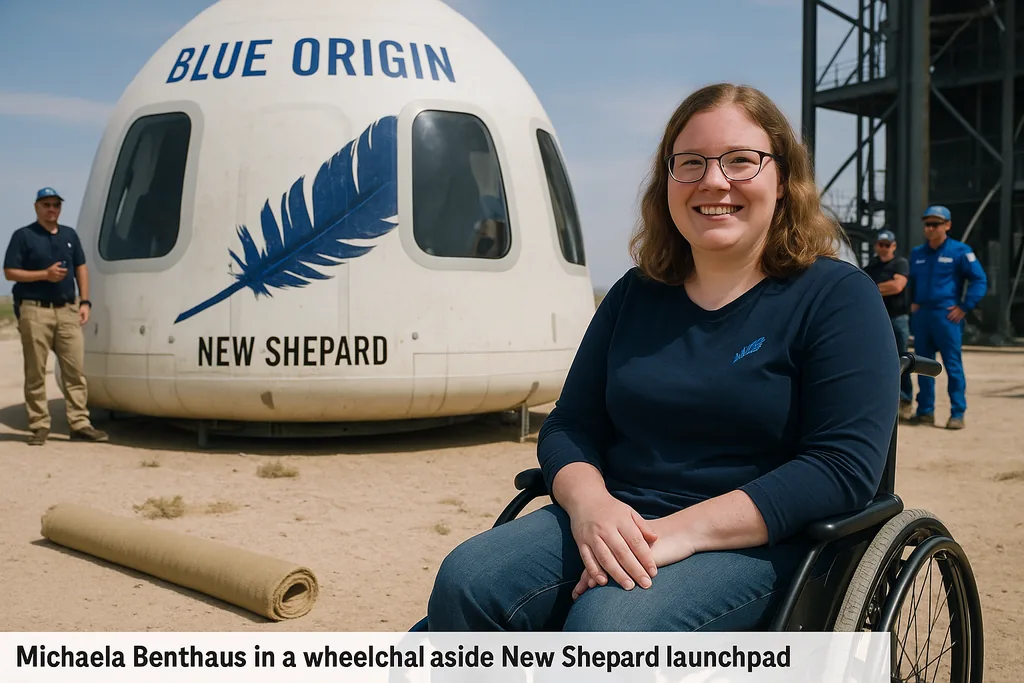
On December 20, 2025, a New Shepard rocket lifted off from West Texas and returned a small crew to Earth after a roughly 10‑minute suborbital flight that crossed the internationally recognised Kármán line. Among the six people who floated briefly in microgravity that day was German aerospace and mechatronics engineer Michaela "Michi" Benthaus — who left her wheelchair on the ground and became the first person who uses a wheelchair to travel to space.
Blue Origin’s webcast and mission briefings described a textbook New Shepard profile: a vertical booster launch, minutes of weightlessness as the capsule coasts above 62 miles, and a parachute‑assisted descent culminating in a soft touchdown on the West Texas plain. The company said the flight required only minor procedural and hardware adjustments to accommodate Benthaus, emphasising the capsule’s original accessibility features.
How the mission worked for a wheelchair user
Benthaus, 33, who trains with the European Space Agency as a graduate trainee and who suffered a spinal cord injury in a 2018 mountain‑bike accident, boarded New Shepard after crew preparations that included an elevator to reach the pad and a short transfer procedure into the capsule. Blue Origin and mission partners added a patient transfer board so she could move between her wheelchair and the seat, and the recovery team unrolled a carpet on the desert floor so her wheelchair would be immediately accessible after landing — small, practical adaptations that removed the largest logistical barriers to participation.
The flight itself lasted about ten minutes from launch to landing; the capsule climbed above the Kármán line and delivered several minutes of weightlessness and a view of Earth through the vehicle’s windows. Benthaus and her crewmates nicknamed themselves the "Out of the Blue" crew, and Blue Origin noted the flight continued the company’s practice of flying a diverse mix of passengers, including people with reduced mobility and sensory impairments.
Michi Benthaus: engineer, advocate, pioneer
Benthaus has a background in aerospace and mechatronics engineering and has been affiliated with the European Space Agency’s trainee programme in the Netherlands. After her 2018 accident left her paraplegic, she continued to pursue engineering and human‑spaceflight experiences, including parabolic weightlessness flights and simulated missions. She told reporters ahead of the launch that she hoped her flight would make space travel feel more attainable for people with disabilities and would spotlight the accessibility gaps that remain on Earth.
Engineering adaptations that matter
New Shepard’s small capsule and autonomous operations could have created significant accessibility hurdles: steep ladder climbs, narrow hatches, and rapid egress needs in an off‑nominal landing. Instead, Blue Origin relied on a mix of design choices and operational steps that reduced those barriers. The pad had an elevator to reach the seven‑storey launch tower, mission planners practised the transfer between chair and seat in advance, and recovery crews staged the landing zone to prioritise rapid access to mobility equipment immediately after touchdown. Those tactical changes — not wholesale redesigns — were enough to bring a wheelchair user safely through the whole flight experience.
That approach is significant because it highlights two routes to inclusion in spaceflight: in some cases, long lead engineering changes will be required; in others, modest procedural adjustments and thoughtful ground support can open opportunities quickly while minimising new certification burdens for vehicles. The Blue Origin case falls into the latter category, though it also raises questions about how well current vehicles would handle more complex disability profiles or emergency evacuations without a designated aide on board.
Where this fits in the larger push for accessible space
Benthaus’s flight is not an isolated incident but part of a steady, if uneven, shift. Space agencies and commercial operators have increased attention to disability inclusion in recent years. The European Space Agency’s Fly! programme, for example, has been working with John McFall — a British Paralympian and surgeon — to study and certify whether a person with a prosthetic limb can safely serve as an ISS crewmember on long‑duration missions; ESA’s work has moved from feasibility studies toward mission‑ready planning. Together these developments mark a cultural and technical change in how the industry thinks about who can go to space.
Still, there is a difference between short suborbital hops and the sustained operational requirements of orbital missions or space station work. A suborbital flight offers minutes of weightlessness and spectacular views; long‑duration orbital missions require certified life‑support, emergency egress procedures, and equipment interfaces that have traditionally been developed around able‑bodied crew metrics. The Benthaus flight demonstrates a pragmatic route to inclusion for short flights and has the potential to accelerate conversations about the engineering and policy work needed for more ambitious missions.
Public reaction and the shape of private space
The launch crew’s small scale and private funding model reflect broader dynamics in human spaceflight today: a mixture of commercial sponsors, private wealth, legacy aerospace expertise, and mission partners such as nonprofits that advocate for inclusion. Blue Origin highlighted partnerships with disability‑inclusion projects and noted its capsule design aimed to be welcoming to a wider spectrum of passengers. For advocates and engineers alike, the challenge now is to translate milestone flights into durable standards and best practices that scale beyond single, highly publicised missions.
For Benthaus personally, the flight was framed as both a dream fulfilled and a platform for advocacy. She told reporters that she hoped her flight would show others that being a wheelchair user doesn't automatically exclude someone from participating in human spaceflight activities, and that the same will to adapt that enabled her mission can be applied on Earth to improve accessibility everywhere.
Next steps
Blue Origin’s passenger manifest now includes a greater range of ages, physical abilities and professional backgrounds, a trend that will put pressure on operators and regulators to codify accessibility protocols. For longer missions, agencies and contractors will need to address medical certification, crew‑life interfaces, and emergency scenarios in a way that is functionally equivalent for all crew members. Benthaus’s flight advances the conversation by turning an abstract question — 'who can go to space?' — into a concrete operational case with lessons to learn.
What happens next will depend partly on whether space agencies and commercial firms choose to convert ad‑hoc fixes into certified design changes and partly on whether governments and international bodies update medical and safety standards to reflect a more diverse astronaut corps. The engineering problems are solvable; the social and policy work will determine the pace of change.
Sources
- Blue Origin (mission brief and press materials)
- European Space Agency (ESA) — astronaut and Fly! programme materials
- SciAccess / AstroAccess (disability inclusion in human spaceflight)