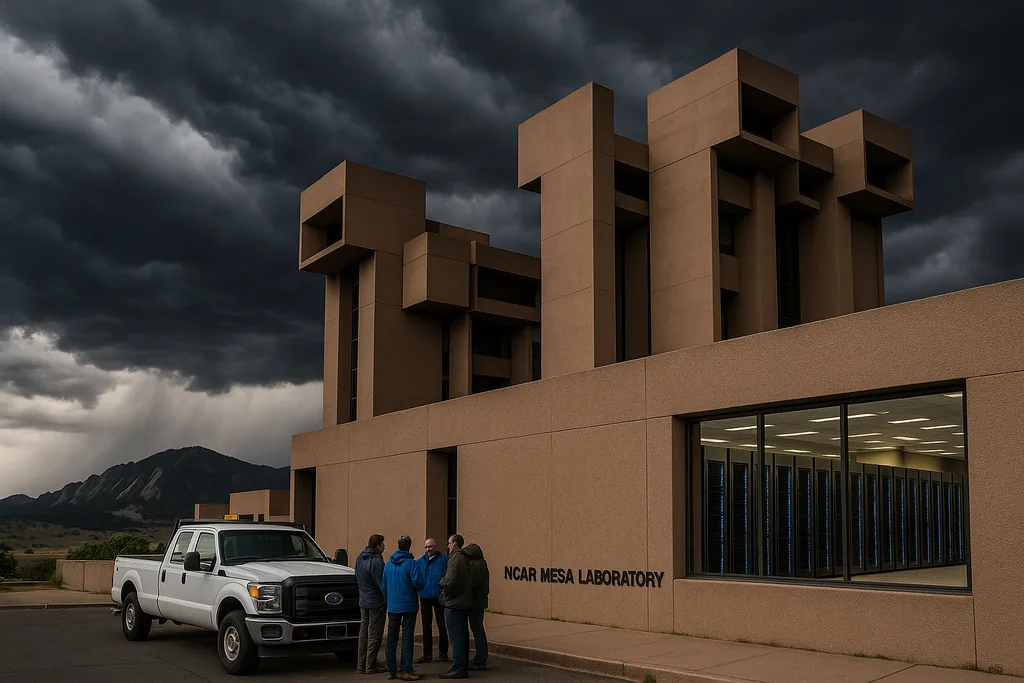
A sudden directive, a stunned scientific community
On December 16, 2025, Russell Vought, director of the White House Office of Management and Budget, posted that the National Science Foundation will "break up" the National Center for Atmospheric Research in Boulder, Colorado. The terse announcement — delivered on social media and amplified by federal briefings — said the center is a source of "climate alarmism" and that any "vital activities such as weather research will be moved to another entity or location." The declaration blindsided NCAR staff, its nonprofit manager and many of the U.S. agencies and universities that rely on the laboratory’s data, models and high-performance computing.
NCAR’s role and the assets at stake
NCAR’s operation is also a workforce engine: it employs roughly 830 people, provides training and short courses that feed the broader meteorological and climate community, and hosts collaborative projects spanning federal agencies, academic groups and private-sector partners. In fiscal year 2025, core funding from the National Science Foundation to NCAR was about $123 million, covering roughly half of the lab’s budget; other work is supported by grants from agencies such as NOAA and NASA.
Why scientists say the timing and method matter
Researchers and public-safety officials warned immediately that an abrupt break-up could damage the nation’s ability to forecast extreme events and prepare for disasters. NCAR-developed tools and observational systems underpin forecasts for severe thunderstorms, floods and hurricanes, and its computing and data services are often the backbone that smaller university groups and regional forecast offices depend on. Without centralized expertise and computing capacity, scientists say forecasts could become less reliable, collaborative projects could stall and the pipeline of trained atmospheric scientists could be disrupted.
Several senior researchers described the center as a shared national resource: a place where scientific specialties — from cloud microphysics to space weather — come together. They say fragmenting those capabilities or dispersing data and computers into unfamiliar administrative structures risks both short-term operational failures and longer-term erosion of research capacity.
Political context and the administration’s rationale
White House officials framed the move as a review to eliminate what they called partisan climate advocacy from federal research, and promised that essential functions would continue elsewhere. Those comments followed weeks of political friction with Colorado leaders; the announcement coincided with heightened attacks on the state’s governor from the administration in the wake of a contentious criminal case and a presidential pardon. Critics see the action as retaliatory and politically motivated rather than a narrowly targeted reorganization.
The National Science Foundation said it is reviewing the structure of the research and observational capabilities associated with NCAR and will solicit feedback from partner agencies and the research community. But neither the White House nor NSF provided a timeline, a concrete plan for asset transfer, nor a clear explanation of where supercomputers, unique instruments and long-running datasets would be housed.
Operational and legal hurdles
Experts note there are also legal levers in the cooperative agreement and grant contracts that could be used to contest hasty action, and members of Congress from both parties have in the past pushed back on steep cuts to weather and climate programs. Any attempt to reassign functions to other federal entities would likely trigger hearings, court challenges and years of negotiation over funding and responsibilities.
Immediate reactions and the political fight ahead
Colorado’s governor and the state’s congressional delegation condemned the move and vowed to fight it. The leader of UCAR, which manages NCAR, called the reports deeply troubling and warned that dismantling the center would set back the nation’s ability to predict, prepare for and respond to severe weather and natural disasters. Prominent scientists described NCAR as a "global mothership" for weather and climate research and said its loss would imperil lives and livelihoods.
At the same time, the administration’s promise to relocate "vital activities" creates a narrow window for negotiation: if the hardware, expertise and funding are explicitly reassigned to capable institutions and the transitions staged to avoid operational gaps, some core functions could persist. But scientists and legal specialists caution that a rushed breakup is likely to cause disruptions that will be difficult to reverse.
Longer-term implications for U.S. climate and weather science
Even if modeling and forecasting tools survive a reorganization, the fracturing of a long-standing collaborative ecosystem would be costly. NCAR hosts cross-disciplinary teams that pursue large, multi-institutional problems; it provides shared infrastructure that individual campuses rarely can afford; and it acts as a training ground for early-career researchers. Loss of that institutional memory and coordination would slow advances in areas such as hurricane intensity forecasting, regional climate projections and aviation safety systems that were pioneered with NCAR involvement.
Industry partners and international meteorological services that depend on NCAR’s community models and data could also face interruptions. In an era of increasingly costly extreme events, experts warn that degrading forecasting infrastructure is a strategic risk to public safety and economic resilience.
What to watch next
The next steps will be crucial. NSF’s review process, the response from UCAR and affected agencies, and how Congress chooses to engage will shape whether NCAR’s capabilities are safely migrated or whether the center is effectively dismantled. Expect hearings, formal consultations and likely legal challenges if the administration moves to terminate or dramatically restructure the cooperative agreement without stakeholder buy-in. Meanwhile, researchers and emergency managers will be watching for evidence that operational forecasting and disaster-response functions remain uninterrupted through any transition.
The suddenness of the announcement has already galvanized a broad coalition of scientists, state officials and some lawmakers. Their immediate goal is to preserve core functions and prevent gaps in forecast delivery. Their longer-term objective is to protect a shared scientific infrastructure that, advocates say, is essential for saving lives in storms, fires and floods and for maintaining the United States’ competitive edge in climate and weather science.
Sources
- National Science Foundation (NSF) statements and oversight responsibilities
- University Corporation for Atmospheric Research (UCAR) and the National Center for Atmospheric Research (NCAR)
- National Oceanic and Atmospheric Administration (NOAA)
- National Aeronautics and Space Administration (NASA)