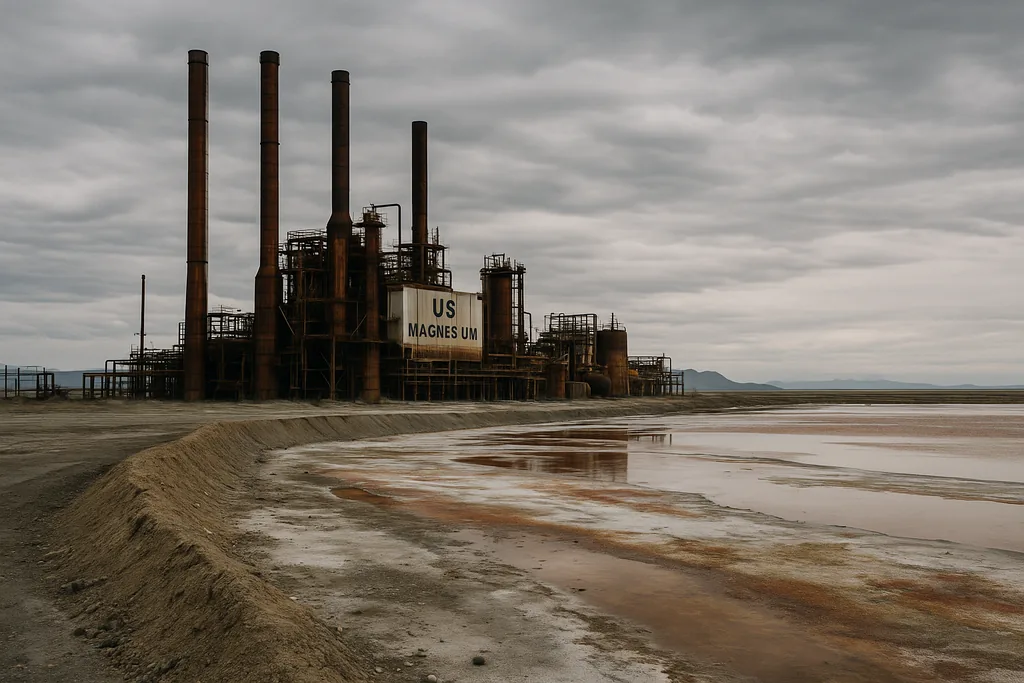
Rowley plant, shuttered stacks and a looming bill
On the dry western edge of the Great Salt Lake, the rusting towers and empty evaporation ponds of the US Magnesium Rowley plant stand as visible reminders of an industrial legacy that federal regulators now say could cost well over $100 million to remediate. The company filed for bankruptcy in September, halting momentum on remediation steps that environmental scientists and state regulators regard as urgent. For nearby communities, conservation groups and ecologists, the central question is no longer just how toxic the site is but who will pay to clean it up.
Persistent contamination and a fraught history
The Rowley site has a contamination record stretching back decades. Under its previous owner, MagCorp, the plant generated highly acidic wastewater and deposited sludge and solid wastes on the ground — materials later found to include persistent toxins such as polychlorinated dibenzo-dioxins, polychlorinated biphenyls (PCBs), hexachlorobenzene and heavy metals. A 2001 federal inspection documented unlined canals that turned red with acidity and flowed through the facility. The Environmental Protection Agency added the property to the National Priorities List as a Superfund site in 2009 and reached a consent decree with the operators in 2021 to move the cleanup forward.
But the record of compliance has been uneven. The site continued to draw penalties and additional regulatory actions while operating, and the plant briefly spilled thousands of pounds of hydrochloric acid onto adjacent public lands in 2014. After briefly reorganizing under Renco Group affiliates and continuing operations for years, the company that now operates the Rowley facility stopped magnesium production in late 2021 and has since resumed only limited activity — producing road salts and ice-control products while the larger remediation obligations remained largely unfinished.
Debt, bankruptcy and a stalled fix
US Magnesium’s bankruptcy has turned routine administrative steps — finishing a barrier wall, expanding monitoring wells, and funding long-term maintenance — into contested items in a courtroom ledger. The EPA has estimated the eventual cleanup will require well over $100 million; the state points to a partially built containment berm required under the consent decree that sits half finished because the contractor stopped work after being unpaid. Completing that wall would cost roughly $10 million, according to court documents.
At the same time, the company lists enormous debts. Court filings show at least $95.4 million owed to its top 20 creditors, including unpaid property taxes of nearly $7 million to Tooele County and administrative costs claimed by the EPA. Another reported figure: $67 million owed to a major lender. The company also set aside roughly $16.5 million in financial assurance under the EPA agreement, money that US Magnesium now seeks to free as part of a proposed sale — a request that alarms regulators who worry releasing those funds would leave taxpayers on the hook.
Environmental stakes and scientific uncertainty
Scientists and local advocates say the risk is not just the headline cleanup price but the uncertain movement of contamination offsite. Geologists and Superfund advisors who have worked on the site warn that decades of wastewater releases and a limited network of monitoring wells mean a corrosive, acidic groundwater plume could already be migrating toward the Great Salt Lake, or impacting the lakebed's sensitive saline ecosystem. The EPA has flagged exposed, highly contaminated sediments in former waste ponds and called attention to hazards to birds and wildlife using those areas.
Bankruptcy law collides with Superfund obligations
The heart of the dispute is legal: Superfund law enables the EPA to pursue current and former operators, parent companies and landowners for contamination costs. Bankruptcy law, however, can restructure or discharge debts and allow assets to move between corporate entities. In past episodes, the company’s owners used corporate restructurings to sell assets and continue operations while leaving environmental liabilities unresolved; that history is central to the federal government’s objections in the current case.
After the September filing, US Magnesium proposed an asset sale with a so-called stalking-horse bidder: LiMag Holdings, a newly formed affiliate of Renco, the plant’s New York-based parent. Regulators have pressed back, arguing the proposal appears to be an attempt to use bankruptcy protections to avoid or weaken cleanup obligations. Federal and state agencies, together with unsecured creditors, have asked the court to convert the case to a Chapter 7 liquidation so the company can be dissolved and its assets distributed rather than reorganized for continued operation under a new subsidiary.
What the options mean for the lake and taxpayers
If the court allows a sale that pauses or modifies the consent decree, regulators warn the result could be a prolonged delay in remediation and potential weakening of financial assurances set aside to protect the public. If the judge converts the case to Chapter 7 and liquidates the company, that outcome could leave federal and state agencies to determine whether to step in and fund or carry out the cleanup, and then pursue responsible parties — a process that can be lengthy and expensive.
Near-term steps and the watchers on the shore
In the short term, attention will focus on a few concrete actions: whether the bankruptcy court converts the case to Chapter 7 or approves a sale; whether the partially built berm is finished; and whether the EPA and state agencies can complete groundwater characterization and shore up monitoring around the site. Advocacy groups are pressing state officials and the court-appointed receiver — whose remit was limited by previous rulings — to keep pressure on the company to comply with sampling and reporting requirements while the legal process plays out.
For those who track the Great Salt Lake’s health, the stakes are practical and immediate. The lake’s shrinking margins already make exposed lakebed and dust a regional hazard, and adding persistent industrial contaminants to that mix complicates restoration and public-health planning. The Rowley plant sits on public lakebed and adjacent lands used by hunters, ranchers and migratory birds — communities and ecosystems that regulators say deserve protections that the current bankruptcy proceedings must not sweep aside.
Sources
- U.S. Environmental Protection Agency (Superfund site records and consent decree)
- Utah Division of Forestry, Fire and State Lands (court filings and lease records)
- University of Utah (geology department and affiliated technical advisors)
- U.S. Bankruptcy Court for the District of Delaware (bankruptcy filings and asset-sale motions)
- FRIENDS of Great Salt Lake (monitoring plans and advocacy materials)