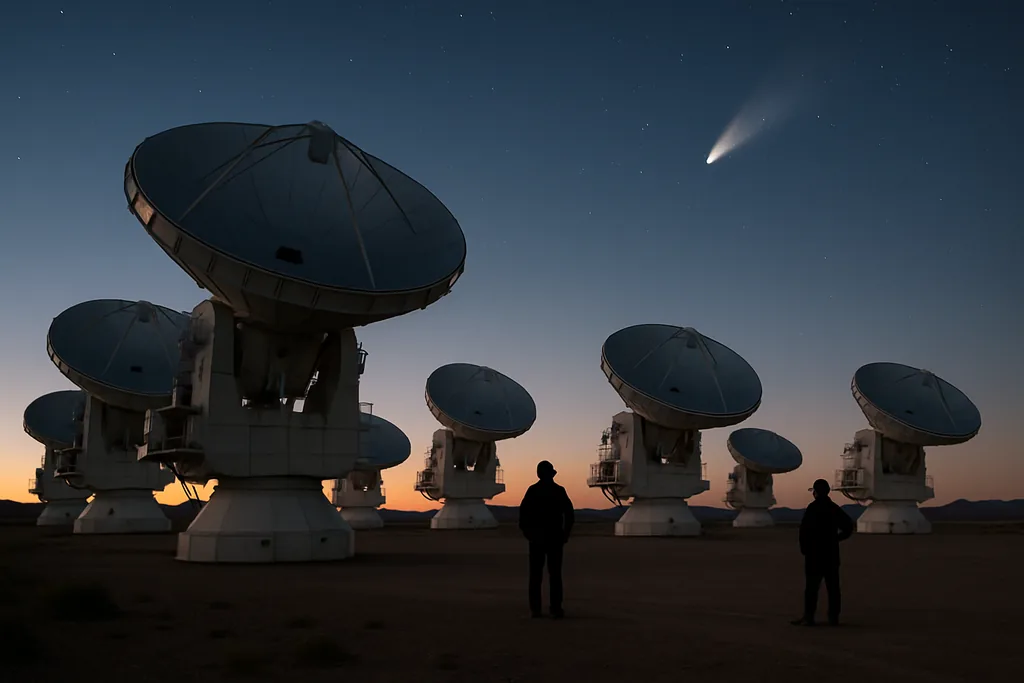
When the interstellar visitor slipped past the Sun
On 29 October 2025, the interstellar object known as 3I/ATLAS swept closest to the Sun. Telescopes and spacecraft around the world had been tracking it for months; when it re‑emerged from behind the Sun a subtle surprise had turned up in the astrometry. Observations reported around perihelion showed the object sitting a few arcseconds away from its predicted, purely gravitational path. Teams that modelled the positions concluded the comet had experienced a tiny extra acceleration that gravity alone could not produce.
How comet jets produce a recoil
That nudging has a straightforward physical origin in ordinary comets. A comet's nucleus is a concentrated, irregular chunk of rock and ices. When increased sunlight heats the surface near perihelion, ices sublimate and the escaping gas carries dust with it in narrow streams or jets. Every kilogram of gas that leaves the nucleus takes momentum with it; by conservation of momentum the nucleus receives an equal and opposite kick. Mathematically this is captured by M·a = (dM/dt)·v, where M is nucleus mass, a the observed acceleration, dM/dt the mass‑loss rate and v the speed at which gas leaves the surface.
What the measurements imply about mass and loss
Teams have already tried to turn the measured acceleration into a physical story for 3I/ATLAS. One recent short paper used available astrometry to estimate an acceleration and, with plausible assumptions for gas ejection speeds, derived a nucleus mass and size: a compact nucleus perhaps a few hundred metres across and a total mass in the tens of millions of tonnes. That calculation is sensitive to the assumed ejection speed and the fraction of the surface actively outgassing; change those inputs and the inferred mass shifts rapidly.
Other researchers, including analysts using Webb and other spacecraft data, have reported much larger mass‑loss rates (hundreds of kilograms per second at times). If that higher mass‑loss persisted near perihelion it would require a much larger original nucleus — by orders of magnitude — to avoid being completely ablated. Conversely, if the nucleus were relatively small, losing even a few percent of its mass in a short interval could explain an observed acceleration as recoil from vigorous outgassing.
In short: the data are consistent with a comet shedding material at a rate high enough to measurably push its trajectory, but the quantitative answer (exact mass, exact fraction lost) is uncertain because the key numbers — dM/dt and v — are only approximately known.
Why some scientists keep a cautious, wider view
Comet outgassing is the canonical, well understood explanation and it fits the behaviour recorded for many solar‑system comets. NASA and other agency groups have stressed that the simplest physical model — jets and sublimation — is sufficient to explain the non‑gravitational term. That is the mainstream interpretation.
Still, a minority of researchers argue the anomaly deserves more scrutiny. The first known interstellar visitor, 1I/ʻOumuamua, showed a small non‑gravitational acceleration without the obvious coma or gas cloud that usually accompanies outgassing, which sparked a long debate about alternatives. For 3I/ATLAS some scientists note unusual features — fast brightening, colour changes, complex tail morphology — and say those deserve careful follow‑up. Those voices typically do not claim certainty about exotic causes; they argue for urgent, comprehensive observation because anomalous data are where new physics, or new astrophysical processes, are discovered.
How the community will test the explanation
The good news is that the most decisive tests are already planned. Between late November 2025 and January 2026 the International Asteroid Warning Network (IAWN) and a set of coordinated campaigns will observe 3I/ATLAS intensively with ground observatories, ALMA, the Hubble and Webb space telescopes, and instruments on missions such as ESA's JUICE and several Mars orbiters that recorded earlier snapshots. If the non‑gravitational acceleration at perihelion was caused by massive outgassing, telescopes should detect a substantial coma and a plume of gas and dust surrounding the nucleus — possibly carrying billions of tonnes of material in aggregate. Spectroscopy will also reveal which molecules are present (water, CO, methanol, hydrogen cyanide and so on), which helps identify the physical processes at work.
Why this matters beyond one comet
3I/ATLAS is the third confirmed interstellar object seen in our system. Each one is a messenger from another star system and carries unique information about planet formation, volatile chemistry and dynamical ejection processes in other planetary systems. Accurately accounting for its mass, composition and the mechanisms of mass loss will refine estimates for how common such interstellar visitors are and what they can tell us about the galaxy's inventory of icy bodies.
More broadly, this episode is also a reminder of how observational astronomy proceeds: an unexpected deviation is measured, simple physics offers a plausible explanation, and then a worldwide campaign of observations tests that hypothesis. That sequence is how ordinary astrophysics sometimes becomes extraordinary discovery.
For now, the simplest explanation remains outgassing jets — a physical, well‑documented mechanism that can and does push comets off purely gravitational paths. But the community will watch: the coming multi‑wavelength, multi‑instrument data set is the experiment, and the sky will give the answer.
Sources
- Research Notes of the American Astronomical Society (paper on 3I/ATLAS non‑gravitational acceleration)
- ALMA (Atacama Large Millimeter/submillimeter Array) observations and technical reports
- NOIRLab / Gemini imaging and NOIRLab press materials
- NASA / JPL ephemeris and mission data (JPL Horizons, mission imaging)
- ESA mission teams (JUICE, ExoMars Trace Gas Orbiter) and ESA observation summaries
- arXiv preprints and trajectory/origin studies using Gaia data
- International Asteroid Warning Network (IAWN) campaign planning materials