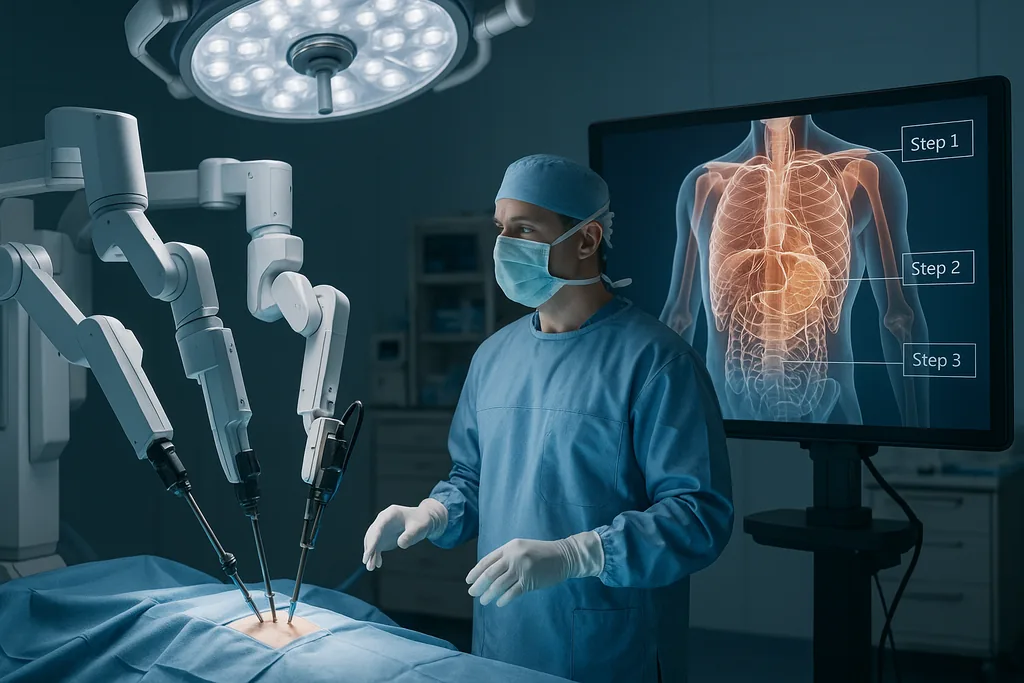
Generative A.I In Surgery
This week, reporting and commentary about generative AI in surgery landed squarely in public view as newsrooms and health-care leaders digested a series of demonstrations and product pitches showing robots doing parts of operations with machine-generated plans. The rush of attention is understandable: surgical robots that combine high-precision hardware with generative models for planning and decision support promise faster procedures, fewer complications and new options for hospitals that lack specialist surgeons. They also force a hard look at regulation, liability, patient trust and what it means to hand a scalpel — or a decision — to software.
A shifting operating room
The modern operating room is already a hybrid of human skill and automated tooling. Laparoscopic and robotic platforms have extended a surgeon's hands with micro-movement stabilization, tremor filtering and sub-millimetre control. The newest move is to add generative AI — large models trained to propose plans, translate imaging into stepwise actions, or generate instructions that a robot can execute. Those additions change the dynamic: instead of simply translating a surgeon's hand motions into robot motion, systems are beginning to propose, select and in some tests autonomously carry out discrete steps.
That distinction matters. At one extreme are assistive features — overlays that highlight anatomy, tempo-keeping prompts or suggestions for suture placement. At the other is conditional autonomy, where the system performs a defined task (for example, tying a knot or excising a small lesion) under predefined constraints with a human supervising. Fully autonomous surgery, where a machine independently performs major procedures from start to finish, remains technologically and clinically distant. For most researchers and clinicians the near-term path is augmentation: robots that take over repetitive, highly constrained tasks and help human teams work faster and more precisely.
How generative models power robots
Generative AI — the class of models that can produce text, images, or structured plans — is being adapted to surgical problems in two linked ways. First, perception models turn sensor streams (video, intraoperative ultrasound, 3D mapping) into semantic maps: what tissue is at risk, where a tumour boundary lies, or where a vessel runs. Second, planning models propose sequences of actions that will accomplish a step of the operation and can be translated into motion commands for robotic arms.
The technical challenge is not simply accuracy but reliability across the messiness of real surgery: variable anatomy, unexpected bleeding, degenerated tissue, or instruments occluding the camera. Generative models are probabilistic; they shine where patterns repeat, but they can hallucinate or overconfidence when faced with rare situations. That is why the most-sensible architectures today pair generative planning with closed-loop control and human oversight — the machine suggests, the human authorises and the control system enforces safety limits.
Regulators and the liability question
Introducing software that can affect surgical outcomes rewires the regulatory and legal landscape. Medical-device regulators assess devices for safety and effectiveness; software that can change over time adds complexity. Regulators are wrestling with questions that include: how do you validate a generative planning model that adapts to new data? What metrics and clinical endpoints should trials measure? How should post-market surveillance detect subtle failure modes that only appear at scale?
Liability is another knot. If a robot follows an AI-generated plan that a supervising surgeon approves but a complication occurs, who bears responsibility: the surgeon, the hospital, the robot maker or the model developer? Legal frameworks and reimbursement models are not yet mature enough to answer these questions cleanly, and the ambiguity will affect how quickly hospitals adopt higher-autonomy systems.
Workforce, cost and access
Claims that robots will make surgeons obsolete overstate how medicine actually changes. Surgical judgment — triaging competing risks, managing complex anatomy that deviates from textbooks, making split-second choices — is not merely a sequence of procedural steps. For foreseeable decades, those cognitive skills will remain human-led. What robotics and AI are likely to do is reshape roles: routine or ergonomically demanding tasks will be delegated to machines, while surgeons supervise multiple cases, plan complex strategies and handle exceptions.
Economics will be decisive. High-end robotic platforms cost millions of dollars and carry recurring service and training expenses. That price structure can widen inequities if only well-resourced centres can afford advanced automation. Conversely, the combination of cheaper sensors, remote operation and standardized AI plans could expand access to specialist-level care in under-served regions — but only if deployment models, reimbursement and training pathways are designed to do so.
A plausible timeline
Expect incremental shifts rather than a sudden replacement of surgeons. Over the next several years hospitals will approve and adopt machine-augmented features that demonstrably reduce complication rates for constrained tasks: improved imaging overlays, assisted suturing, or automated instrument exchange. More ambitious conditional-autonomy modules will arrive as companies and academic teams complete clinical trials and as regulators define pathways for adaptive software.
Full autonomy — a robot independently carrying out complex, unplanned surgeries — faces technical, ethical and regulatory barriers that make it unlikely in the near term. Instead, the plausible five-to-fifteen-year trajectory is one of augmentation, with carefully scoped automation expanding as evidence accrues and governance frameworks mature.
What hospitals and policymakers should do
Hospitals, payers and regulators can shape whether AI in surgery widens disparities or improves outcomes. Practical steps include:
- Phased clinical evaluation: require tightly scoped trials that test automated steps across diverse patient groups and publish results in peer-reviewed venues.
- Safety-first architecture: mandate human-in-the-loop designs and safety envelopes that prevent robots from acting outside certified parameters.
- Data governance: insist on representative training datasets, documented provenance and mechanisms to detect distributional shifts in the field.
- Liability clarity: develop legal and reimbursement frameworks that align incentives for safe deployment and rapid monitoring.
- Workforce transition: fund training and certification programs so surgical teams can supervise and collaborate with AI-enabled platforms.
Why this matters beyond the OR
The debate about AI robots in surgery is not only about tools and outcomes; it is a test case for how medicine integrates adaptive, probabilistic systems into life-critical work. The same questions — validation, equity, oversight, trust — recur across health care as generative AI spreads into diagnostics, triage and care planning. How the surgical world answers them will create templates that other clinical areas will follow.
For patients, clinicians and policymakers the takeaway is pragmatic: generative AI will change who does what in the operating room, but replacement is not the likeliest, immediate outcome. More probable is a future where machines do the repetitive, constrained tasks with superhuman steadiness while surgeons keep responsibility for judgement, creativity and exception handling. That future can be safer and more accessible — if industry, hospitals and regulators focus on evidence, fairness and robust oversight rather than on hype.
Sources
- U.S. Food and Drug Administration (medical device and software-as-a-medical-device guidance)
- Johns Hopkins University (robotics and surgical research)
- Massachusetts Institute of Technology (CSAIL robotics and AI research)
- Intuitive Surgical (technical reports and regulatory filings related to surgical robotics)
- Nature and The New England Journal of Medicine (peer-reviewed studies on surgical robotics and clinical trials)