Buried in the Sound: a 28‑metre trading giant resurfaces
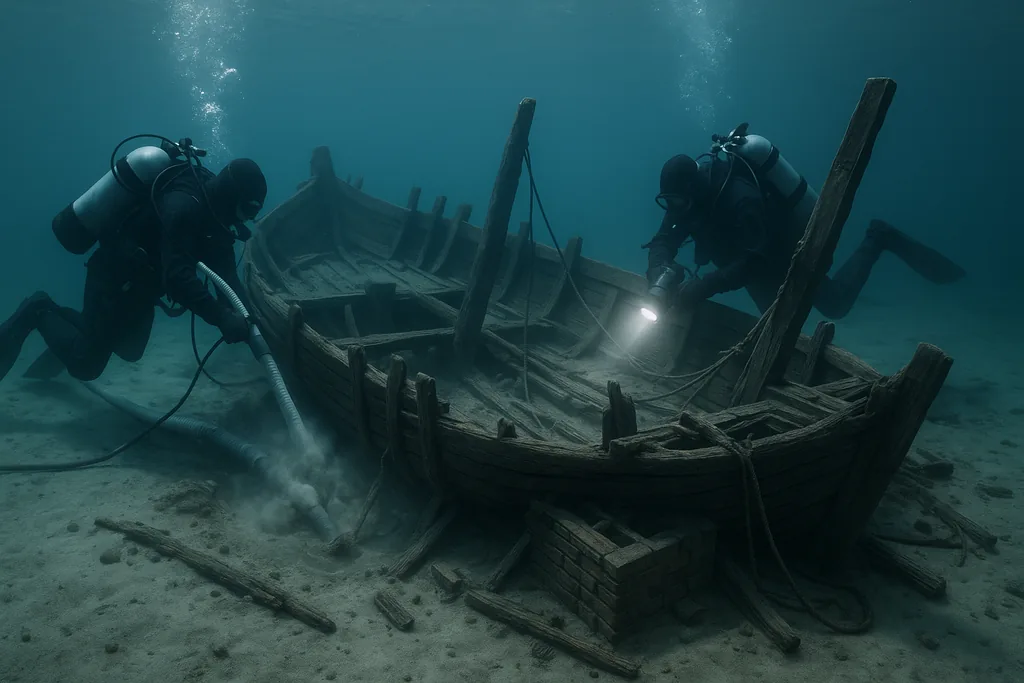
On a seabed lane between Amager and Saltholm, divers cleared centuries of sand and silt to reveal the hull of a trading ship so large and intact that maritime archaeologists say it rewrites what was possible for late‑medieval northern European shipping. The vessel — named Svælget 2 after the channel where it lies — measures roughly 28 metres long, 9 metres wide and 6 metres tall and has been dated to around 1410. Specialists call it a cog: the cargo workhorse that transformed trade across the North Sea and Baltic in the later Middle Ages. The excavation team describes it as the largest cog ever discovered.
What the wreck looks like and why it survives
The wreck sits at about 13 metres depth inside the busy Øresund fairway. Over the centuries, shifting currents buried much of the starboard side beneath a thick blanket of sand and silt; that natural armour has preserved sections of hull planking, framing and, unusually, details of the ship’s rigging. Excavators report survival of structural features rarely seen in wrecks of this era — including remnants of so‑called castles at bow and stern, components of a large brick galley used for cooking, and an array of personal and provisioning items. Those finds allow archaeologists to read the vessel as a lived space, not just a hull fragment.
How researchers dated and located the ship
Dating came from dendrochronology: specialists compared growth rings from preserved oak to reference sequences and concluded the timbers were felled around 1410. The planks and ribs show different geographic origins — the heavy planking oak came from Pomerania (modern‑day Poland) while frame timber points to the Netherlands — a pattern that suggests large timbers were shipped to major shipbuilding yards where frames were shaped locally. That mix of materials speaks to multi‑regional supply chains and specialised craft economies in late‑medieval shipyards.
What a cog is, and why size matters
Cogs were single‑masted, flat‑bottomed cargo vessels with a broad beam and a single square sail; they were simpler to build and could carry far bulkier loads than earlier longships and trading craft. The emergence of large cogs helped shift medieval commerce from high‑value luxuries to everyday bulk goods such as salt, timber, brick and foodstuffs. Svælget 2’s estimated cargo capacity — roughly 300 tonnes — puts it at the extreme upper end of that spectrum and confirms that late‑medieval merchants pushed the cog form to very large dimensions where market depth and financing allowed. That has implications for models of trade, ship finance and port infrastructure in the 14th and 15th centuries for northern Europe.
Everyday objects, extraordinary context
Beyond timbers and rigging, divers recovered household and provisioning remains: bronze cooking pots, painted wooden bowls, ceramic tableware, shoes and combs, rosary beads and traces of meat and fish — plus architectural clues such as brick and tile in a fire‑proof galley. Those domestic items let researchers reconstruct the rhythms of life aboard a vessel that could have carried dozens of tons of cargo over long coastal runs and risky open stretches such as the passage around Skagen. Finding a complete galley and covered stern platform gives the first direct archaeological confirmation of features that previously existed mostly in period illustrations.
Why the wreck was being surveyed
Technical work under water and in the lab
Underwater archaeologists used a combination of diver‑operated suction systems and photogrammetry to remove sediment and record the wreck in three dimensions without further damaging fragile timbers. The preserved sections are now being transported to conservation facilities at the National Museum’s Brede workshop, where slow, controlled desalination and stabilisation will begin — a process that can take years but is essential to keep wood from collapsing once removed from its anaerobic tomb. The museum’s team stresses a phased approach: documentation in situ, careful recovery of the most informative elements (rigging hardware, pottery, the galley), then long‑term conservation and study.
Reports, media and public access
The Viking Ship Museum in Roskilde has already featured the excavation in a Danish documentary series, and it plans temporary public displays and specialist tours linked to the find. Curators emphasise that conservation and analysis must come first: samples and fragile fittings will be stabilised and studied before any large‑scale exhibition. The scale and preservation of Svælget 2 make it an unusually rich source for future museum interpretation — not only of shipbuilding technology but also of crew life, provisioning and the logistical networks that sustained maritime commerce.
What Svælget 2 changes about medieval maritime history
Discoveries such as Svælget 2 rarely overturn long‑standing frameworks so much as refine them. Here the wreck confirms that cogs could be built to very large dimensions and that the trade networks and timber markets of the North Sea and Baltic supported such construction. The ship provides rare hard evidence for features long sketched in manuscripts and iconography — notably crew shelters on deck and permanent, fire‑resistant cooking installations — and it supplies practical data on how a comparatively small crew could manage a very large trading hull. Those details allow archaeologists and historians to recalibrate models for labour, cost and route organisation in late medieval maritime commerce.
Open questions and next steps
- How representative was Svælget 2? Its size and equipment may reflect a prosperous subset of coastal and North Sea merchants rather than the typical cog.
- What cargoes was it carrying? Organic cargo rarely survives, but residue analysis and careful sediment sampling may reveal traces of traded goods.
- Where exactly was it built? Dendrochronology narrows timber origins; further wood chemistry and tool‑mark analysis could tie construction to specific Dutch shipyards.
- How will conservation priorities be set? Long conservation timetables force curators to choose which parts to stabilise and display first.
Answers will come slowly. The wreck’s survival is generous but fragile: each phase of study must balance public interest with technical patience. For now, Svælget 2 sits as a near‑complete chapter of late‑medieval maritime life recovered from the deep — a working ship with tools, food and shelter intact enough to make the past feel decidedly present.
Sources
- Viking Ship Museum (Vikingeskibsmuseet) press release on Svælget 2
- National Museum of Denmark (conservation and collection facilities in Brede)
- DR (Danish Broadcasting Corporation) documentary coverage 'Gåden i dybet'