A pop‑culture comeback with a scientific punch
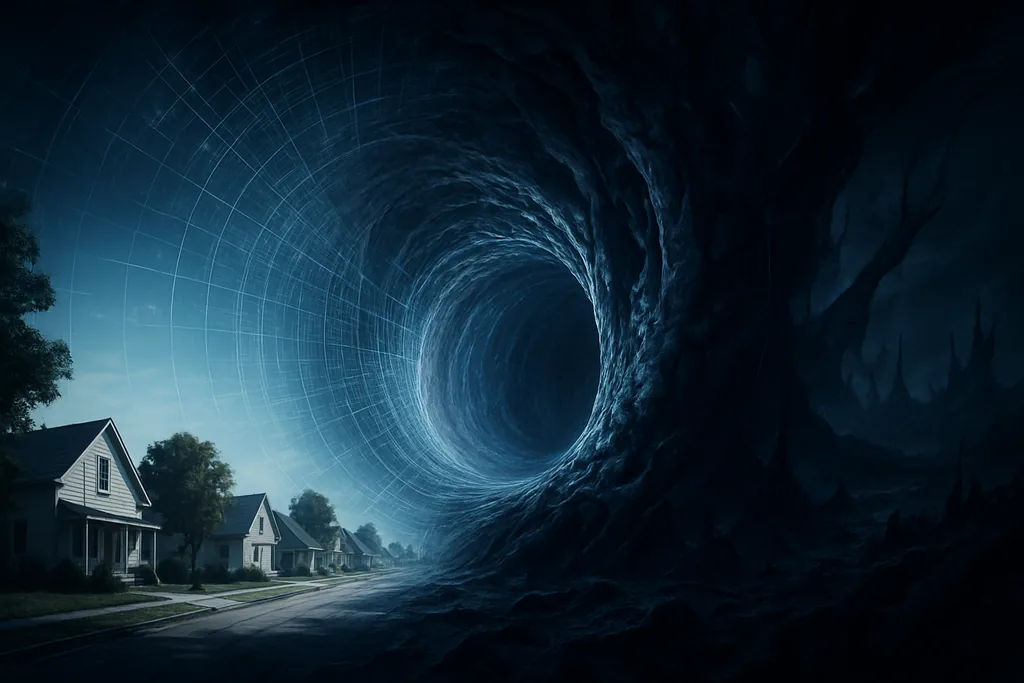
When the final episodes of Stranger Things revealed the Upside Down as a type of "bridge" between worlds, discussion of wormholes — once the playground of hard‑SF and late‑night blackboard diagrams — surged across social feeds and news sites. The show imagines a fragile, organic tunnel that links Hawkins to an alien domain; that narrative shorthand maps directly onto a set of ideas physicists have been debating for nearly a century. The series’ twist crystallizes why the subject fascinates both writers and scientists: wormholes sit at the intersection of general relativity, quantum effects and human-scale storytelling.
Relativity’s bridges: where the idea comes from
The technical story begins in 1935, when Albert Einstein and Nathan Rosen described geometries now called Einstein–Rosen bridges — mathematically legitimate solutions of Einstein’s field equations that connect two regions of spacetime. Those early bridges, and later discussions by physicists such as John Wheeler, established the image of a tunnel in spacetime that could in principle link distant locations. But the original constructions were not traversable in any practical sense: classical analyses showed they pinch off or collapse too quickly for anything to pass through.
The hard physics: stability, horizons and energy
Two technical obstacles have always dominated the debate. First, generic wormhole solutions tend to form horizons or singularities that prevent passage — the tunnel closes or becomes a black hole. Second, the throat of a traversable wormhole requires matter that violates the usual energy conditions of general relativity: in plain terms, it needs stress–energy with negative energy density or unusual pressure. Classical matter obeys these conditions, so researchers either invoke quantum effects that can produce temporary negative energy (the Casimir effect is the canonical example) or consider modified gravity theories where geometric terms play the supporting role. These requirements make practical, long‑lived, human‑size wormholes extraordinarily speculative.
Quantum loopholes and traversability
From toy models to four‑dimensional solutions
Lasting headlines in the technical literature arrived when teams moved from highly symmetric toy models toward more realistic geometries. In 2023, Juan Maldacena, Alexey Milekhin and Fedor Popov presented a wormhole solution in four dimensions that uses charged massless fermions to generate a Casimir‑like negative energy density supporting the throat. Their construction is mathematically consistent and avoids many of the artificial features of earlier examples; importantly, it can be embedded, in principle, in models that share aspects of the Standard Model if the object is kept extremely small compared with familiar particle‑physics scales. That paper shifted the conversation: traversable wormholes stopped being an exclusively AdS/holography curiosity and became an active topic in conventional four‑dimensional gravity research.
New metrics, modified gravity and continuing caveats
Work since then has expanded the landscape. A 2024 study introduced a new class of traversable wormhole metrics, exploring different functional forms for the metric components and making explicit which assumptions about matter and geometry are required. Other researchers examine whether modified gravity theories can hide the exotic requirements inside geometric terms so ordinary matter need not violate energy conditions. These avenues are mathematically rich, and some yield solutions that are technically traversable — but they often trade one difficulty for another (microscopic size, instability, or dependence on poorly constrained high‑energy physics). In short, progress has been substantial on the theoretical front, but the physical obstacles that make a macroscopic, stable tunnel feasible remain formidable.
What the equations allow versus what we can build
The headlines sometimes blur two separate statements: (1) General relativity and quantum field theory admit mathematical solutions that look like wormholes, and (2) building or finding a wormhole in nature would require conditions for which we have no evidence. The first is unambiguously true and the modern literature is full of explicit examples; the second is also true from every observational and practical perspective. The negative energies invoked are tiny, fleeting, or require matter and fields arranged in highly nonstandard ways. No astronomical observation to date points to wormhole mouths or strange lensing signatures that would betray large‑scale tunnels.
Stranger Things and the science of storytelling
What Stranger Things does well — beyond delivering a thrilling season finale — is use the wormhole as a compact metaphor: a place that is physically connected but ontologically alien. The series’ Upside Down behaves like a corridor whose mouth sits near Hawkins but whose interior obeys different rules. That captures a real tension in current research: wormholes can connect regions, but the nature of the connection can carry peculiar causal and energetic baggage (time delays, horizons, singular behaviour). On the other hand, the show’s depiction of a fragile, energy‑dependent bridge echoes genuine lessons from the physics literature: keeping a throat open typically depends on a narrow range of conditions and a source of "exotic" energy.
Where the field goes next
Researchers are still sorting conceptual puzzles that matter for any eventual physical interpretation: how to reconcile entanglement and geometry (the ER=EPR idea), whether quantum gravity will permit macroscopic stability, and whether any observational signature could be distinctive enough to separate a wormhole from an ordinary compact object. Some recent computational and analytic work has proposed concrete measurement signatures for wormhole‑like lensing or echoes in gravitational‑wave data, but those searches face enormous practical challenges. Meanwhile, the steady stream of new metrics and the 2023 four‑dimensional constructions mean the topic is no longer a footnote in review articles — it is an active frontier of theoretical gravity.
Reading the science without the science fiction
If the Upside Down inspires someone to pick up a primer on relativity or follow a new paper about Casimir energy and throat stability, that is a healthy exchange between fiction and science. The correct takeaway is modest but interesting: wormholes are not forbidden by the mathematics we use to describe spacetime, and quantum and modified‑gravity ideas have opened pathways to traversability in controlled models. However, the gulf between a controlled, microscopic, theoretically engineered wormhole and the cinematic, human‑scale tunnels of fiction remains enormous. The conversation that follows — between model builders, observational astronomers and the public — will determine whether wormholes stay a powerful metaphor or ever become a genuine empirical target.
Sources
- Physical Review (Einstein & Rosen 1935)
- Journal of High Energy Physics (Gao, Jafferis & Wall 2017)
- Classical and Quantum Gravity (Maldacena, Milekhin & Popov 2023)
- European Physical Journal C (new metrics paper, 2024)
- Physical Review Letters (Ben Kain, 2023)