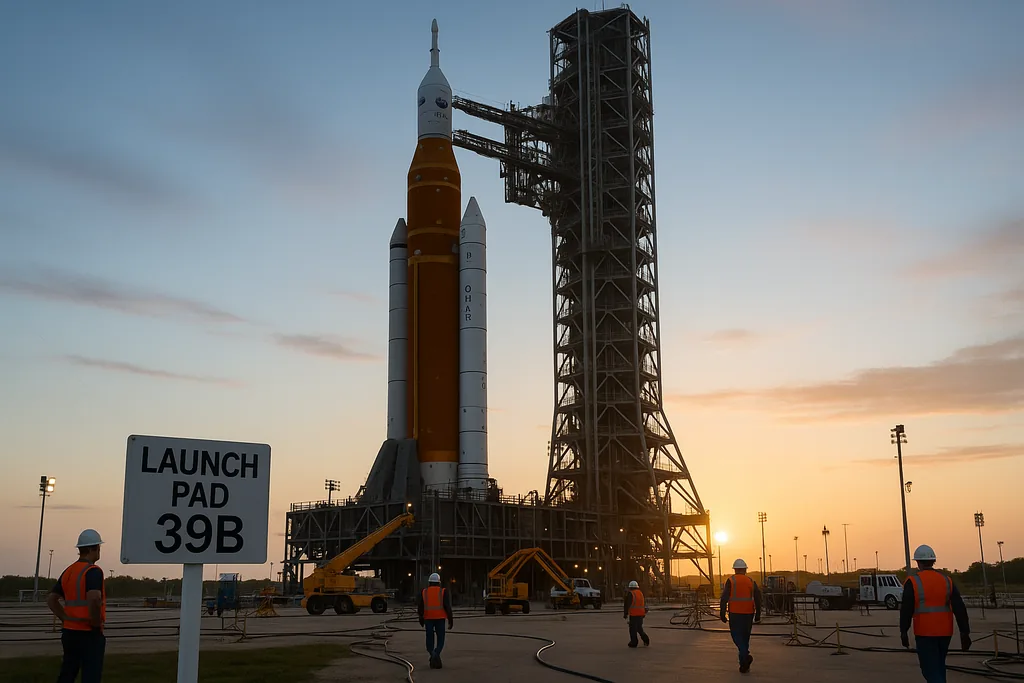
Rollout and a return to a very different Moon programme
On the morning of January 17, 2026, technicians are scheduled to move NASA’s stacked Space Launch System booster and Orion spacecraft from the Vehicle Assembly Building to Launch Pad 39B at Kennedy Space Center — a slow, deliberate procession that will mark the beginning of the last major ground campaign before the agency attempts to send humans beyond low Earth orbit for the first time in more than half a century. The move, using NASA’s crawler-transporter, begins what engineers call integrated testing: system checks, propellant loading rehearsals and final inspections that will determine whether the flight can proceed into an early February launch window.
A ten-day mission to test deep-space systems
Artemis II is planned as a roughly 10-day crewed test flight: four astronauts will ride Orion on a hybrid free-return trajectory that will loop the spacecraft around the Moon and bring it back to Earth without a lunar landing. The flight’s objectives are concrete and deliberately limited — validate life support, navigation, communications and re-entry procedures with humans aboard — but the stakes are high because the results will shape follow-on missions that aim to return people to the lunar surface and, eventually, send humans to Mars. NASA’s current published schedule lists launch opportunities beginning in a February window (with specific viable dates clustered in early February) and continuing through April 2026, though managers will let hardware readiness dictate the exact day.
The crew combines experienced NASA pilots and mission specialists with one Canadian astronaut. Commander Reid Wiseman will lead the flight, with Victor Glover as pilot and Christina Koch as mission specialist; Jeremy Hansen of the Canadian Space Agency joins the team as the fourth crewmember. Together they will push Orion’s systems — including the spacecraft’s thermal control, power, communications and a tested but upgraded environmental control and life-support package — farther from Earth than any human-rated vehicle has carried people in decades.
Hardware: SLS, Orion and a European heart
Two pieces of hardware define Artemis II: NASA’s Space Launch System Block 1 rocket, the heavy-lift booster that will hurl Orion out of Earth orbit, and the Orion crew module with its European Service Module (ESM). The ESM — designed and produced in Europe under contract led by Airbus on behalf of the European Space Agency — supplies propulsion to perform trans-lunar injection burns, attitude control, as well as power, water and oxygen for the crew while in deep space. For Orion, the ESM is effectively the spacecraft’s powerhouse and a visible example of how Artemis relies on multinational contributions.
On Artemis II the SLS and Orion will fly together with a configuration that has flown before only on the uncrewed Artemis I mission. That earlier test demonstrated core systems and returned a trove of engineering data; Artemis II is intended to stress those same systems with humans aboard and to practise the mission timelines, deviations and contingency responses that will be needed for operations farther from Earth. Lockheed Martin, Airbus and a network of industrial suppliers have delivered the assembled spacecraft and modules to Kennedy Space Center for processing — completed build steps that now feed into the final pad flow.
Countdown mechanics and flight-readiness realities
Preparing for a crewed deep-space test flight is an exercise in margins. Launch planners must balance orbital mechanics, re-entry conditions, Eastern Range availability, and the logistics of propellant and ground teams — and then fold in the extra caution required when four astronauts are at risk. NASA’s public briefings show multiple small launch windows per month through April 2026; the agency also explicitly eliminated dates that would force Orion into extended eclipses or an entry profile outside safe constraints. To get from the Vehicle Assembly Building to a launch pad is only the start: technicians will perform a wet dress rehearsal that loads hundreds of thousands of gallons of cryogenic propellant to validate seals and plumbing under flight-like conditions, and only after a flight readiness review will managers clear any attempt.
Past Artemis ground campaigns exposed tricky failure modes — hydrogen leaks and valve issues that delayed earlier test ops — and managers are keenly aware that schedule compression invites risk. NASA has stated it will let performance and safe margins drive the final launch date rather than hitting a symbolic calendar target, even as political and programmatic pressure mounts for a rapid cadence of missions that will culminate in a lunar surface landing later in the decade.
International politics, industry and the path toward a sustained presence
Artemis II is more than a single flight; it is a demonstration of a new architecture for lunar exploration that mixes U.S. government hardware, European-provided propulsion and sustenance, Canadian crewmembers and a private-sector ecosystem that ranges from prime contractors to small suppliers. ESA’s and Airbus’s work on the ESM is central — the module provides main engine capability, dozens of thrusters, large solar arrays and the consumables a crew needs for the outbound and return legs — and recent European contracts show plans to build additional service modules to sustain the programme. Those commitments matter because a reusable, international supply chain is a prerequisite for any long-term Moon base or Gateway outpost.
Canada’s involvement — including astronaut Jeremy Hansen’s seat aboard Orion — underscores the diplomatic dimension of Artemis. National contributions, whether hardware, crew slots or technical expertise, translate into influence over how the architecture evolves: who gets to fly to the Moon, what science is prioritised, and how the logistics of a lunar economy might develop. The Canadian Space Agency has framed Hansen’s flight as a historic national moment and as a step toward possible Canadian participation in later surface missions.
Where Artemis II fits in the long arc of exploration
If all goes according to plan, Artemis II will close a gap of more than five decades during which humans have lived and worked in low Earth orbit but not travelled beyond it. The mission will not return boots to the lunar surface — that is the aim of Artemis III and subsequent flights — but it will validate the core vehicle and operational concepts necessary for a landing. Results from Artemis II’s in-flight tests will directly inform the hardware and procedures used on Artemis III, including docking operations, crew transfer and surface systems integration.
Program managers face a squeeze: multiple complex developments — the human landing system, new spacesuits, mission-specific hardware — must be finished and matured on a schedule that still leaves room for testing and contingency. That is why NASA has talked publicly about launch-date bands and conservative readiness reviews, even while acknowledging internal efforts to shrink timelines where safe to do so. The agency has said it will prioritise crew safety and system performance above meeting the earliest advertised window.
Why this mission matters beyond the headlines
Artemis II is, in one sense, a test — but it is also a signal. It demonstrates that the architecture, industrial base and multinational partnerships that grew out of the early 21st century are now capable of moving astronauts beyond the protective envelope of low Earth orbit again. The flight will gather human-in-the-loop data on radiation exposure, habitat operations, navigation and abort options: information that cannot be replicated in ground tests or robotic missions. For engineers and planners, those data are the currency of future mission assurance; for the public and policymakers, the mission is a tangible milestone in a programme that promises scientific return, commercial opportunity and strategic influence across the next two decades.
In the coming weeks, as the rocket crawls toward the pad and teams run through integrated checklists, the timetable will crystallise and NASA will set a firm launch date. Whether February becomes the moment humans once again cross into deep space will depend on how the hardware and teams perform during the remaining tests. Either way, Artemis II will hand the agency its first in-space proof points for human systems beyond LEO since Apollo — and with those proof points will come the next set of choices about how fast and how far to push toward the lunar surface and beyond.
Sources
- NASA (Artemis II mission page and agency briefings)
- European Space Agency (Orion European Service Module and Artemis programme materials)
- Airbus (European Service Module technical and programme pages)
- Canadian Space Agency (statements and media advisories on Artemis II)