An unsettling pattern in orbit
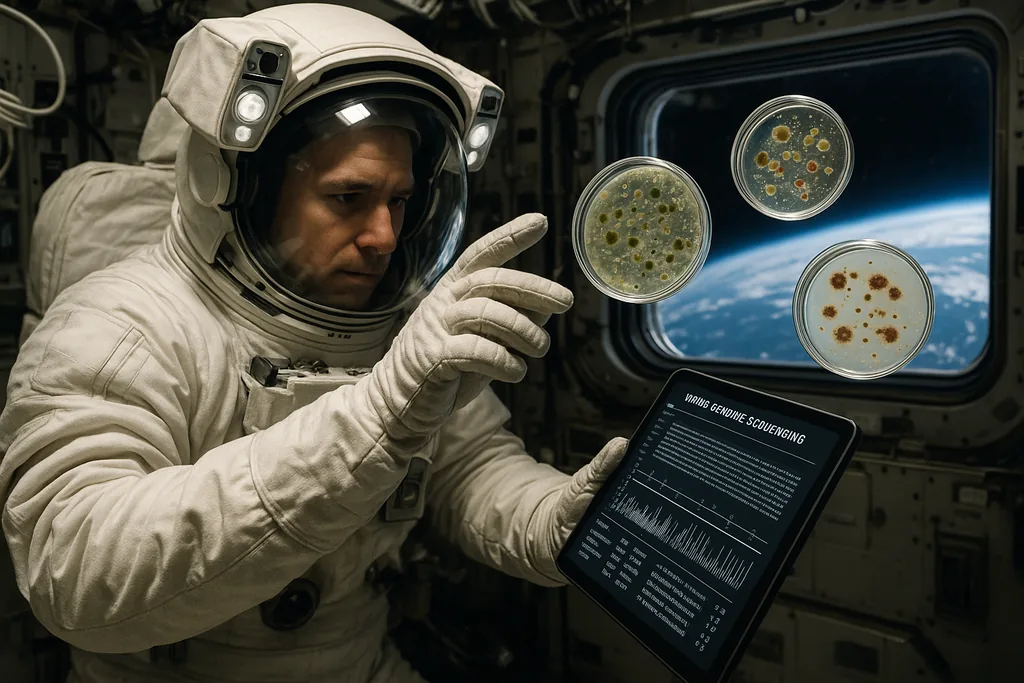
Onboard the International Space Station a few years ago, clinicians treating a crewmember found an ordinary skin rash carried an extraordinary clue: live herpes simplex virus type 1 present at high levels in both a lesion and the astronaut’s saliva. The finding was not an isolated curiosity. Over decades of human spaceflight, teams monitoring astronauts have repeatedly recorded dormant herpesviruses reappearing during missions, and laboratory groups have reported that some microbes grown in microgravity or onboard spacecraft become more aggressive or produce more infectious particles than their Earth-grown twins. Those separate observations — virus reactivation in humans, bacteria that grow more virulent after spaceflight, and laboratory demonstrations that viral particles can assemble more efficiently in low gravity — are prompting a difficult question for mission planners and microbiologists alike: are pathogens really getting “stronger” in space, and if so, why?
There is no single, simple answer. What scientists do have now is a patchwork of experiments, clinical case reports and genomic surveys that point to several ways the space environment can change microbes and the human immune system, and to real operational risks for long-duration missions beyond low Earth orbit. The evidence is robust enough to demand attention, and incomplete enough to leave major mechanistic gaps.
Unexpected biology in orbit
Clinical monitoring of astronauts has repeatedly documented the reactivation and shedding of latent human herpesviruses — Epstein–Barr virus (EBV), varicella zoster virus (VZV), cytomegalovirus (CMV) and herpes simplex virus (HSV) — during both short shuttle flights and longer ISS missions. In one detailed case, an astronaut developed HSV-1 dermatitis mid-mission and investigators recovered high viral loads from both the rash and saliva; genomic sequencing showed the in-flight virus population carried more minor variants than samples taken after return to Earth, suggesting altered viral dynamics during the mission. These findings, and larger survey work of astronaut saliva and urine, indicate viral reactivation is common and sometimes yields live infectious virus in flight.
Virion assembly and phages in microgravity
Meanwhile, genomic surveys of bacterial isolates from the ISS reveal a rapidly adapting microbial community on the station’s surfaces and in its water systems. Those surveys identified hundreds of prophages — viral genomes integrated in bacterial chromosomes — and prophage-encoded functions associated with stress resistance, DNA repair and antimicrobial resistance. That mobile genetic element activity is a credible mechanism for microbes to acquire traits that improve survival in the spacecraft environment and potentially alter pathogenicity.
Possible mechanisms and interacting factors
Researchers are juggling several hypotheses rather than a single explanatory model. One set of mechanisms acts on the human host: prolonged mission stress, disrupted sleep and circadian rhythms, shifting hormone levels (notably cortisol) and measurable changes in immune-cell function reduce immune surveillance and control of latent viruses. High-energy particle radiation can also damage host cells and has been shown in laboratory systems to trigger herpesvirus lytic transcription, offering a direct, non-immune route to reactivation. These human-centred effects help explain why latent viruses that live quietly for years on Earth can begin shedding during a mission.
From the microbial side, microgravity changes fluid flow and transport so that diffusion dominates over sedimentation. That alters nutrient gradients, shear forces and biofilm architecture; in some experiments those physical changes lead to altered gene expression, increased biofilm formation and changes in regulatory networks such as the Hfq regulon implicated in Salmonella’s spaceflight response. For viruses, altered assembly dynamics — fewer convection currents, different collision rates of capsid proteins, or modified lipid membrane behaviour — could conceivably change the efficiency or stability of produced virions, although direct evidence for human viruses in genuine space conditions remains limited. Finally, phage–host dynamics and horizontal gene transfer aboard spacecraft create another vector for microbes to gain persistence-related traits.
Operational risks and mission design
For short missions the immediate health risk appears manageable: most viral reactivations recorded so far were asymptomatic or mild, and routine countermeasures exist. But planners for Artemis, lunar habitats and eventual Mars missions worry about prolonged exposure. On a months‑long trip beyond Earth the combination of higher galactic cosmic radiation, longer microgravity exposure and limited medical evacuation options amplifies the stakes. If a latent human virus reactivates into symptomatic disease at a time when medical supplies and immune status are compromised, the mission could be jeopardised. Likewise, microbes that form stubborn biofilms or spread antibiotic‑resistance genes pose a threat to life‑support systems such as water recycling.
What scientists and agencies are doing
Space agencies and academic groups are responding on multiple fronts. Continuous biological monitoring of crew fluids and surfaces, genomic surveillance of station microbes, improved sterilisation and antimicrobial surfaces, and experiments designed to tease apart the separate roles of microgravity, radiation and stress are all in progress. Some teams are investigating “astropharmacy” approaches: small, cell‑free kits that could synthesise therapeutics or phage‑based antimicrobials on demand in space. Other groups are testing mitigation strategies identified in ground experiments — for example, media supplements that counteract space‑associated virulence signatures in Salmonella — and refining environmental control systems to limit biofilm formation.
How worried should we be?
The short answer is: watchful, not panicked. The constellation of results from astronaut monitoring, bacterial virulence assays and laboratory phage assembly studies shows consistent, reproducible biological responses to the space environment, but those responses vary by organism, experimental setup and duration. There is clear evidence that the host immune system is altered in flight and that some microbes respond by becoming more stress‑resistant or more virulent in model systems — but translating those findings into a simple headline like “viruses are stronger in space” overstates the current evidence. Critical unknowns remain about whether human viruses become intrinsically more infectious in true space conditions, how long any space‑driven changes persist once samples return to Earth, and whether countermeasures can reliably prevent clinically significant outcomes during deep‑space missions.
The practical takeaway for mission designers is already clear: microbiology must be integrated into spacecraft design and medical planning, not treated as an afterthought. For researchers the urgent agenda is equally clear: more controlled spaceflight experiments (including viral assembly studies in real microgravity), mechanistic work that isolates the roles of radiation and fluid dynamics, and expanded in‑flight medical monitoring across a broader and more diverse crew population. Only with that evidence will we move from worrying headlines to robust engineering and medical solutions that keep astronauts safe as human exploration leaves low Earth orbit for good.
Sources
- NPJ Microgravity (Enhanced assembly of bacteriophage T7, 2024; Serratia marcescens virulence study, 2019; Salmonella host–pathogen study, 2021)
- Viruses (case report: Dermatitis during spaceflight associated with HSV‑1 reactivation, 2022)
- Nature Reviews Immunology (Astroimmunology review, 2025)
- Nature Communications / NASA Ames technical reports (survey of prophages and microbial adaptation on the ISS, 2023)
- NASA Science program materials on biofilms and life‑support microbial investigations (Bacterial Adhesion and Corrosion / BAC study)