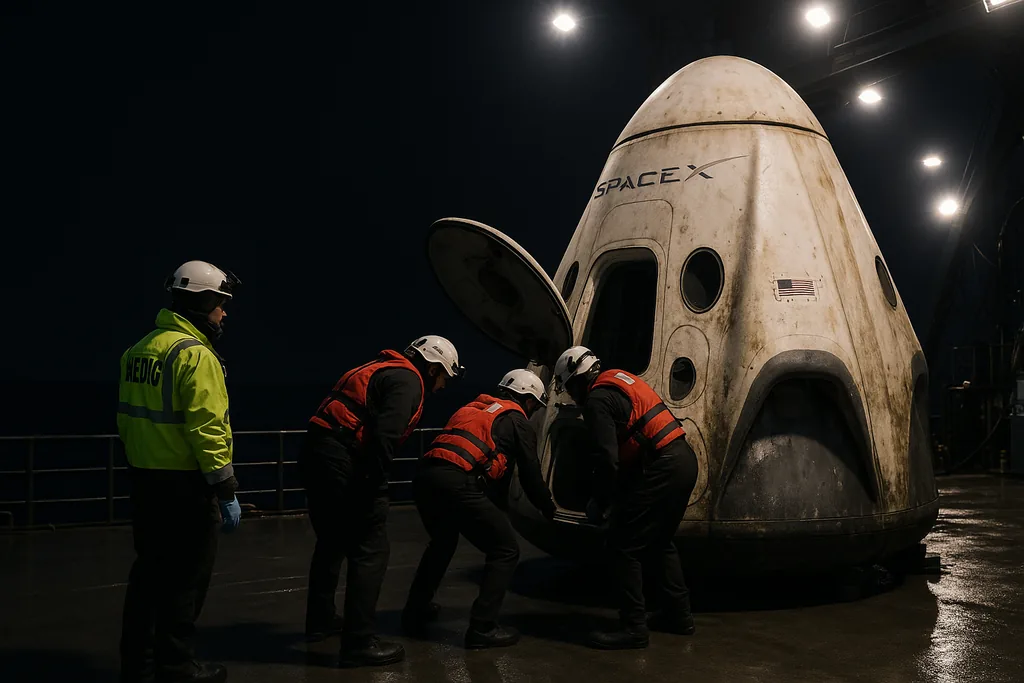
First medical evacuation from the ISS
On the night of 14–15 January 2026, a SpaceX Crew Dragon carrying four astronauts broke the routine of continuous human presence in low Earth orbit: the capsule splashed down off the coast of Southern California after an expedited return from the International Space Station (ISS). The flight — originally scheduled to conclude months later — was cut short because one Crew‑11 member developed a "serious" medical condition that ground physicians decided could not be fully diagnosed or treated on the station. NASA has not identified the astronaut or disclosed a diagnosis, saying the patient is stable and receiving care on Earth.
Crew, timing and what NASA said
The four Crew‑11 astronauts who returned were NASA’s Zena Cardman and Mike Fincke, Japan’s Kimiya Yui, and Roscosmos cosmonaut Oleg Platonov. NASA announced on 8 January that medical teams were evaluating a concern that emerged aboard the station on 7 January; the agency and SpaceX targeted a controlled undocking no earlier than 5 p.m. Eastern on 14 January with splashdown in the early hours of 15 January. Officials emphasised the return was deliberate and controlled rather than an emergency deorbit.
At a short‑notice briefing, NASA leaders described the problem as "serious" and said the decision to return the astronaut was taken so the full range of hospital‑level diagnostics and treatment would be available on the ground. NASA’s chief health officer explained that while the station carries a robust suite of medical hardware and skilled crew training, it lacks the complete diagnostic capability of an Earth hospital for complex workups. For privacy reasons NASA has withheld the patient’s name and clinical details.
Why this matters operationally
Beyond the individual case, the event exposed a set of operational fault lines for long‑duration orbital operations. With Crew‑11 returning early, the ISS temporarily shifted to a smaller on‑orbit staff: three crewmembers remained to continue essential systems work and experiments. That reduced manpower forced missions that require two crew — notably spacewalks — to be postponed. The agency is moving to accelerate the launch of a replacement crew, currently targeted for mid‑February, to restore the station’s planned complement.
NASA has modelled the likelihood of medical evacuations for the station era and expected that a controlled medevac could be required roughly once every few years. The fact it had not happened in 25 years of continuous occupancy speaks to the durability of station systems and protocols — but the Crew‑11 case shows those contingencies must remain live, and that ground‑based care still defines the gold standard when diagnostics are uncertain.
Medical constraints in microgravity
Human bodies change in microgravity in well‑documented ways: bone density declines, fluids shift toward the head, and the cardiovascular system adapts to a different loading environment. Those changes can disguise or complicate common problems seen on Earth, from cardiac events to renal stones or abdominal complaints, and can make on‑orbit assessment harder. The ISS has telemedicine capability, ultrasound, basic laboratory tools and a trained crew medical officer, but it does not replicate the diagnostic breadth of an emergency department with advanced imaging and specialist consults. That gap was the central reason cited by NASA for returning the astronaut for hospital‑level evaluation.
Space medicine specialists have long warned that as missions extend beyond low Earth orbit — to the Moon and to Mars — medical autonomy will be essential because evacuation windows widen from hours to days, weeks or never. For the ISS, by contrast, evacuation remains feasible: a docked Soyuz or Crew Dragon can be used to bring crew home quickly if needed. What changed in this case was the assessment that Earth‑level diagnostics should be prioritised now rather than waiting for a scheduled end‑of‑mission return.
How NASA managed the return
NASA and SpaceX described the operation as a "controlled expedited return" executed using standard departure burns, trunk jettison, atmospheric re‑entry and a Pacific splashdown with recovery teams and medical staff on hand. Officials stressed that no unusual modifications to flight systems were needed and that standard recovery procedures — including post‑splashdown triage and transport to a hospital — were followed. The returning crewmembers were taken for immediate medical evaluation after splashdown.
Mission leaders also highlighted the human dimension: crews deployed their training to manage the incident, command was formally transferred aboard the station in a change‑of‑command ceremony prior to the departure, and commanders framed the return as the right choice for the affected crewmember’s health and for mission integrity. Public statements emphasised that the returning astronauts were in good spirits and that the agency would provide updates as clinical assessments progressed.
Historical context and precedents
Although this is the first time NASA has executed a planned medevac from the ISS era, medical returns are not without precedent in human spaceflight. Soviet and later Mir-era missions recorded early returns for crew illness or operational health concerns, including Salyut 7 in 1985 and Mir expeditions in the 1980s and 1990s. These cases underline that long‑duration stations have always carried the risk of medically driven schedule changes. NASA’s own archive of significant incidents traces multiple medical events across decades of crewed missions.
Implications for future missions and medicine
The Crew‑11 medevac will sharpen attention on several threads of space medicine and mission design. First is diagnostics: the event demonstrates the operational value of compact, hospital‑grade imaging and laboratory systems that can operate robustly in orbit. Second is telehealth and AI: better on‑board decision support and remote interpretation could reduce the need for Earth return in borderline cases. Third is crew composition and redundancy: mission planners will weigh the tradeoffs between on‑orbit medical expertise (carrying a physician) and extra payload or training costs. Finally, the incident is a practical reminder that, even for low Earth orbit, ground‑based medical capacity remains decisive.
Scientists and planners building architectures for lunar or Mars missions have argued for robust autonomous medical care because ground evacuation will be impossible or massively delayed on those flights. In that respect, an ISS medevac — while resolvable within hours here on Earth — offers a case study in the limits of current systems and the investments needed before crew health can be assured beyond Earth orbit.
What we still don’t know
The Crew‑11 medevac will almost certainly be studied inside NASA and among international partners as an operational lesson: how decisions were made, how on‑orbit teams and ground controllers coordinated, and which gaps in on‑orbit medicine most urgently need investment. For the public, the episode provides a clear illustration of what remains uniquely risky about living off‑planet, and why building medical capability is as much a part of space exploration as rockets and habitats.
Sources
- NASA press materials and mission overview
- SpaceX Crew‑11 mission overview and recovery statements
- Roscosmos press materials
- Japan Aerospace Exploration Agency (JAXA) mission statements
- NASA Space Medicine and Human Research Program / Significant Incidents archive