From a Marietta workshop to a rideshare manifest
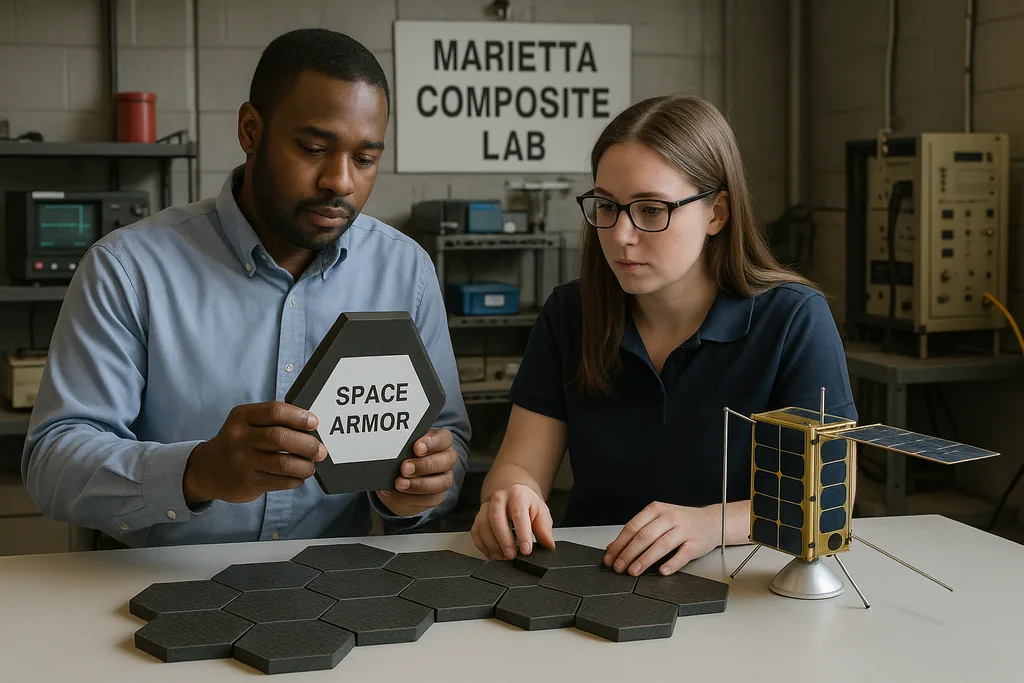
On a gray January afternoon in Marietta, Georgia, Trevor Smith stood in a small composite lab and showed a local TV crew a video meant to make a familiar problem look unfamiliar: a tiny projectile hitting a satellite at speeds measured in thousands of meters per second, slicing through electronics and leaving systems dead in its wake. "We're essentially stopping 'bullets' in space," Smith told WSB‑TV as he described the tiles his company calls Space Armor, a modular composite designed to stop hypervelocity impacts without producing harmful secondary fragments.
What the tiles are claiming to do
Atomic‑6, the Marietta firm behind Space Armor, markets the tiles as lightweight composite panels that can be installed as modular shields or radomes. The company says the tiles are RF‑permeable—meaning they allow radio signals to pass through—while resisting micrometeoroid and orbital debris (MMOD) strikes. According to Atomic‑6's technical material and recent press announcements, the product comes in two protection levels: a "Lite" tile rated for roughly 3 mm projectiles and a "Max" version designed for much larger impacts, with both options offered in RF‑permeable or RF‑blocking variants. Atomic‑6 says the tiles were tested at hypervelocity facilities and stopped projectiles at speeds above 7 km/s in ground firing tests.
That combination—impact resistance plus radio transparency—is central to Atomic‑6's pitch. Traditional MMOD shielding used on decades of spacecraft, such as Whipple bumpers made of metal, are often heavy and can fragment when struck, creating secondary debris. Atomic‑6's marketing and test demonstrations emphasize two claims: lower mass than metal alternatives, and much less secondary ejecta after a hit. Those are precisely the properties operators say they want if more satellites are to survive crowded low Earth orbits.
On‑orbit demonstration and the schedule
Atomic‑6 and its announced customer, Portal Space Systems, say the first operational flight of Space Armor tiles will be part of a Transporter rideshare mission in late 2026. A PR announcement published on 15 January 2026 states that Portal selected Space Armor tiles as the primary MMOD protection for a Starburst satellite scheduled to fly on SpaceX's Transporter‑18, with a launch window in October 2026. Portal's own material also lists Transporter‑18 in Q4 2026 as the debut flight for its Starburst spacecraft. Independent launch trackers show Transporter‑18 tentatively manifesting for October 2026 on a Falcon 9. Taken together, those filings point to an on‑orbit validation opportunity in roughly ten months' time.
Local reporting, however, described the planned launch differently. A WSB‑TV piece published 15 January 2026 said a satellite carrying Space Armor would hitch a ride on an Elon Musk Starship mission this fall from Vandenberg. The company and Portal materials we found instead cite a Falcon 9 rideshare in October 2026. That discrepancy highlights a common downstream issue in reporting fast‑moving commercial space news: manifest changes and shorthand descriptions of rideshare flights sometimes create mismatches between local accounts and company release language. Atomic‑6 and Portal’s press materials provide the clearest record of the stated plan: Transporter‑18 aboard Falcon 9 in October 2026.
Hypervelocity testing and the challenge it addresses
The reason companies make a big deal about a tile stopping a 3 mm or 12.5 mm object is that even millimeter‑scale debris in low Earth orbit can behave like a bullet. NASA’s summaries of the micrometeoroid and orbital debris environment note average impact speeds in LEO of order 7–10 km/s (many thousands of miles per hour), and that small, untrackable particles are the principal risk to both satellites and astronauts today. In that regime, impact energy scales quickly; a speck of paint or a millimeter fragment can punch through thermal blankets, solar arrays, or sensitive electronics.
What an on‑orbit test will prove—and what it will not
An in‑space experiment will answer a few essential questions: does the tile preserve RF throughput when mounted over antennas and radomes, does it survive the thermal and atomic‑oxygen environment of the chosen orbit, and how does it behave when exposed to the chaotic population of small, untrackable debris? Portal describes the payload as a one‑year evaluation that will collect data on installation and on‑orbit performance; Atomic‑6 emphasises lessons for integration and scale. If the tiles work as advertised in real operational conditions, they could reduce one class of failure mode for smallsat operators and—if widely adopted—lower one contributor to the cascading‑debris problem known as Kessler syndrome.
But there are limits to what a single flight can demonstrate. Catastrophic debris protection is probabilistic: a component that resists a handful of particle strikes during a year is different from certifying a shield for decades of service in highly populated orbital planes. Regulators, insurers and many customers will want independent test data, repeat flights, and third‑party measurements before calling a new material a drop‑in replacement for existing MMOD architectures. Here the space industry’s usual route—incremental adoption, independent verification, and standardised test matrices—will determine whether Space Armor becomes a product category or a promising demo.
Industry and policy context
Atomic‑6’s pitch does more than sell tiles; it signals a broader market dynamic. Satellite operators face rising collision risk as constellations, retired stages and legacy fragments populate valuable orbital bands. The result is a commercial appetite for mitigation technologies that reduce mission risk without imposing heavy mass or blocking communications. That same demand attracts companies hyping breakthrough composites or adhesives that allow post‑build installation—a fact visible in the tone of recent trade coverage and PR materials.
There are also geopolitical angles. Atomic‑6 frames parts of the product rationale around protection from deliberate, adversarial actions in space. While kinetic anti‑satellite attacks to date have been rare and mostly state‑sponsored tests, the strategic community is watching any change in survivability technology closely because it affects doctrines of deterrence, escalation, and space traffic management. That adds a layer of export‑control and procurement scrutiny to otherwise commercial conversations about shielding.
Next steps and independent validation
What observers should watch next: (1) whether Portal and Atomic‑6 follow through on component integration and public data releases ahead of Transporter‑18; (2) whether independent labs or government facilities publish comparative test results; and (3) what on‑orbit telemetry Portal plans to share after deployment. If the companies open their on‑orbit data to third parties—or invite a NASA or national‑lab measurement—industry confidence will rise more quickly than marketing claims alone can achieve. For now, the January announcements set an ambitious target: a first operational deployment on a rideshare manifest in October 2026, with the usual caveat that flight manifests historically slip and test programs expand.
Whether Space Armor tiles become a standard part of smallsat integration or a one‑off novelty depends on how they perform where it counts—outside the Marietta lab and above the atmosphere. In the months before Transporter‑18, engineers and program managers will be watching test reports, integration notes and the fine print in company data sheets. The more the industry treats the October flight as data collection rather than a commercial launch party, the faster the market will learn whether a new type of shielding can help keep satellites—and the people who use their services—safe.
Sources
- Atomic‑6 (company press materials and Space Armor technical datasheet)
- Portal Space Systems (company press release on Starburst and Transporter‑18 mission)
- NASA (Micrometeoroids and Orbital Debris / Remote Hypervelocity Test Laboratory and technical reports)
- NASA Technical Reports Server (NTRS) historical and technical context on orbital debris)